
Part 1 of 5 in our Iqbal Day series.
Iqbal Day: Honouring the Man Who Dreamed of Pakistan
Every year on 9 November, Pakistan pauses to remember one of its greatest sons, Allama Muhammad Iqbal. Iqbal Day is organised and celebrated on 9 November every year in all the provinces as a tribute to Allama Muhammad Iqbal, the “Poet of the East.” The day is a national public holiday in Pakistan that honours his vision for a separate homeland for Muslims, his philosophy, and his teachings on faith, self-respect, education, and national unity.
Schools close, flags fly, and seminars are held across the country. But beyond the holiday, Iqbal Day is an invitation to understand the extraordinary man behind the date, a poet, a philosopher, a lawyer, and a visionary whose words helped birth a nation.
A Boy from Sialkot Who Changed History
Allama Muhammad Iqbal was born on 9 November 1877 in Sialkot, British India, now in Pakistan. He was a poet, philosopher, and politician who inspired the Pakistan Movement. He was born to Kashmiri parents and received his early schooling at Scotch Mission College in Sialkot.
Iqbal later attended Government College in Lahore, where he studied under Sir Thomas Arnold, a scholar who had a profound influence on his intellectual development. In 1905, Iqbal travelled to Europe for higher studies. He earned a degree from the University of Cambridge and a doctorate in philosophy from the University of Munich, Germany.
His time in Europe exposed him to Western philosophy and literature, which largely shaped his intellectual development. Yet, rather than abandoning his roots, Iqbal returned from the West with an even deeper love for Islam and a burning desire to awaken his people. Deeply grounded in religion since childhood, Iqbal began intensely concentrating on the study of Islam, the culture and history of Islamic civilisation and its political future, while embracing Rumi as his guide.
More Than a Poet, A Complete Personality
It would be too simple to call Allama Iqbal merely a poet. Allama Muhammad Iqbal is generally known as a poet and philosopher, but he was also a jurist, a politician, a social reformer, and a great Islamic scholar. He is also regarded as the Mufakkir-e-Pakistan (Thinker of Pakistan), Shaayir-e-Mashriq (Poet of the East), and Hakeem-ul-Ummat (Sage of the Ummah).
After returning to Lahore in 1908, Iqbal taught philosophy and English literature while practising law. With three professional degrees in hand, he embarked on three careers side by side, as an attorney, a college professor, and a poet. However, the poet and philosopher won at the expense of the professor and attorney. His pen, it turned out, was his most powerful tool.
The Poetry That Woke a Generation
Iqbal is known for his influential poetry in Persian and Urdu, advocating for self-respect and the unity of the Muslim Ummah. His collections like Bang-e-Dra (The Call of the Marching Bell), Payam-e-Mashriq (Message of the East), and Bal-e-Jibril (Gabriel’s Wing) continue to inspire readers worldwide.
His poetry was never just about beautiful words. Iqbal’s thoughts in his work primarily focused on the spiritual direction and development of human society, centred around experiences from his travels and stays in Western Europe and the Middle East. In his writings, he addressed and exhorted people, particularly the youth, to stand up and boldly face life’s challenges.
One of his most beloved symbols was the Shaheen, the eagle, which he used as a metaphor for the free, self-reliant Muslim spirit. Through powerful symbolism in his poetry such as Shaheen (eagle), Khudi (selfhood), and the spiritual bond between humanity and the divine, Dr Iqbal emphasised self-realisation, empowerment, and moral strength.
The Big Idea: Khudi, Know Yourself, Rise Yourself
If you had to pick one word that captures Iqbal’s entire message, it would be Khudi. One of Iqbal’s most influential philosophical concepts was Khudi, often translated as “selfhood” or “self-realisation.” In his poetry and philosophical writings, Iqbal emphasised the importance of developing the inner self, believing that the path to freedom and empowerment for individuals and nations alike was through self-awareness and self-reliance.
His renowned work Asrar-e-Khudi highlighted the importance of discovering inner potential and living with purpose to achieve set goals in life. This message is just as fresh today as it was a century ago, perhaps even more so in an age where young Pakistanis are building startups, writing code, and pushing boundaries in technology and the arts.
The Allahabad Address: A Dream Spoken Aloud
Iqbal was not just a thinker locked in his study. He stepped into the political arena and changed the course of history. Iqbal was elected president of the Muslim League in 1930 at its session in Allahabad. In his presidential address on 30 December 1930, Iqbal outlined a vision of an independent state for Muslim-majority provinces in northwestern India.
It was Iqbal who, through his Allahabad Address in 1930, gave this idea concrete geographical and political contours, explicitly naming the regions that would constitute such a state, Punjab, NWFP, Sindh, and Baluchistan. This was a defining moment, a poet had given a nation its roadmap.
Though Dr Iqbal passed away in 1938, his vision was carried forward by Quaid-e-Azam Muhammad Ali Jinnah, who transformed the All-India Muslim League into a dynamic political force. The creation of Pakistan was, in this sense, Iqbal’s dream which was actualised by Jinnah.
His Passing and Eternal Legacy
Iqbal passed away on 21 April 1938 and is celebrated as the Poet of the East for his contributions to literature and the idea of a separate homeland for Muslims in India. He did not live to see Pakistan come into being on 14 August 1947, but Pakistan came into being carrying his dream.
The Government of Pakistan has officially declared him the national poet. His mausoleum stands proudly beside the Badshahi Mosque in Lahore, visited daily by thousands of Pakistanis who come to pay their respects. A changing of guard ceremony at the mausoleum of Dr Iqbal outside Lahore traditionally kicks off the events scheduled for the day.
Iqbal Day in the Digital Age: His Words, Our Screens
Every Iqbal Day, something remarkable happens on Pakistani social media, his couplets trend on X (formerly Twitter), his verses are shared in WhatsApp groups, and YouTube fills up with recitations of his poetry. In an era of smartphones and short attention spans, Allama Iqbal’s words still stop people mid-scroll.
Universities and tech communities are increasingly using Iqbal Day as an occasion to reflect on his philosophy of Khudi in the context of modern Pakistan. His call for self-reliance, continuous learning, and bold ambition maps perfectly onto the spirit of Pakistan’s growing startup ecosystem and its young, talented workforce. When a software engineer in Lahore builds an app that solves a local problem, or a student in Karachi wins an international science competition, they are, in a very real sense, living Iqbal’s dream.
Allama Iqbal Day is observed every year on November 9 to honour the poet and philosopher who was born on the same date in 1877 in Sialkot. His poetry and philosophical contributions played an important role in shaping the intellectual foundations of the Pakistan Movement. Today, that same intellectual spirit calls us to build, to create, and to lead.
How Iqbal Day Is Observed Across Pakistan
- National Public Holiday: The federal government announces a nationwide public holiday on November 9 to commemorate the birth anniversary of national poet Allama Muhammad Iqbal.
- Seminars and Symposiums: Schools, colleges, universities, and literary organisations hold events to discuss Iqbal’s philosophy and poetry.
- Guard Changing Ceremony: A special ceremony is held at Allama Iqbal’s mausoleum in Lahore to mark the occasion with dignity and honour.
- Recitation Competitions: Students across the country participate in mushaira and poetry recitation events, keeping his verses alive.
- Social Media Tributes: Pakistanis worldwide share his couplets, quotes, and life lessons online, making his wisdom reach a global audience.
Frequently Asked Questions About Iqbal Day
When is Iqbal Day celebrated and why on this date?
Iqbal Day falls on 9 November, his birthday, and is celebrated as a public holiday in Pakistan. It is organised and celebrated every year in all the provinces as a tribute to Allama Muhammad Iqbal, the “Poet of the East.” The date was chosen to mark his birth anniversary so that every Pakistani remembers and honours his contributions on the very day he entered the world.
What was Allama Iqbal’s most important philosophical idea?
One of Iqbal’s most influential philosophical concepts was Khudi, often translated as “selfhood” or “self-realisation.” He emphasised the importance of developing the inner self, believing that the path to freedom and empowerment for individuals and nations alike was through self-awareness and self-reliance. Simply put, he believed that a person, and a nation, that knows its own worth cannot be held back by anyone.
What was Allama Iqbal’s role in the creation of Pakistan?
One of the most prominent leaders of the All India Muslim League, Iqbal encouraged the creation of a “state in northwestern India for Indian Muslims” in his 1930 presidential address. Though Dr Iqbal passed away in 1938, his vision was carried forward by Quaid-e-Azam Muhammad Ali Jinnah, who transformed the All-India Muslim League into a dynamic political force. Pakistan was born in 1947, nine years after Iqbal’s death, but it was built on the foundation he had laid.
Which are Allama Iqbal’s most famous literary works?
His collections like Bang-e-Dra (The Call of the Marching Bell), Payam-e-Mashriq (Message of the East), and Bal-e-Jibril (Gabriel’s Wing) continue to inspire readers worldwide. His renowned work Asrar-e-Khudi highlighted the importance of discovering inner potential and living with purpose. He wrote in both Urdu and Persian, and his works are studied and loved across the Muslim world to this day.
A Hopeful Closing: His Dream, Our Responsibility
Allama Iqbal spent his life waking people up, with poetry, with philosophy, with his unwavering belief that every individual, and every nation, carries within itself the seed of greatness. He called that seed Khudi. He watered it with knowledge, faith, and courage.
Pakistan today faces many challenges, but it also carries enormous potential, a young population, a growing digital economy, and a spirit of resilience that has carried this nation through decades of difficulty. On Iqbal Day, the best tribute we can offer is not just to recite his couplets, but to live by his message: know yourself, believe in yourself, and never stop striving.
As we mark another Iqbal Day, let us carry his light forward, in our classrooms, in our startups, in our communities, and in our hearts. Pakistan Zindabad.
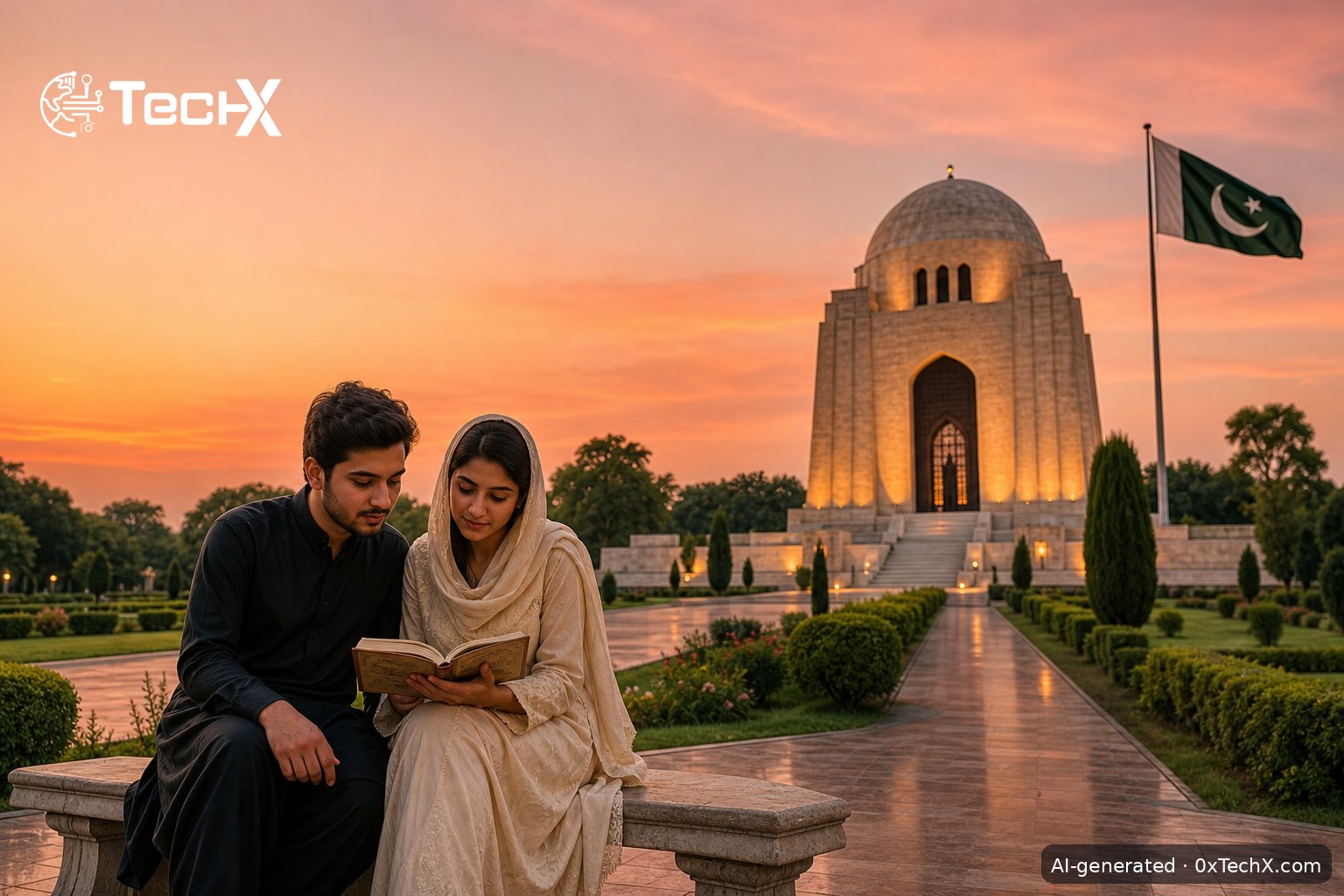
Disclaimer: This article has been compiled from information publicly available on the internet and from published sources. The featured image is AI generated and is for illustration only. If you notice anything that needs correction, please contact us.