

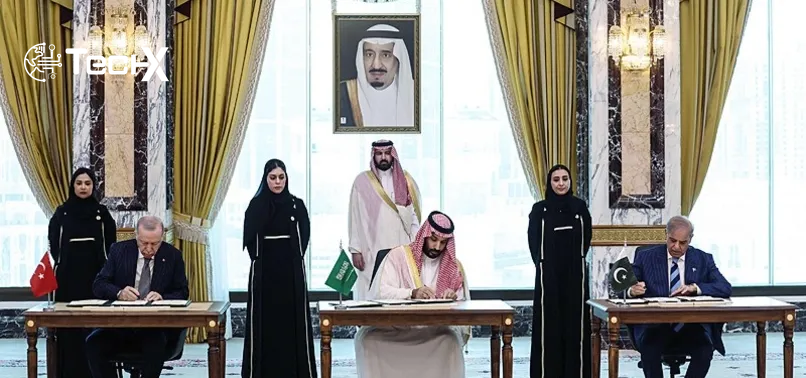
The Mecca Joint Defence Agreement, signed on 7 August 2026, is the most significant security pact Pakistan has joined in decades, bringing Islamabad into a formal three-way collective defence arrangement with Saudi Arabia and Turkey. It is a trilateral collective-defence pact signed in Mecca, Saudi Arabia, under which an armed attack against any one of the three states is to be treated as an attack against all three.
What Is the Mecca Joint Defence Agreement?
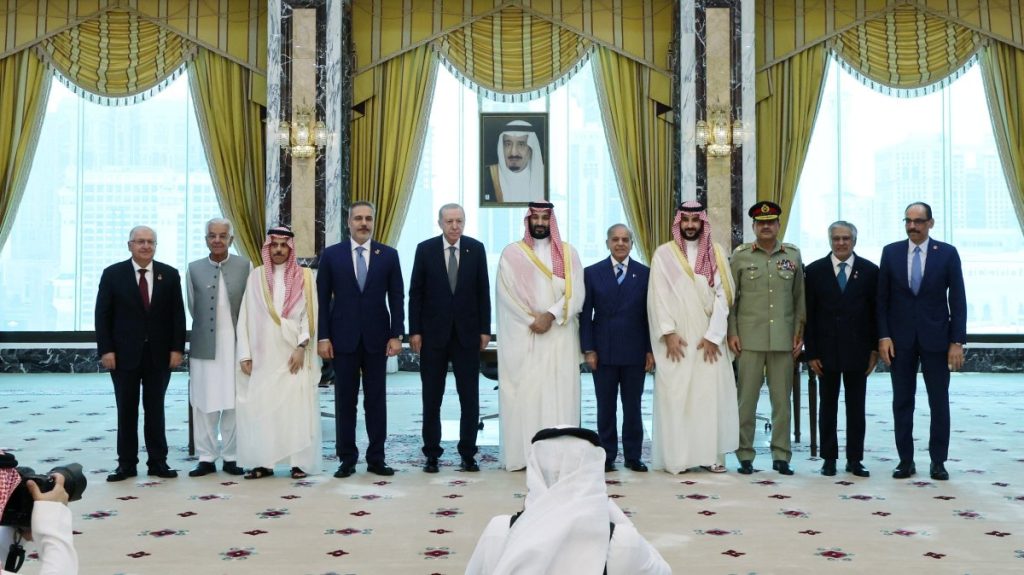
The agreement was signed by Saudi Crown Prince Mohammed bin Salman, Turkish President Recep Tayyip Erdogan and Pakistan’s Prime Minister Shehbaz Sharif, according to statements from all three countries. The deal, named the Mecca Joint Defence Agreement, follows nearly a year of negotiations. Sealing the agreement in Mecca, the holiest site in Islam, adds symbolic heft to a pact that builds on longstanding bilateral military ties.
Beyond its core collective defence clause, the pact aims to enhance joint deterrence and deepen military cooperation among the three powers. While precise military obligations remain undisclosed, a Turkish official told Reuters the agreement is purely defensive, open to other regional states, and does not supersede existing bilateral or multilateral alliances.
How Did This Pact Come About?
The road to this agreement was built step by step over the past year. The agreement builds on the bilateral Strategic Mutual Defence Agreement concluded between Saudi Arabia and Pakistan in September 2025, extending a comparable mutual-defence commitment to include Turkey. That earlier Strategic Mutual Defence Agreement between Pakistan and Saudi Arabia was signed at Al-Yamamah Palace in Riyadh.
Turkey sought to join the Saudi-Pakistan pact in early 2026, with reports describing it as a NATO-style military alliance. Talks on Turkey’s participation moved to an advanced stage and a deal was widely considered likely. On 19 March 2026, the foreign ministers of Turkey, Pakistan and Saudi Arabia met in Riyadh during an Islamic summit, formally discussing what a joint security agreement could look like. The signing in Mecca on 7 August was the end result of those months of quiet diplomacy.
Why Now? The Regional War Context
The timing of the Mecca Joint Defence Agreement is directly tied to the escalating conflict in the Middle East. It was signed against the backdrop of a wider regional war involving Iran that began in February 2026, during which Saudi Arabia and other Gulf states came under repeated missile and drone attack. Iran and its allies have been firing on Saudi Arabia and other Gulf states, and blockading their energy shipments, since the US and Israel attacked Iran on 28 February 2026 in a major escalation of years of regional tumult.
Ozgur Unluhisarcikli of the German Marshall Fund told Al Jazeera that this defence deal reflects a growing desire for greater regional strategic autonomy at a time when confidence in the existing security order has eroded. Ankara also views the arrangement as a way to bolster security and deterrence amid questions over US reliability and President Donald Trump’s commitment to NATO.
What Each Country Brings to the Table
Analysts point out that the three partners are not simply allies of convenience. They each fill a different role. Turkey has NATO’s second-largest military, Saudi Arabia is the world’s top oil exporter, and Pakistan is the only Muslim nation with nuclear weapons. Analysts say the three partners bring complementary strengths, including Turkey’s defence-industrial capabilities, Saudi financial muscle and influence, and Pakistan’s military experience and strategic deterrent.
The defence-industry links between these three countries also run deep. Pakistan has provided training and technical assistance to Saudi forces for decades, while Turkey and Pakistan have exchanged warships and training aircraft. In 2023, Riyadh agreed to buy Turkish drones in what Ankara called its largest defence export contract. The framework also seeks to strengthen defence industry cooperation and military coordination among the three countries, according to the Associated Press.
What Pakistan Gains and What It Commits To
For Pakistan, the Mecca Joint Defence Agreement is a major shift in its formal security partnerships. Defence analyst Abdullah Khan in Islamabad described the agreement as a natural evolution and formalization of decades of strategic ties among Pakistan, Saudi Arabia, and Turkey, saying a changing regional security environment and the evolving nature of warfare had increased the need for closer cooperation. Khan said the pact was ‘purely defensive’ and not directed against any country, with collective deterrence intended to raise the cost of aggression and prevent conflict.
One critical question for Pakistan is whether its nuclear weapons are now part of the deal. The answer, experts say, is no. The accord would likely not include a nuclear component, with Pakistan’s atomic deterrent focused on what it sees as the threat from India. This means Pakistan’s strategic nuclear posture stays pointed firmly at the India-Pakistan equation and does not become a blanket shield for all three partners.
Abdulaziz Sager, chairman of the Gulf Research Center, said the accord could strengthen the countries’ collective diplomatic and defence clout and foster a more self-reliant regional security order. For Islamabad, that means a bigger voice in Middle Eastern security talks, stronger arms trade opportunities, and deeper ties with two of its closest strategic partners.
Is This a New ‘Islamic NATO’?
Some media outlets have called this grouping an ‘Islamic NATO’, but analysts push back on that label. One expert noted that ‘this is a framework for closer strategic, military, and defence-industrial coordination among three influential regional powers and not a mutual defence pact that can be compared to NATO.’ A statement from Saudi Arabia insisted that the agreement does not amount to a military pact and would not affect the kingdom’s existing partnerships.
The pact is also not a closed club. A Turkish official confirmed the agreement is open to other regional states. That means more Muslim-majority countries could join in the future, potentially widening the bloc’s reach across the Middle East and South Asia. For Pakistan, being a founding member of such a framework gives it a strong first-mover advantage in shaping what this security architecture looks like going forward.
You can read more about the agreement on the Wikipedia page for the Mecca Joint Defence Agreement and on the Pakistan Ministry of Foreign Affairs official website.
Frequently Asked Questions
What is the Mecca Joint Defence Agreement?
It is a trilateral collective defence pact signed on 7 August 2026 in Mecca by Saudi Arabia, Pakistan and Turkey. Under it, an armed attack on any one of the three countries is treated as an attack on all three.
Does the agreement include Pakistan’s nuclear weapons?
No. Analysts say Pakistan’s nuclear deterrent remains focused on its own national security needs, particularly in relation to India, and is not part of the trilateral pact’s commitments.
Why was the agreement signed in Mecca?
Mecca is the holiest city in Islam. Signing the pact there adds deep symbolic weight for all three Sunni-majority nations and sends a strong signal about the shared values and identity behind the alliance.
Can other countries join this pact?
Yes. A Turkish official confirmed the agreement is open to other regional states, which means the alliance could expand beyond the current three founding members.