
Part 6 of 14 in our Independence Day series.
A Nation Born from a Dream
Every year on 14 August, Pakistan comes alive with green and white. Flags flutter from rooftops, children paint their faces in national colours, and the air fills with the joyful cry of Pakistan Zindabad. But Independence Day is more than a celebration, it is a reminder of why this country was created, and of the extraordinary man who made it possible: Quaid-e-Azam Muhammad Ali Jinnah.
This year, as we mark yet another Youm-e-Azadi, it is worth pausing to ask: what exactly did the Quaid envision for us? And how far have we come in making that dream real?
The Road to 14 August 1947
Pakistan did not appear overnight. The journey to independence was long, hard, and driven by a deep desire for self-determination. The demand for a separate homeland grew from the conviction that the Muslims of the subcontinent needed a place where their religious, cultural, and political rights would be truly protected.
A turning point came with the Lahore Resolution of 1940, which laid the formal foundation for a separate Muslim state. Under the leadership of Quaid-e-Azam and the All-India Muslim League, the Tehreek-e-Pakistan gained unstoppable momentum through the 1940s. Finally, the British Parliament passed the Indian Independence Act, and on 14 August 1947, Pakistan emerged as a sovereign nation, free from British colonial rule.
On that historic day in Karachi, Muhammad Ali Jinnah was sworn in as the first Governor-General of the new country. The green and white flag, bearing the crescent and star, was raised for the very first time, and the streets rang out with Pakistan Zindabad. It was a moment of triumph earned through years of sacrifice.
The Quaid’s Vision: More Than a Homeland
Quaid-e-Azam’s vision for Pakistan went far beyond drawing a line on a map. He wanted something much bigger, a modern, democratic welfare state where every citizen, regardless of faith, caste, or background, would be treated as an equal.
Just three days before independence, on 11 August 1947, the Quaid addressed the first Constituent Assembly of Pakistan in Karachi. This speech remains one of the most important documents in our national history. He spoke of an inclusive government, the rule of law, and a state where justice would be available to all. He made it clear that every person living in Pakistan, Muslim or non-Muslim, was an equal citizen and deserved equal protection.
He envisioned Pakistan as a progressive democratic welfare state based on Islamic principles, where all citizens would have equal opportunities. He believed strongly in economic development, urging leaders to promote industrial growth, create jobs, and lift people out of poverty. He also placed great weight on education and healthcare as the twin pillars of a strong nation.
In his own words and actions, the Quaid showed that Islam’s true message is one of democracy, equality, and justice. He said that Pakistan’s democracy should be rooted in the golden principles of Islamic teaching, consultation, fairness, and the welfare of the people.
Unity, Faith, and Discipline
Quaid-e-Azam’s famous motto, Unity, Faith, Discipline, was not just a slogan. It was a practical roadmap. He knew that a new nation facing enormous challenges, a mass migration, a divided economy, and hostile circumstances, could only survive if its people stood together. He warned against corruption, bribery, and nepotism as some of the worst enemies a new state could face. He called on Pakistanis to organise themselves economically, socially, educationally, and politically.
He also reached out to the world immediately. Within weeks of independence, Pakistan sought membership of the United Nations so that it could take its rightful place among the nations of the world and contribute to global peace and prosperity. The Quaid saw Pakistan not as an isolated state, but as a confident, responsible member of the international community.
Independence Day in 2026: Carrying the Vision Forward
Pakistan today is a country of over 240 million people, young, energetic, and increasingly connected to the world through technology. On every Independence Day, we see the Quaid’s vision reflected in new ways: in the Pakistani engineers building software for global companies, in the women entrepreneurs running businesses online, in the students using digital tools to access world-class education, and in the startups from Karachi, Lahore, and Islamabad making a mark on the global tech map.
Pakistan’s growing IT sector, its vibrant freelance community, consistently ranked among the top in the world, and its expanding digital infrastructure are all steps toward the modern, progressive nation that the Quaid dreamed of. Every Pakistani who works hard, pays their taxes honestly, and serves their community is living the Quaid’s vision in the truest sense.
Of course, the journey is not complete. Challenges remain, in education, in governance, in economic stability. But Independence Day is the perfect moment to recommit. The Quaid once said that failure was a word unknown to him. That spirit of determination belongs to every Pakistani.
How Pakistan Celebrates Independence Day
- Special prayers are offered in mosques across the country for Pakistan’s prosperity and well-being.
- The national flag is hoisted on all major government buildings, including Parliament House and the Presidency.
- A main ceremony is held at Quaid-e-Azam’s mausoleum in Karachi, where leaders and citizens pay tribute to the founder of the nation.
- A full military parade takes place in Islamabad, the capital, showcasing national pride and defence strength.
- Cultural events, music, fireworks, and flag-raising ceremonies are held in cities, towns, and villages throughout the country.
- People dress in green and white, decorate their homes and vehicles, and share the spirit of Youm-e-Azadi with family and friends.
Frequently Asked Questions About Independence Day
Why does Pakistan celebrate Independence Day on 14 August and not 15 August?
The Indian Independence Act originally set 15 August 1947 as the date for the transfer of power. However, the formal ceremony in Karachi, Pakistan’s first capital, took place on 14 August 1947, a day earlier. Muhammad Ali Jinnah was sworn in as Governor-General on that day, and Pakistan has officially celebrated its Independence Day on 14 August ever since.
What was the Lahore Resolution and why does it matter?
The Lahore Resolution, passed by the All-India Muslim League in 1940, was the formal declaration demanding a separate homeland for the Muslims of the subcontinent. It marked a historic shift in the Tehreek-e-Pakistan’s goals and set the political direction that ultimately led to the creation of Pakistan seven years later. It is considered one of the founding documents of our nation.
What did Quaid-e-Azam say in his speech of 11 August 1947?
In his address to the first Constituent Assembly of Pakistan on 11 August 1947, just three days before independence, Quaid-e-Azam outlined his vision of an inclusive, just, and democratic Pakistan. He called for equal citizenship for all people living in Pakistan, emphasised the rule of law, and spoke strongly against corruption. He wanted every Pakistani, regardless of religion, to feel safe and equal under the state.
How is Independence Day connected to modern Pakistan’s progress?
Quaid-e-Azam dreamed of a progressive welfare state where citizens would have equal opportunities and economic empowerment. Today, Pakistan’s growing technology sector, its large community of digital freelancers, and its young, educated population are all steps toward realising that vision. Independence Day is a reminder that the work of building the nation the Quaid imagined is ongoing, and that every Pakistani has a role to play in it.
Pakistan Zindabad, Long Live Pakistan
Seventy-eight Independence Days have come and gone since that unforgettable morning of 14 August 1947. The challenges have been many, but so has the resilience. Pakistan endures, grows, and moves forward, just as the Quaid believed it would.
On this Youm-e-Azadi, let us honour the sacrifices of those who gave us this land, let us remember the vision of Quaid-e-Azam Muhammad Ali Jinnah with clarity and pride, and let us each commit, in our own lives, our own work, our own communities, to building the Pakistan he dreamed of: fair, strong, educated, and full of hope.
Pakistan Zindabad.
- How the Demand for Pakistan Began, The Story Behind Independence Day
- How Pakistan Won Its Independence on 14 August 1947
- Part 3: Pakistan Independence Day Heroes of the Independence Movement
- Part 4: The Partition, the Migration, and the Birth of a Nation
- Part 5: The Green Flag and the Anthem That Gave Pakistan Its Voice
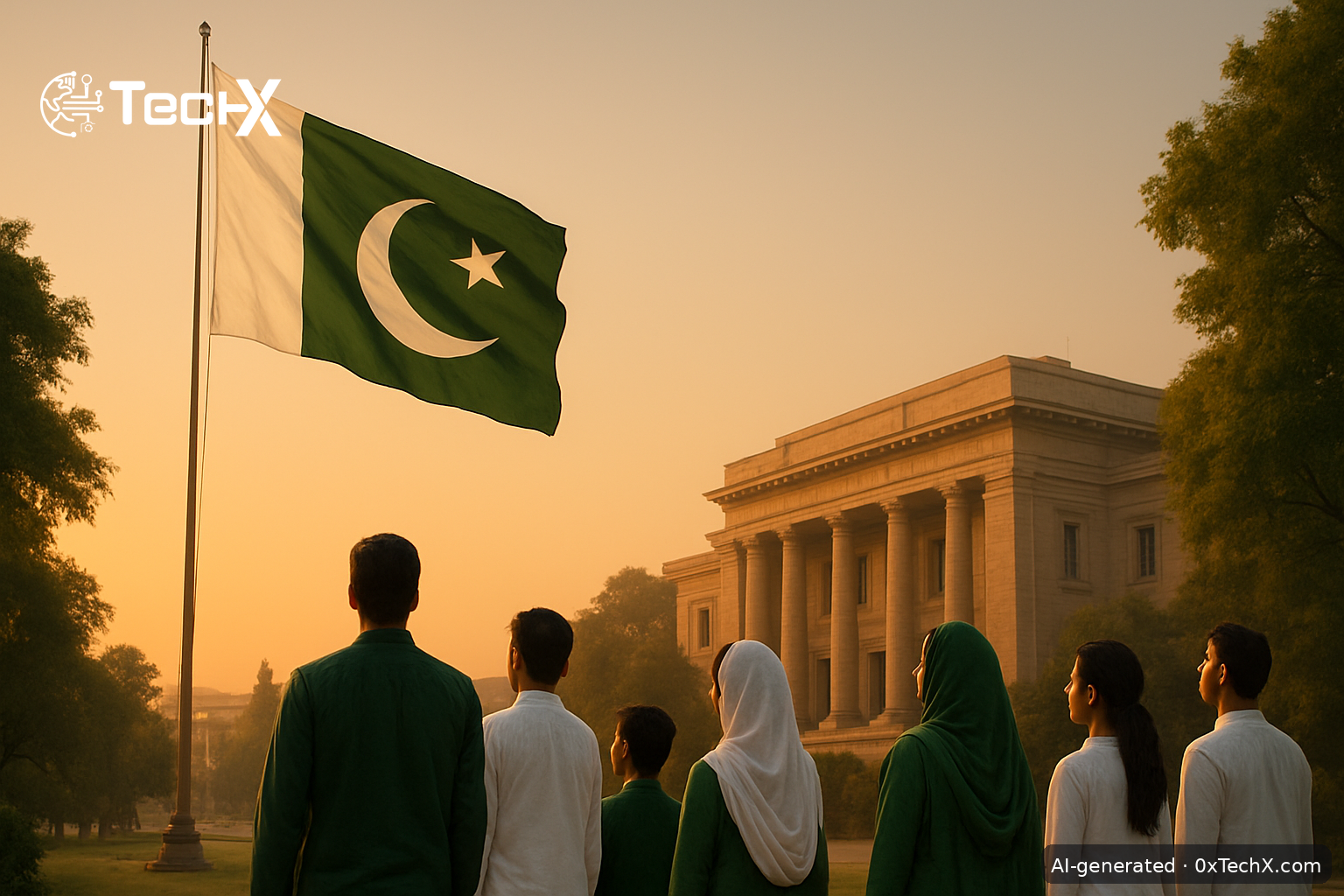
Disclaimer: This article has been compiled from information publicly available on the internet and from published sources. The featured image is AI generated and is for illustration only. If you notice anything that needs correction, please contact us.