
Every 14 August Tells a Much Older Story
Pakistan Independence Day is not just a date on a calendar. It is the end of a long, difficult journey, one that began decades before the green-and-white flag was raised for the very first time. Every time we see fireworks light up the sky on 14 August, we are really celebrating a movement that was built on thought, sacrifice, and an unshakeable belief in a better future. To truly appreciate what we have, it helps to understand where it all began.
Life Under British Rule
For nearly a century, the Indian subcontinent was governed by the British. British rule in the region stretched back to the mid-1700s, and after the events of 1857, direct British control, known as the British Raj, was firmly established. For the millions of Muslims living in the subcontinent, this era brought real worries about identity, political voice, and the future of their community.
As the 20th century approached, a new political energy was building. Muslims across the subcontinent began to feel that their concerns were not being heard in the larger political conversation. They needed a platform of their own, organised, united, and clear in its goals.
1906: The Muslim League Is Born
That platform arrived on 30 December 1906, in Dhaka. The All India Muslim League was founded at a gathering during the All India Muhammadan Educational Conference, with Nawab Khwaja Salimullah of Dhaka playing a key role in making it happen. Its first president was Aga Khan III. The League’s early mission was straightforward: to protect the political rights and interests of Muslims in British India, who felt their voice was being lost in the wider political space.
Over the next few decades, the League grew. It was no longer just a platform for voicing concerns, it became, as history would show, the driving force behind the demand for a separate homeland for the Muslims of the subcontinent.
Allama Iqbal’s Vision: A Dream Takes Shape
Before the demand became a formal political movement, it was a dream, and no one gave that dream more beautiful words than Allama Muhammad Iqbal. In his famous presidential address at Allahabad in December 1930, Iqbal proposed the idea of a separate Muslim state in north-western India. This speech, now remembered as the Allahabad Address, is considered a turning point in the intellectual history of the Pakistan movement. Iqbal gave the idea of Pakistan a philosophical and moral foundation that inspired a whole generation.
Meanwhile, a young Cambridge student named Choudhry Rahmat Ali took that dream further. In 1933, he published a pamphlet called “Now or Never”, and that was the first time the name “Pakistan” appeared in writing. The word combined the names of the regions, Punjab, Afghania (the North-West Frontier), Kashmir, Sindh, and Balochistan, into a name that also meant “Land of the Pure.”
Quaid-e-Azam: The Man Who Made It Happen
No account of the freedom movement is complete without Quaid-e-Azam Muhammad Ali Jinnah. A brilliant lawyer and a principled statesman, Jinnah became the leader of the All India Muslim League and dedicated his life to turning the dream of Pakistan into reality. Under his steady leadership, the League transformed from a political organisation into a mass movement. Jinnah’s clarity of thought, his courage in negotiations, and his refusal to compromise on the rights of the Muslim community made him the irreplaceable figure of the Pakistan movement, and, eventually, the Father of the Nation.
23 March 1940: The Lahore Resolution Changes Everything
If there is one moment when the Pakistan movement went from an idea to a firm, formal demand, it was 23 March 1940. On that day, the All India Muslim League held a historic session in Lahore, at the ground now known as Iqbal Park. The resolution moved at that session, presented by A.K. Fazlul Huq, the Chief Minister of Bengal, and backed by Quaid-e-Azam Jinnah, called for the creation of independent Muslim-majority states in the north-western and eastern zones of British India.
This was a decisive shift. The League had moved from asking for political protections within a united India to demanding a separate homeland altogether. The resolution marked a clear turning point: the Muslims of the subcontinent were now asking not for a seat at someone else’s table, but for a home of their own.
Interestingly, the word “Pakistan” was not actually written in the text of the resolution, it was officially called the Lahore Resolution. But the idea it carried was so powerful and so clear that the world began calling it the Pakistan Resolution. To remember this day, the iconic Minar-e-Pakistan now stands at the very site in Lahore where the resolution was passed.
The Final Years: From Resolution to Reality
After 1940, the Pakistan movement gained speed. Ordinary men and women, from cities, towns, and villages, joined the cause. They gave their time, their resources, and many gave their lives. After years of negotiations, debates, and determined political work, the British finally agreed to partition British India into two independent nations. The Indian Independence Act was passed in July 1947, and at midnight between 14 and 15 August 1947, Pakistan came into existence as a sovereign state. Muhammad Ali Jinnah was sworn in as the nation’s first Governor General.
It was the realisation of a vision that had taken decades of hard work, shaped by thinkers like Iqbal, named by students like Rahmat Ali, and brought to life by leaders like Jinnah, and the countless ordinary people who believed in it.
Pakistan Independence Day in the Modern Age
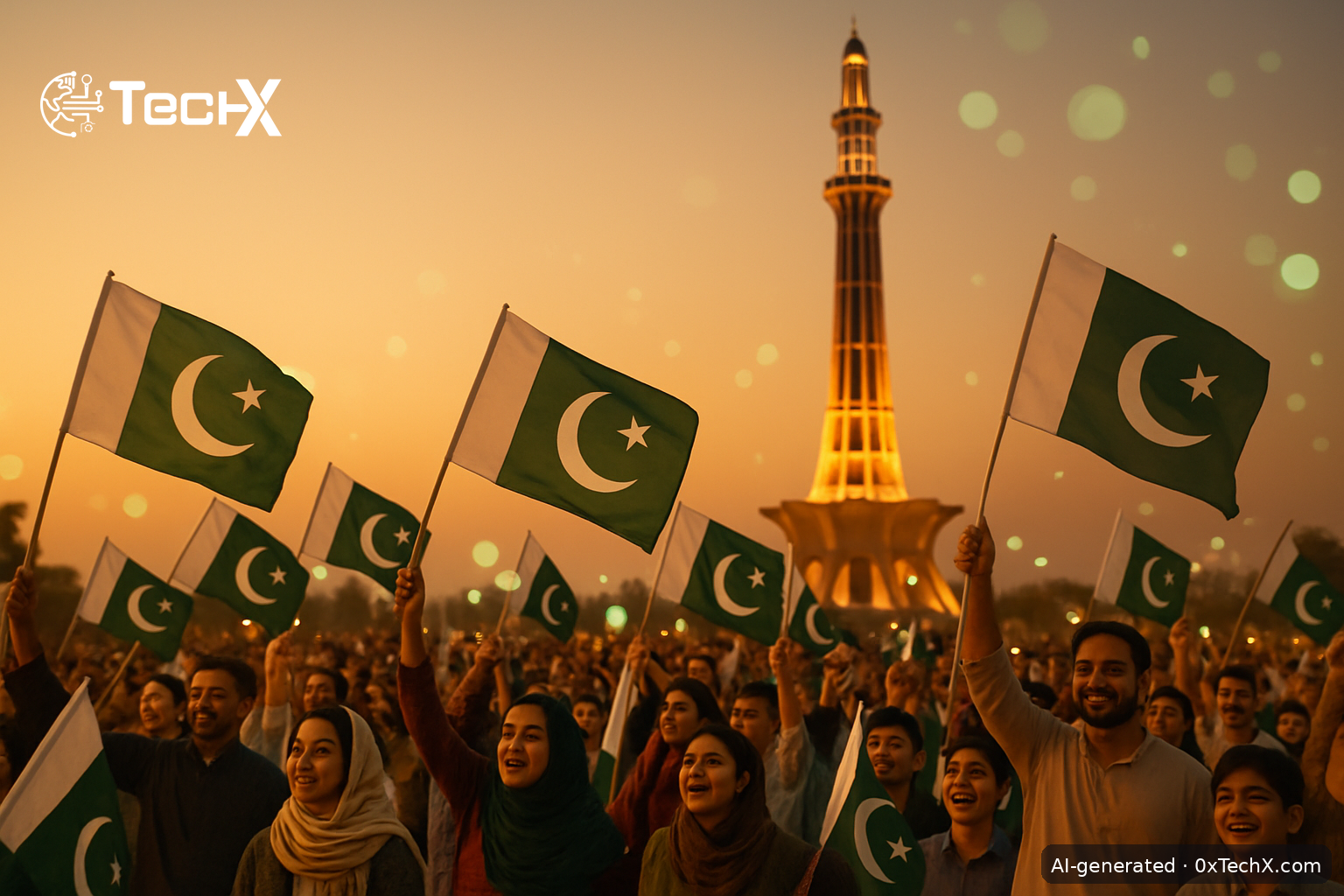
Today, Pakistan Independence Day is celebrated with great spirit across the country and among Pakistani communities all over the world. The main national ceremony takes place in Islamabad, with a full military parade and flag-hoisting ceremonies at government buildings, schools, and homes. Streets glow in green and white, the colours of the national flag, where green represents the Muslim majority and white stands for religious minorities and peace.
Technology has added a new dimension to how Pakistanis celebrate. Social media platforms light up with tributes, short films, and digital artwork every 14 August. Pakistani content creators, tech companies, and startups launch campaigns that connect young Pakistanis to their history in fresh and creative ways. From interactive maps of the freedom movement to mobile apps that let you virtually hoist the flag, the spirit of independence is very much alive in Pakistan’s digital generation. In this way, the journey that began in 1906 continues, now carried forward not just in hearts, but on screens and in code.
Frequently Asked Questions About Pakistan Independence Day
When is Pakistan Independence Day celebrated?
Pakistan Independence Day is celebrated every year on 14 August. It marks the day in 1947 when Pakistan became an independent, sovereign nation after the end of British rule.
What was the Lahore Resolution and why does it matter?
The Lahore Resolution was a formal declaration passed by the All India Muslim League on 23 March 1940 in Lahore. It demanded the creation of independent Muslim-majority states in the subcontinent. It is considered the most important step in the formal demand for Pakistan, and 23 March is observed as Pakistan Day every year in its memory.
When was the All India Muslim League founded?
The All India Muslim League was founded on 30 December 1906 in Dhaka. It was established to represent the political rights and interests of Muslims in British India, and it eventually became the organisation that led the movement for the creation of Pakistan.
Who first used the name “Pakistan”?
The name “Pakistan” first appeared in a pamphlet called “Now or Never,” written by Choudhry Rahmat Ali and three other students at Cambridge University in 1933. The name brought together the initial letters or names of several Muslim-majority regions of the subcontinent, and it also carries the meaning of “Land of the Pure.”
A Day Worth Celebrating, and Understanding
Pakistan Independence Day is a moment of joy, but it is also a moment for reflection. The freedom we enjoy today was not given, it was earned, through generations of thought, courage, and sacrifice. The best way to honour those who built this nation is to know their story, to carry it forward with pride, and to keep building a Pakistan worthy of their dream. Jashn-e-Azadi Mubarak to every Pakistani, wherever you are in the world.
Disclaimer: This article has been compiled from information publicly available on the internet and from published sources. The featured image is AI generated and is for illustration only. If you notice anything that needs correction, please contact us.