

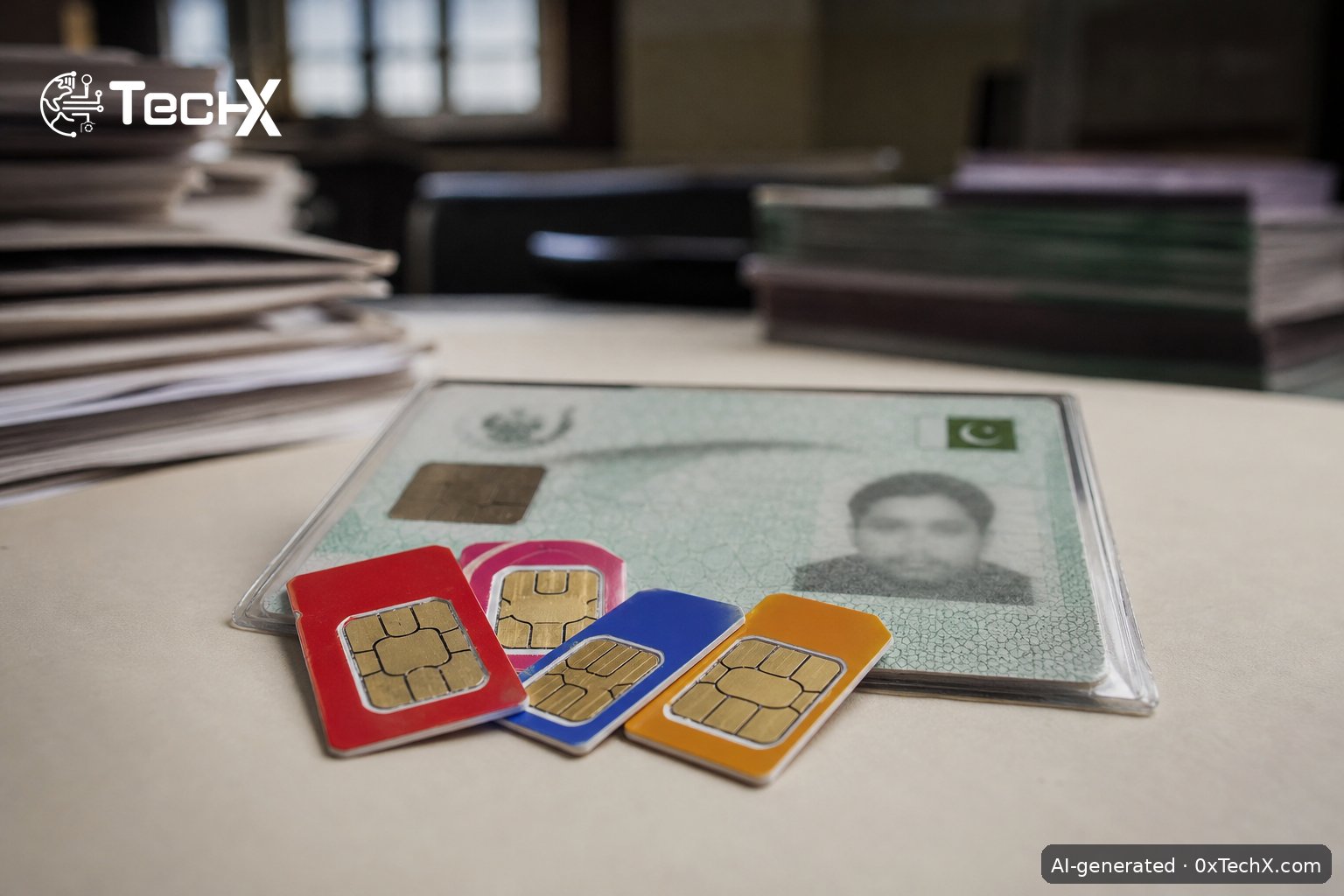
Pakistan’s telecom regulator PTA is weighing a cut to the SIM limit per CNIC for voice calls, bringing it down from the current five to just three. The proposal, reported on 14 November 2026, would reshape how Pakistanis register mobile connections, while a planned rise in data SIM allowances signals that the authority is trying to match rules to how people actually use their phones today.
What Is the SIM Limit per CNIC Right Now?
At present, every Pakistani citizen can register up to eight SIM cards against one Computerised National Identity Card (CNIC). That total breaks down into five voice SIMs, which can make calls and send SMS, and three data SIMs, which carry internet traffic only. This split was set following a court decision and has been in place for some time.
Checking your current count is straightforward. You can send your CNIC number by SMS to 668 (free), or visit the PTA’s online portal at cnic.sims.pk to see all SIMs registered against your identity card across every network.
What Is PTA Proposing to Change?
PTA officials have confirmed that an in-principle decision has been taken to review the existing SIM limit per CNIC. The specific proposals on the table are:
- Voice SIMs: reduce the maximum from five to three per CNIC.
- Data SIMs: raise the maximum above the current three, though the new figure has not yet been announced.
Officials say most mobile users in Pakistan already operate only two or three voice SIMs at a time, so the reduction would not trouble the majority of subscribers. The authority has not stated whether people who already hold four or five voice SIMs would be forced to give up connections, or whether a grace period would apply. That is one key question that still needs an answer before any rule change is finalised.
Why Is PTA Doing This Now?
The timing is no accident. Pakistan’s telecom sector has faced a serious fraud problem for years. PTA told a National Assembly committee that roughly 18.2 million SIMs were blocked over a two-and-a-half-year period, and telecom operators were collectively fined Rs 4.5 billion for regulatory violations. In one documented case, a suspect was found with 195 active SIMs, 16 smartphones and 81 ATM cards, showing how multiple SIM registrations can enable financial crime at scale.
Earlier in 2026, PTA also extended the SIM disowning period from 60 days to 365 days, meaning a newly activated SIM cannot be transferred or closed for a full year after activation. The proposed cut to the SIM limit per CNIC fits that same pattern of tightening controls around how mobile connections are issued and held.
Criminals who use fake or stolen CNICs to register many voice lines become harder to operate if the voice cap is lowered. Fewer available slots means less room for misuse before a CNIC hits its ceiling.
The 5G and Data Angle
While voice SIMs may shrink, the other side of this proposal actually expands connectivity. Pakistan officially launched 5G in March 2026, with Zong and Jazz leading the rollout across multiple cities. As 5G spreads, demand for data-only SIMs in devices like home routers, smart meters, vehicles and industrial sensors, which are part of the Internet of Things (IoT), is expected to rise sharply.
Raising the data SIM cap directly supports that growth. A higher data SIM limit per CNIC would let households and small businesses connect more devices without hitting a wall. PTA has not disclosed the exact new ceiling for data SIMs, but the direction is clear.
For more on how Pakistan’s connectivity landscape is shifting, see our coverage of Pakistan’s internet speeds jumping 60% and 5G users nearing 2 million.
Will Mobile Operators Be Consulted?
Yes. PTA officials have stated clearly that the proposed changes will be reviewed together with mobile network operators before any final rule is published. Pakistan’s main operators, Jazz, Zong, Telenor and Ufone, serve hundreds of millions of connections combined, so any change to the SIM limit per CNIC affects their sales processes, franchise operations and subscriber management systems directly.
Operators will likely want to understand how the new rules interact with existing corporate or business SIM allocations, which sometimes follow different limits. Until a formal notification is issued by the Pakistan Telecommunication Authority, the current allowance of five voice SIMs and three data SIMs per CNIC remains fully in force.
What Should You Do Right Now?
Nothing urgent, but it is a good time to check your own CNIC. Send your CNIC to 668 or visit cnic.sims.pk to see how many SIMs are registered in your name. If you find connections you did not register yourself, you should visit a franchise outlet to disown them. PTA grants a one-time waiver on the standard disowning fee where a SIM was activated without your consent.
If you currently hold four or five voice SIMs across different networks, keep an eye on official PTA announcements. The regulator has said no existing SIMs are being blocked under this proposal, and a transition plan has not yet been announced. When formal rules are published, they will appear on the PTA’s official website first.
Frequently Asked Questions
What is the current SIM limit per CNIC in Pakistan?
Right now, one CNIC can hold up to eight SIMs in total: five voice SIMs and three data SIMs across all networks combined. This is not a per-network limit; it covers Jazz, Zong, Telenor, Ufone and SCO added together.
When will the new SIM limit take effect?
No date has been set. PTA has made an in-principle decision to review the limits and will consult mobile operators before publishing any final rule. Until an official notification is issued, the current five voice and three data SIM limit per CNIC stays in place.
Will people with five voice SIMs have to give one up?
PTA has not yet said whether existing subscribers will be asked to reduce their connections. Any rule change is expected to include guidance on this, but nothing has been announced. Watch the PTA website for updates.
Why is PTA increasing data SIMs while cutting voice SIMs?
The logic is straightforward. Voice SIMs are the main tool used in phone scams, SIM fraud and financial crime. Data SIMs, by contrast, are needed in growing numbers for 5G home broadband, IoT devices and smart gadgets. PTA wants to tighten the SIM limit per CNIC where misuse is highest while opening space where genuine demand is growing.