
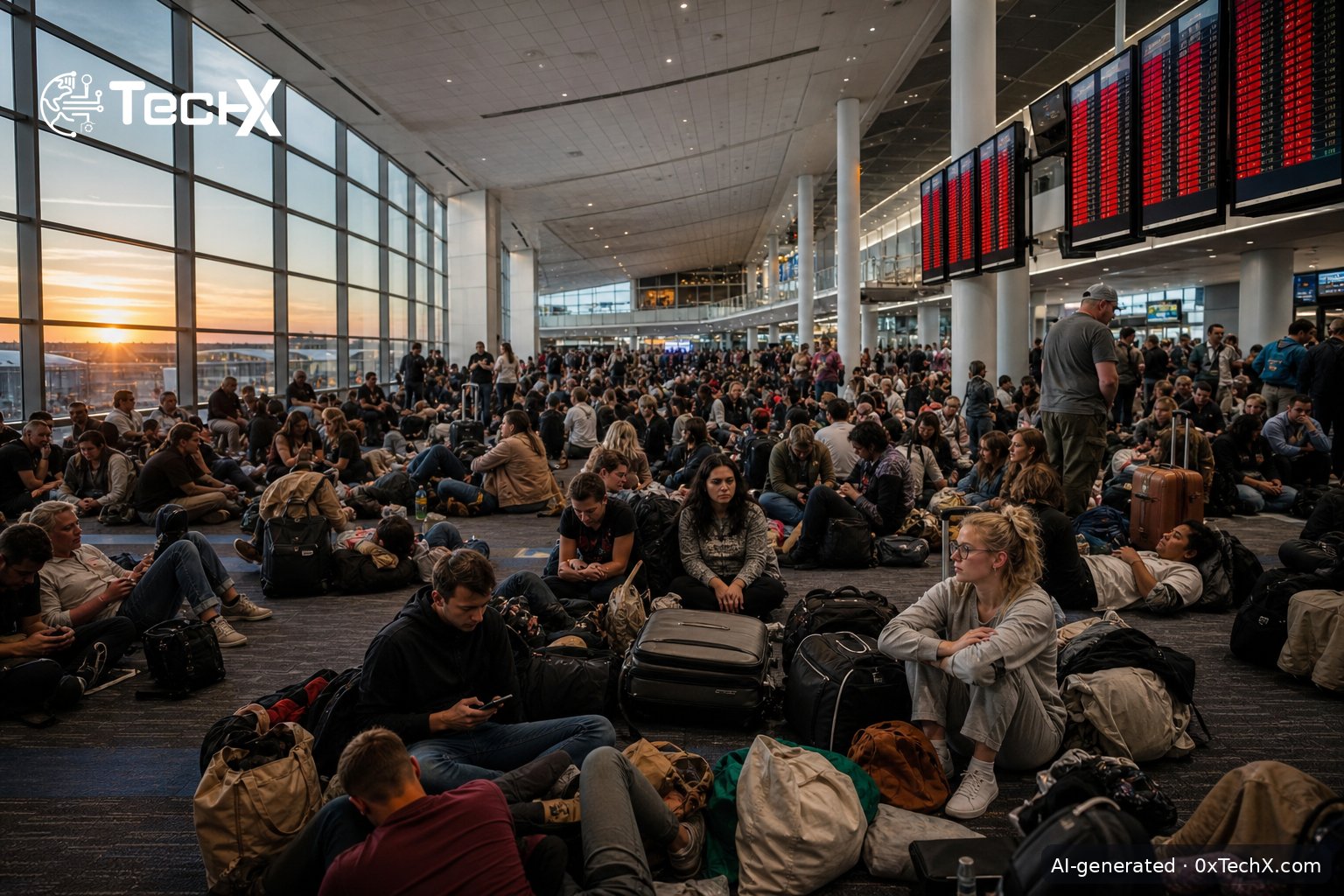
The FAA ground stop on November 13, 2026 brought US aviation to a near-standstill, grounding every domestic departing flight for more than four hours after a telecommunications failure knocked out air traffic control systems across the country. Nearly 5,000 flights were cancelled and tens of thousands of passengers were left stranded at airports, the worst aviation disruption America has seen in decades.
What Triggered the FAA Ground Stop?
The Federal Aviation Administration (FAA) said the halt was caused by a telecommunications outage that affected multiple Air Route Traffic Control Centers at the same time. These centers are the backbone of US airspace, they guide planes across the country and keep traffic separated safely.
Transportation Secretary Sean Duffy was quick to point to old infrastructure as the root cause. He said the system relies on outdated switches, old routers, and copper telephone lines dating back to the 1980s. A data overload caused by those ageing routers led to a failure in both communications and radar systems used by air traffic controllers.
Duffy described it as an “inconsistency” in data flowing through the system. When controllers could not fully trust the data they were seeing, the FAA acted out of caution and grounded all departing traffic immediately.
How Big Was the Disruption?
The scale was enormous. Within hours of the FAA ground stop being issued, more than 10,000 flights had been delayed and close to 5,000 were outright cancelled, according to flight-tracking data. Airlines including JetBlue cancelled hundreds of flights, and major carriers like Delta had to pause all scheduled departures.
At that moment, more than 3,500 planes were already in the air when the order came through. Those flights were allowed to continue and land normally, a ground stop does not affect aircraft already airborne. But nothing new was allowed to take off. Airports from New York to Los Angeles to Dallas filled up with confused and frustrated travellers who had no clear timeline for when they could leave.
Homeland Security Secretary Markwayne Mullin was quick to calm fears, saying there was no sign this was a cyberattack or any kind of deliberate act. The White House echoed that message, calling it a technical failure with no indication of a “nefarious act.”
How Long Did the FAA Ground Stop Last?
The FAA ground stop was lifted at around 8:15 PM Eastern Time on Friday evening, more than four hours after it began. Secretary Duffy told reporters: “At 8:15 tonight, Eastern time, we’ve opened up the airspace.” However, he was clear that the return to normal would not be instant. The ripple effect of thousands of delayed and cancelled flights takes many hours to clear.
Flight cancellations were expected to continue well into Saturday, with airlines warning passengers to check their status before heading to the airport. Cargo and passenger flights to Asia and Hawaii were also resuming from the West Coast by late Friday evening.
According to aviation records, this was only the second nationwide ground stop since the September 11, 2001 attacks, and the longest since that day. The only other comparable event in recent years was a 90-minute NOTAM system failure in January 2023, which disrupted over 10,000 flights but lasted far less time than this episode.
Why Does Old Infrastructure Keep Causing These Crises?
Duffy’s comments shine a harsh light on a problem the US aviation sector has long tried to ignore. America’s air traffic control network runs on technology that is decades old. The copper telephone lines, legacy routers, and older software systems were never designed to handle the volume of modern air traffic.
This is not the first time outdated tech has grounded US planes. The 2023 NOTAM outage happened because a worker accidentally corrupted a critical database during routine maintenance. Each incident raises the same question: when will the US invest in a modern, resilient system?
Duffy said after lifting the FAA ground stop that it is going to “take us some time to unwind”, a phrase that applies as much to years of underinvestment as it does to Friday night’s flight chaos.
Impact on Passengers Flying to or from Pakistan
For Pakistani travellers connecting through US airports, this event was a serious problem. Many international passengers use hubs like JFK, Chicago O’Hare, or Los Angeles as transit points for flights to Karachi, Lahore, or Islamabad. A multi-hour ground stop at any of these airports can break a connection and strand a traveller for a full day or more. If you have US transit plans in the coming days, airlines are advising passengers to verify their booking and check for rebooking options before the weekend is out.
Frequently Asked Questions
What is an FAA ground stop?
An FAA ground stop is an order that prevents aircraft from departing a specific airport or, in rare cases, all airports in the US. It is used when safety cannot be guaranteed, for example, because of bad weather, a system failure, or a communications outage. Planes already in the air are not affected.
How many flights were cancelled in the November 2026 FAA ground stop?
Close to 5,000 flights were cancelled and more than 10,000 were delayed during and after the FAA ground stop on November 13, 2026. Cancellations were still being reported into Saturday, November 14.
What caused the FAA to ground all US flights?
A telecommunications outage overloaded old routers in the air traffic control system, corrupting data fed to multiple Air Route Traffic Control Centers. The FAA halted all departures as a safety measure while the problem was fixed. Secretary Duffy attributed the failure to decades-old infrastructure still in active use.
Was the FAA ground stop a cyberattack?
No. Both the FAA and the White House said there was no evidence of any deliberate or hostile action. Homeland Security Secretary Mullin confirmed it appeared to be a technical failure caused by a telecommunications outage, not a hack or attack of any kind.