
The Pakistan EV running cost in 2026 has dropped to as little as Rs 3 per km for drivers who charge at home overnight, while a typical petrol car still costs between Rs 19 and Rs 26 per km to run. That gap is now big enough to change a family’s monthly budget by tens of thousands of rupees. This article breaks down the verified per-kilometre numbers, explains all three charging scenarios, and shows what the difference means for a normal city commuter.
What Petrol Actually Costs Per Km Right Now
Petrol in Pakistan costs Rs 299.50 per litre as of June 27, 2026, according to the latest OGRA notification. That is down sharply from a record high of Rs 458.41 per litre reached in early April 2026 during regional conflict-driven oil price spikes, but it is still high by any historical standard.
Now put that into per-km terms. A common petrol sedan averaging 12 km per litre spends roughly Rs 25 per km on fuel alone at today’s price. A more efficient hatchback like the Suzuki Cultus, which averages around 16 km per litre in city driving, brings that down to about Rs 18.7 per km. Maintenance, oil changes, and servicing sit on top of these numbers.
So the realistic petrol cost range for most Pakistani drivers is Rs 19 to Rs 26 per km, depending on their car.
Pakistan EV Running Cost in Three Scenarios
Electric vehicles do not have one fixed running cost. It depends entirely on where and how you charge. Here are the three main scenarios for Pakistani EV owners in 2026.
Scenario 1: Home Charging on the Off-Peak NEPRA Rate
This is the cheapest option. NEPRA’s subsidised off-peak residential tariff under S.R.O. 279(I)/2026 is Rs 23.57 per kWh. A typical EV like the MG ZS EV uses about 13 kWh per 100 km. At Rs 23.57/kWh, that works out to just Rs 3 to Rs 5 per km. Most EV owners in Pakistan charge at night, which means they naturally benefit from the lower off-peak rate.
Scenario 2: Home Charging on Standard Domestic Electricity
If you charge at home but fall into a higher consumption slab, your rate goes up. Standard domestic rates in Pakistan in 2026 range from about Rs 22 to Rs 47 per kWh depending on your monthly usage bracket. At the mid-range of Rs 40 to Rs 65 per kWh, the Pakistan EV running cost comes to roughly Rs 6 to Rs 10 per km. That is still far below petrol, but the savings narrow if your electricity bill is already high.
Scenario 3: Public Fast Charging
The government’s Power Division cut the electricity tariff for dedicated EV charging stations from Rs 71 per unit to Rs 39.70 per unit, a 44% reduction under the NEV Policy 2025-30. Public chargers such as PSO EV Charging and Go Green stations operate around Rs 110 to Rs 120 per kWh after station operator costs and service charges are added. At that rate, the per-km cost rises to about Rs 18 to Rs 20 per km on public fast chargers. That is close to petrol, so public charging alone does not give you the big savings.
The Solar Scenario: Near-Zero Running Cost
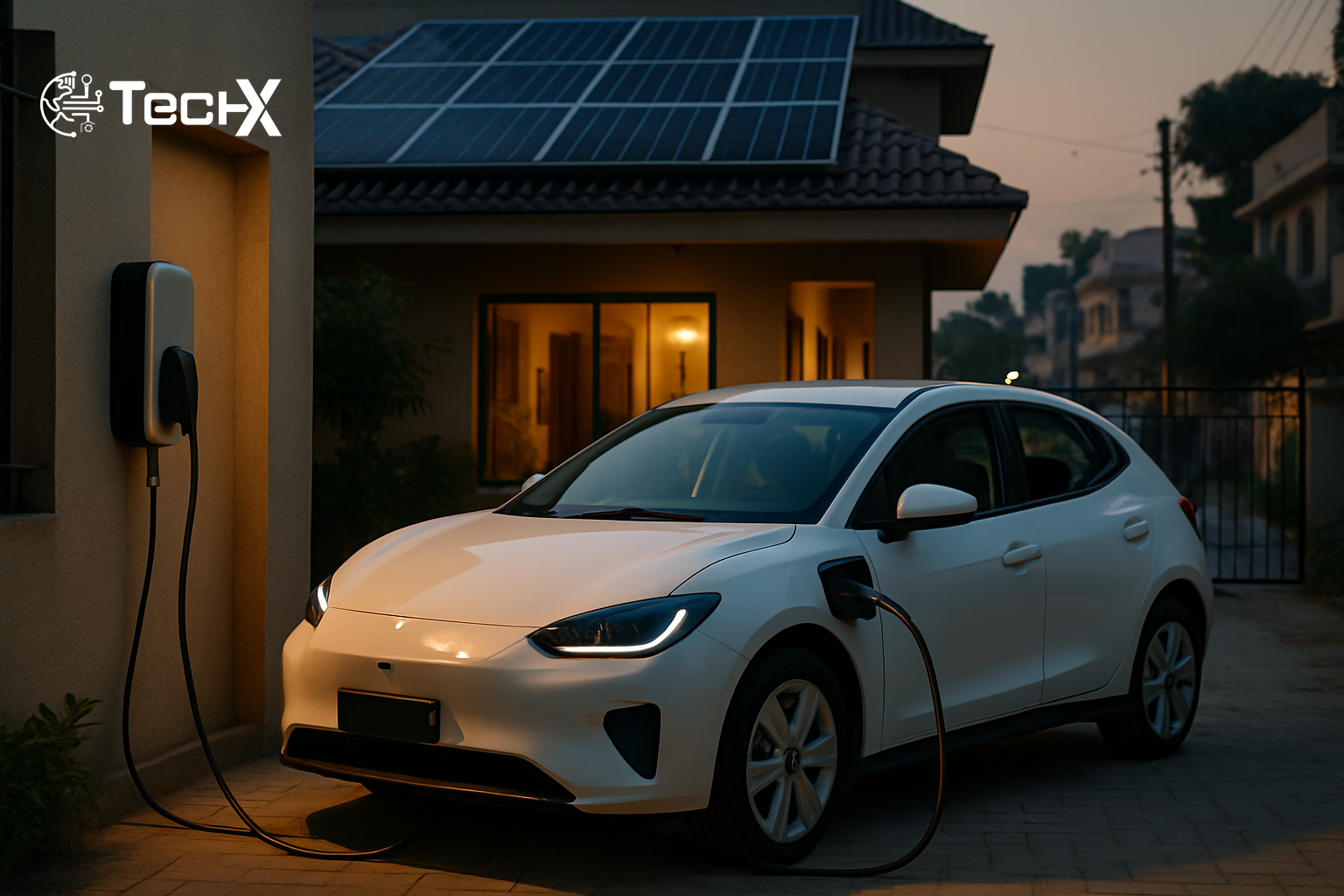
For drivers who have rooftop solar panels at home, the picture changes completely. Once the solar system is paid off, the marginal cost of the electricity used to charge a car is effectively zero. With solar panels, your driving cost can become almost zero per km, which is the single biggest reason many Pakistanis are making the switch right now. Pakistan has seen a rapid rise in home solar installations over the past two years, and integrating EV charging with an existing solar setup is now a realistic option for many households.
The Monthly Bill in Real Numbers
Let’s make this practical. Say a Karachi office worker drives 40 km every day, five days a week, that is roughly 800 km per month.
- Petrol car (12 km/L at Rs 299.50/L): about Rs 19,967 per month in fuel
- EV on home off-peak charging (Rs 23.57/kWh, 13 kWh/100 km): about Rs 2,452 per month
- EV on mid-slab home charging (Rs 50/kWh): about Rs 5,200 per month
- EV on solar: near Rs 0 per month once panels are installed
For a driver doing 40 km daily, switching from a petrol sedan to an EV that charges at home can save up to Rs 40,000 per month, depending on the charging method and actual usage. Over a year, that is Rs 480,000 in fuel savings alone.
Beyond Fuel: Maintenance Savings Add Up Too
Running costs are not just about fuel. Electric vehicles have far fewer moving parts than petrol cars. There is no engine oil to change, no spark plugs, no fuel filter, and no exhaust system. EV owners in Pakistan are saving an estimated Rs 16,000 to Rs 27,000 per year on routine maintenance compared to equivalent petrol cars. No oil changes every 5,000 km, no transmission fluid, and regenerative braking means brake pads last two to three times longer.
The one big cost to keep in mind is battery replacement, which can run Rs 800,000 to Rs 1,300,000. But most batteries are warranted for eight years, and most people sell the car before reaching that point.
Who Actually Benefits Most From Switching
The savings are real, but they are not the same for everyone. The Pakistan EV running cost advantage is strongest for people who:
- Drive mostly inside the city (30 to 80 km per day)
- Have a reliable home charging setup or rooftop solar
- Cover at least 1,000 km per month
- Plan to keep the car for four to five years or more
If you rely only on public fast chargers because you live in an apartment with no dedicated parking, the savings shrink significantly. The public charging cost per km can approach petrol costs once operator fees are included.
For those considering the broader picture of EV access and affordability in Pakistan, there are also new financing options emerging. Buy-now-pay-later partnerships are starting to bring device and vehicle financing to more Pakistanis, which could lower the barrier to EV ownership over the next few years.
Frequently Asked Questions
What is the Pakistan EV running cost per km in 2026?
It depends on your charging method. Home charging on the NEPRA off-peak rate of Rs 23.57/kWh costs about Rs 3 to Rs 5 per km. Standard home charging costs Rs 6 to Rs 10 per km. Public fast chargers cost Rs 18 to Rs 20 per km. Solar charging brings the cost close to zero.
How much does a petrol car cost per km in Pakistan right now?
With petrol at Rs 299.50 per litre as of June 2026, a car averaging 12 km per litre costs about Rs 25 per km. A more efficient hatchback at 16 km per litre costs around Rs 18.7 per km. Most Pakistani drivers fall in the Rs 19 to Rs 26 per km range.
Is solar charging an EV really free?
The electricity itself costs nothing once your solar system is paid off, but solar panels have an upfront cost. Once installed, though, the marginal cost per km for driving on solar power is essentially zero. This is the most cost-effective long-term setup for Pakistani EV owners with a home and roof access.
What is Pakistan’s official EV charging tariff in 2026?
The Power Division reduced the tariff for dedicated EV charging stations from Rs 71 per unit to Rs 39.70 per unit, a 44% cut, under the NEV Policy 2025-30. The NEPRA subsidised off-peak residential rate is Rs 23.57 per kWh. Public station operators add their own fees on top, taking real-world public charging costs to Rs 110 to Rs 120 per kWh.