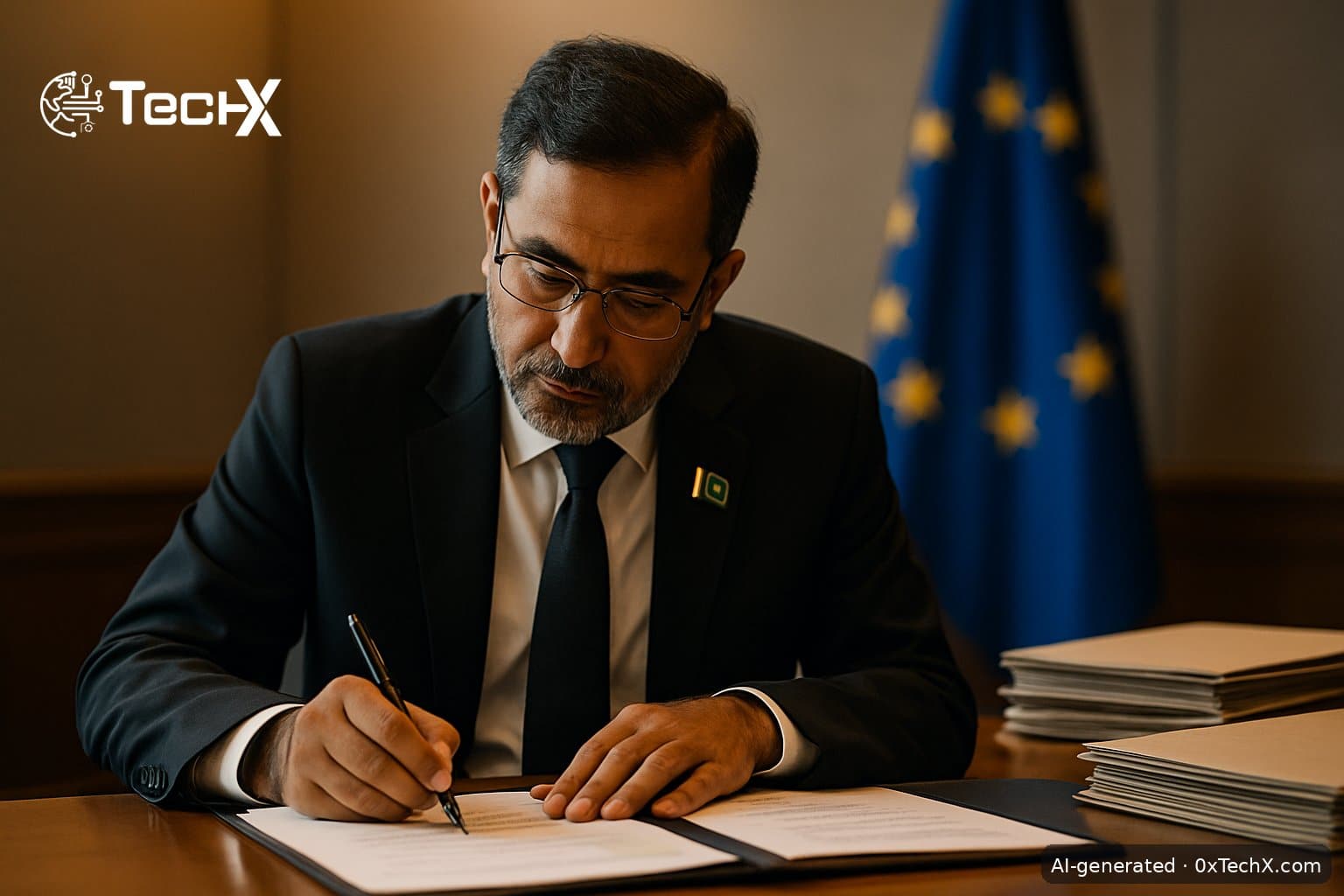
The EU GSP+ warning Pakistan received on September 7, 2026 is one of the most serious trade signals Islamabad has faced in years. EU Ambassador Raimundas Karoblis said plainly that preferential trade access to Europe cannot be taken for granted as Pakistan prepares to seek entry into a tougher successor regime. With close to $9 billion in annual exports flowing through this channel, every sector of Pakistan’s export economy, including its fast-growing tech and IT industry, needs to pay attention.
What Is GSP+ and Why Pakistan Depends on It
GSP+ stands for the Generalised Scheme of Preferences Plus. It is offered by the European Union to a select group of developing countries, giving them duty-free or reduced-tariff access to the EU market in exchange for meeting standards on human rights, labour rights, good governance, and the environment. Pakistan has benefited from GSP+ since 2014 and is the scheme’s largest beneficiary.
In 2024 alone, Pakistan received nearly €732 million in tariff exemptions, and $7.115 billion worth of exports used that preferential access. The EU accounts for about 28 percent of Pakistan’s total exports, with nearly 90 percent of shipments to the bloc eligible for GSP+ preferences.
Textiles and clothing are the most dependent sector, making up roughly 70 to 76 percent of Pakistan’s exports to the European market. But the story does not stop at fabric and garments. Pakistan’s IT and digital services sector, which posted record export earnings of $4.6 billion in FY2025-26, up from $3.814 billion the year before, a rise of about 20.6 percent, operates in the same trade environment. Stable EU relations and investor confidence in Pakistan’s governance record directly affect how European clients view Pakistani tech firms and freelancers.
The EU GSP+ Warning Pakistan Must Act On
The current EU Generalised Scheme of Preferences Plus framework expires at the end of 2026, after which Pakistan will have to seek inclusion in the successor scheme. Existing beneficiaries are expected to receive preferences during a two-year transition period until December 31, 2028, but this transition does not guarantee automatic continuation under the new framework.
EU Ambassador Karoblis told reporters that there were serious concerns within the European Commission over Pakistan’s compliance with the conventions underpinning GSP+, and that areas of regression identified in the EU’s latest assessment would need to be addressed as part of Pakistan’s reapplication.
A European Commission assessment covering 2023 to 2025 found compliance problems and regression in several areas, while noting that legislative and administrative measures had often not translated into improvements on the ground. Concerns included enforced disappearances and extrajudicial killings, freedom of expression, minority and journalists’ rights, judicial independence, access to justice, and forced labour.
The new GSP regime will cover 32 international conventions instead of the current 27. Pakistan has already ratified five additional conventions, but their practical implementation will be the decisive criterion.
The India and Bangladesh Squeeze Makes This Worse
What most Pakistan-focused coverage misses is the competitive trap closing in from both sides. India concluded Free Trade negotiations with the EU in January 2026, and that deal will take all textile and apparel tariff lines, currently facing duties of up to 12 percent, to zero. That access is a treaty, not conditional on 32 conventions. Once in force, India can undercut Pakistan on the same products in the same European market.
Bangladesh sits on the other side of the squeeze. It is scheduled to graduate from least-developed-country status on November 24, 2026, but EU transition rules will preserve its duty-free access for three years after that graduation, until late 2029. So Pakistan faces rivals with treaty-level or transitional advantages exactly when it must prove compliance under stricter rules. Losing GSP+ would mean Pakistani goods face standard EU tariffs, making them immediately less competitive on price.
What This Means for Pakistan’s Tech and IT Sector
Pakistan’s IT exporters may ask why a trade scheme built around textiles concerns them. The answer is broader than any single sector. When European clients assess whether to outsource software work or sign long-term digital contracts with Pakistani firms, they look at country risk, governance record, and rule of law. Those are exactly the areas Brussels has flagged.
To keep preferences from 2029, Pakistan must reapply before the transition ends, with binding undertakings and a priority plan of action. The July 2026 EU assessment report is the baseline against which that application will be judged. A failed reapplication would be a governance signal that damages Pakistan’s reputation far beyond textiles, cooling European investment in and sourcing from Pakistan’s tech sector too.
This connects directly to challenges Pakistan’s digital workers already face. As covered in our piece on Pakistan’s gig economy being blocked by tax and regulatory barriers, the people most exposed to policy failure are often freelancers and small digital businesses that cannot absorb sudden market shifts. Losing EU trade confidence would add another layer of risk to an already fragile environment for tech exporters.
The Implementation Gap Is the Core Problem
The latest EU assessment found that Pakistan had regressed in several areas while positive change stayed limited. Its central finding is that most progress was legislative and had not reached the ground. Laws exist but are not being enforced as expected by the EU.
This is not a drafting problem. Pakistan can write good laws. The problem is turning those laws into real change that EU monitors can verify on the ground. Karoblis stressed that Pakistani authorities must improve the situation and that specific steps will matter for the reapplication. The European Commission has serious doubts about Pakistan’s effective implementation of the international conventions on which GSP+ is based.
The Ministry of IT and Telecommunication and the Ministry of Commerce need to treat this as a joint crisis. The tech export growth story depends on a stable trade relationship with Europe, which in turn depends on governance reforms that go far beyond the IT sector’s direct remit. Pakistan cannot grow its digital economy inside a country that is losing its biggest trade deal.
Learn more about the EU’s GSP+ framework directly on the European Commission’s official GSP page.
Frequently Asked Questions
What is the EU GSP+ warning Pakistan received?
EU Ambassador Raimundas Karoblis warned on September 7, 2026 that Pakistan cannot assume it will keep zero-duty access to European markets. The current GSP+ scheme ends in 2026, and Pakistan must formally reapply under stricter new rules or lose preferences after December 2028.
How much is at stake for Pakistan’s exports?
For the full fiscal year 2025-26, Pakistan’s exports to European countries reached $9.089 billion. In 2024, Pakistan received nearly €732 million in tariff exemptions, while Pakistani exporters used preferential access for exports worth €7.115 billion. Losing this would make Pakistani goods immediately more expensive in Europe.
Does the GSP+ warning affect Pakistan’s IT sector?
Yes, indirectly but significantly. Pakistan’s IT exports hit $4.6 billion in FY2025-26. European clients and investors watch Pakistan’s governance record closely. A failed GSP+ reapplication would signal governance failure, raising country risk for tech contracts and digital investment from European buyers.
What must Pakistan do before 2028?
Pakistan must reapply for GSP+ before the transition period ends, providing binding undertakings and a priority plan of action. The EU requires real on-the-ground improvement in human rights, labour standards, judicial independence, and press freedom, not just new laws but their actual enforcement.