


As the commodity experiences increasing acceptance across several countries, Bitcoin (BTC) continues to draw criticism for its impact on the environment. The situation may be changing, though, as mining companies increasingly choose renewable energy sources in an effort to cut back on carbon emissions.
According to a recent analysis by BatCoinz, Bitcoin is apparently on track to become the first monetary system to reach net zero emission by December 2024.
By taking carbon-negative mining into account, the study found that the Bitcoin network presently has 62.4% zero emissions. Based on recently announced carbon-negative initiatives, the activity is anticipated to have 72.7% zero emissions by March 2023.
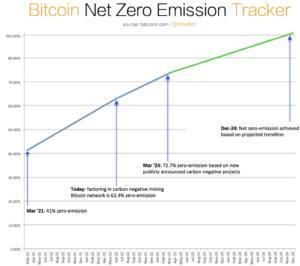
According to the technique, the researchers first estimated the amount of Bitcoin energy coming from sources with positive carbon, from which they then deduced the quantity of positive carbon. In order to balance the negative carbon amount, the researchers also reverse-engineered to determine how much methane would need to be removed from the air through burning.
The study’s findings are based on the fact that since May 2021, the amount of flared gas used to power Bitcoin mining has increased by 8.3 MW per month.
“We anticipate that Bitcoin mining using vented methane as power will initially grow at only 83% of the growth rate of flared gas mining (6.9 MW/month). Based on this more modest growth rate, we forecast that the Bitcoin network will become carbon neutral in Q4, 2024 fully,” the study said
The report also stated that with the expansion of Bitcoin, both the hash rate and energy consumption will probably rise. However, the report noted that increased use of renewable networks and miner efficiency will provide a counterbalance to the hash rate.
To read our blog on “According to a study, 62% of the Bitcoin network is zero-emission,” click here.