
Pakistan’s solar boom is a success story for those who installed panels, but it is creating a growing bill for everyone else. The government has now sought recovery of around Rs34 billion from consumers of distribution companies and K Electric for April to June 2026, equivalent to roughly Rs1.34 per unit, because lower grid consumption pushed up capacity-related charges. This is the sharpest single quarterly signal yet that the Pakistan solar boom is reshaping who pays for the national grid.
How Pakistan’s Solar Boom Reached This Point
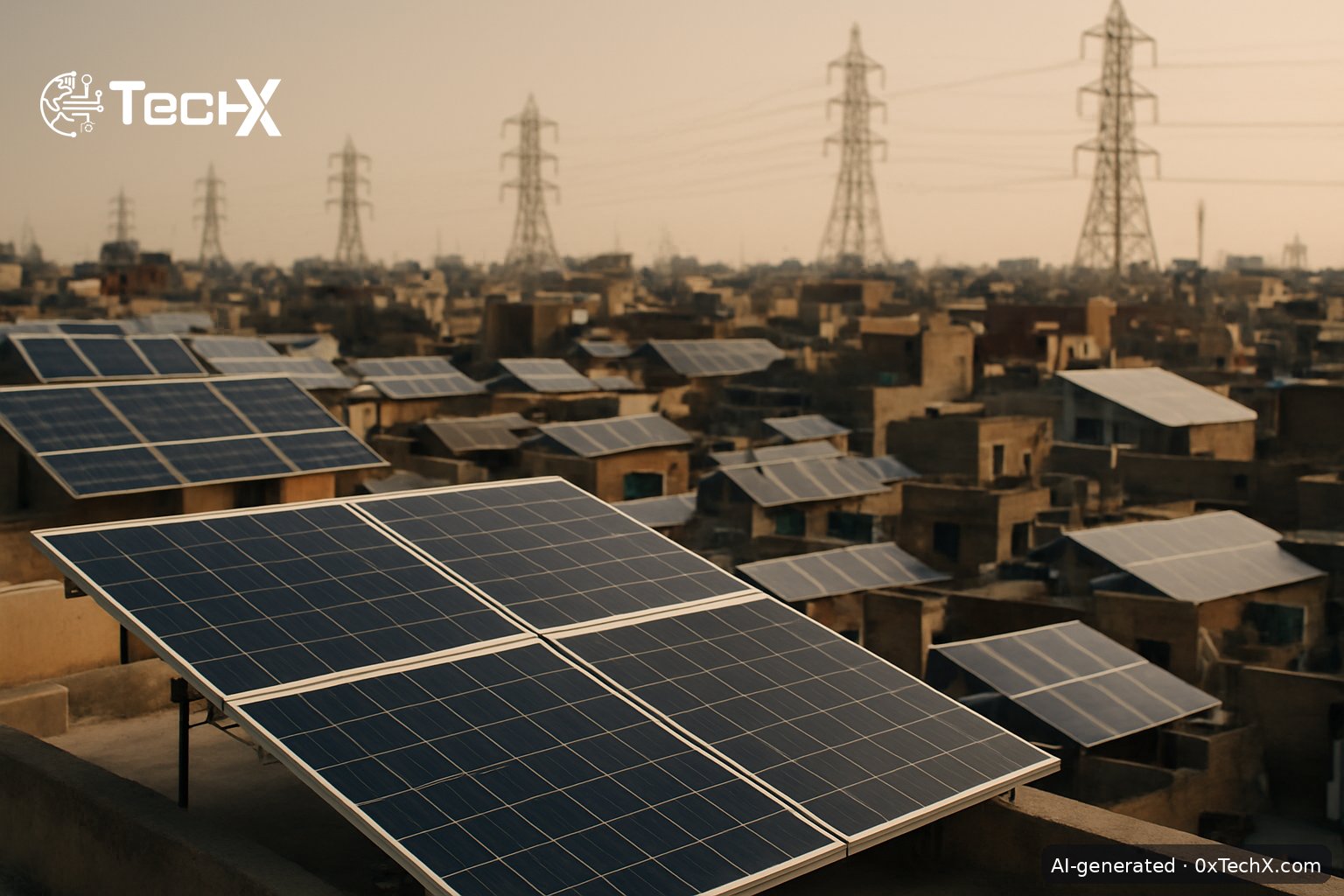
The scale of what happened is hard to overstate. Solar generation under the net-metering system grew from just 190 MW in FY2020 to nearly 7,000 MW by June 2026, an almost 37-fold jump in six years. Pakistan’s adoption of rooftop solar has been described as the fastest of any country of its size anywhere in the world. And it was not driven by government subsidies. Consumers were desperate. Electricity tariffs rose around 140 percent between FY2021 and FY2025 while global solar panel prices fell by roughly 60 percent over a similar period, making panels the rational choice for anyone who could afford the upfront cost.
By March 2026, Pakistan had an estimated 51 GW of total solar capacity deployed. Industrial users led the charge, accounting for 67 percent of net-metering installations, while residential users made up only 14 percent. Large factories and commercial premises went solar first because the savings at high tariffs were fastest to recover.
The Rs34 Billion Problem for Non-Solar Consumers
Here is the basic problem. The national grid has fixed costs, power plant capacity payments, transmission lines, distribution infrastructure, that must be paid whether or not any electricity flows through them. When solar users stop buying from the grid, those fixed costs do not disappear. They are spread over fewer units of grid electricity, so every remaining unit gets more expensive.
The proposed quarterly tariff adjustment that triggered the Rs34 billion headline was initially estimated at Rs23 billion, but was revised upward to Rs33.78 billion when presented before NEPRA. Capacity charges alone accounted for Rs46.28 billion of the proposed adjustment. This is the direct financial arithmetic of the solar shift.
As of December 2024, the government estimated that net-metered solar consumers had already transferred a burden of Rs159 billion onto other grid consumers. Projections show this could reach Rs4,240 billion by 2034 if the old net metering rules had stayed in place. Even the near-term trajectory is alarming: by FY2034, grid revenue losses could translate into a Rs5 to Rs6 per unit tariff increase for non-solar consumers.
The deeper equity issue is that those bearing this burden are largely the people who cannot afford solar, lower-income households, small renters, and businesses operating on thin margins. More than 90 percent of grid-connected consumers are estimated to be facing a higher tariff burden as a direct result of ongoing solarisation. The fixed costs are being pushed onto a shrinking base.
NEPRA’s Net Billing Fix, And Its Limits
Pakistan’s power regulator responded with the Prosumer Regulations 2026, which came into effect on 8 February 2026. The change scrapped the old net metering system, where solar users got a one-for-one credit at the full retail tariff for every unit they exported. Under the new net billing framework, the buyback rate for electricity exported to the grid dropped from around Rs26 per unit to approximately Rs11 per unit. Consumers still pay the full retail rate, between Rs37 and Rs55 per unit, when they draw power from the grid at night or on cloudy days.
Existing net metering contracts signed before the change are protected until they expire. But new solar users and anyone who modifies their system falls under the new rules. The investment case for rooftop solar has changed, though panel prices have also fallen fast enough that payback periods for self-consumption-focused systems remain in the three-to-five-year range for many users.
Why This Matters for Tech Businesses and Data Centres
For Pakistan’s digital economy, startups, software houses, e-commerce warehouses, and data centres, this is a direct operating cost story that most energy coverage misses. A data centre cannot simply put panels on the roof and go off-grid. It needs uninterrupted, high-quality grid power around the clock. Battery storage at the scale required remains expensive. These businesses are grid-dependent by design, and rising per-unit tariffs hit them harder than households that can at least shift daytime appliance loads to solar hours.
Pakistan’s ambitions around AI sovereignty and local data centre infrastructure depend on affordable, stable electricity. Every Rs1 per unit increase in the tariff directly raises the cost of running servers, cooling systems, and network equipment. The Rs1.34 per unit quarterly adjustment announced for April to June 2026 may look small on a household bill, but for a mid-sized data centre consuming millions of units per quarter, it is a significant line-item cost increase. As these surcharges compound, they risk making Pakistan a less competitive location for digital infrastructure investment.
There is also the IPP capacity payment problem underneath all of this. Many independent power producers secured contracts guaranteeing payment for installed capacity regardless of whether their electricity is actually used. As solar eats into grid demand, these unused-capacity bills still land on consumers. The government and grid consumers are effectively paying twice, once for the solar system on someone’s roof, and again for the idle thermal plant that was built to serve that same demand.
What Comes Next
NEPRA’s net billing shift is a course correction, not a full solution. The quarterly Rs34 billion adjustment shows the problem is already materialising in real bills right now. Analysts warn that without smarter grid pricing, fixed access fees, time-of-use tariffs, and proper incentives for battery storage, the cost spiral will continue regardless of which metering system is in use.
For businesses planning energy budgets, the message is clear: grid electricity in Pakistan will get more expensive before it gets cheaper, and the speed of the solar boom is a key reason why. Companies that can invest in on-site storage or shift heavy loads to daytime solar hours will gain a real cost edge. Those that cannot, particularly grid-dependent digital infrastructure, need to factor rising capacity surcharges into their financial planning now.
Frequently Asked Questions
Why is Pakistan’s solar boom making electricity bills higher for non-solar users?
As more consumers go solar, fewer units are bought from the grid. But the grid’s fixed costs, power plant payments, poles and wires, stay the same. Those fixed costs are then spread across fewer units, so each unit gets more expensive for people still on the grid.
What is the Rs34 billion charge and who pays it?
The government sought recovery of about Rs34 billion from consumers of distribution companies and K Electric for the April to June 2026 quarter, at roughly Rs1.34 per unit. It covers capacity charges that rose because solar users consumed less grid power during that period. All grid-connected consumers share this cost through their bills.
What changed in NEPRA’s Prosumer Regulations 2026?
Pakistan moved from net metering to net billing in February 2026. Under net metering, solar users got the full retail rate as a credit for every unit they exported. Under net billing, the export rate is cut to around Rs11 per unit, while grid electricity is still billed at the full retail tariff of Rs37 to Rs55 per unit.
How does this affect tech companies and data centres in Pakistan?
Data centres and digital businesses depend on constant, high-quality grid power and cannot easily switch to rooftop solar. Rising capacity surcharges increase their operating costs directly. As Pakistan tries to grow its digital economy and AI infrastructure, higher electricity costs make local data hosting less competitive compared to other countries.