
Part 7 of 14 in our Independence Day series.
A Nation Born from Sacrifice
Every year on 14 August, Pakistan wakes up draped in green and white. Flags flutter from rooftops, children paint their faces, and the air rings with Pakistan Zindabad. Pakistan Independence Day is a festival of joy, and rightly so. But behind those celebrations lies a story that deserves to be remembered with just as much feeling: the story of millions of ordinary men, women, and children who left behind everything they had ever known so that Pakistan could exist.
This Youm-e-Azadi, let us pause and remember them.
How Pakistan Came to Be
The road to independence was long and hard. The All-India Muslim League, led by Quaid-e-Azam Muhammad Ali Jinnah, fought for the right of Muslims in the subcontinent to have their own homeland, a place where they could practise their faith, protect their culture, and govern themselves. The Lahore Resolution of 1940, also known as the Pakistan Resolution, was a landmark moment in this journey, when the demand for a separate state was formally placed before the world.
After years of political struggle, the British Parliament passed the Indian Independence Act, and on 14 August 1947, Pakistan emerged as a sovereign nation. Quaid-e-Azam Muhammad Ali Jinnah was sworn in as the country’s first Governor-General in Karachi, which was declared the new capital. That evening, as the green-and-white crescent flag was raised, streets filled with joy and the cry of Pakistan Zindabad echoed from Karachi to Peshawar.
But at the very same moment, on roads, on trains, and on foot across the Punjab and Bengal, millions of people were in the middle of the most painful journey of their lives.
The Largest Migration in Human History
When the borders of the new nations were drawn, hurriedly, by a British lawyer named Cyril Radcliffe who had never even visited the region, they sliced through villages, farms, and families without warning. Entire communities woke up to find they were now on the “wrong” side of a line. The announcement of the Radcliffe boundary came only on 17 August, three days after Pakistan’s independence, meaning millions were already moving without even knowing exactly where the border would fall.
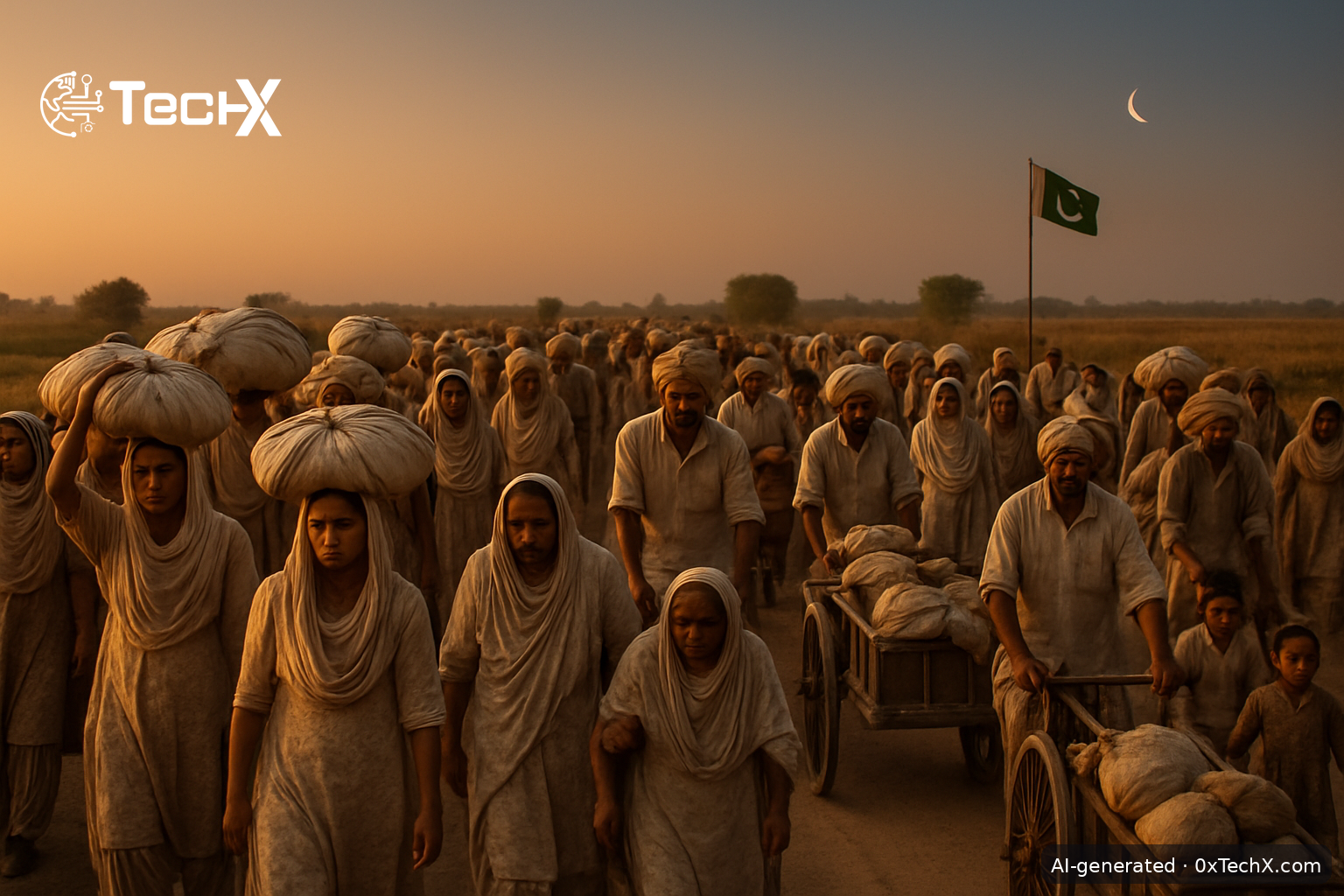
What followed was a human movement of staggering scale. Around 12 to 15 million people crossed the new borders in the weeks and months around independence, Muslims heading towards Pakistan, Hindus and Sikhs heading towards India. Historians widely describe this as the largest mass migration in recorded human history. These were not soldiers or politicians. They were farmers, teachers, shopkeepers, mothers, grandfathers, and newborn babies.
They travelled however they could. Many walked for weeks. Others packed themselves onto bullock carts piled high with whatever belongings they could carry. The lucky ones found space on trains, though the trains themselves became scenes of unimaginable tragedy. Overcrowded beyond any safe limit, with people clinging to the outsides of carriages and sitting on rooftops, these trains were sometimes attacked by mobs. Some trains arrived at their destinations carrying only corpses. People came to call them “ghost trains.”
The violence and loss of life during this period was devastating. Estimates of those who died vary, but credible historical sources suggest that somewhere between several hundred thousand and one million people lost their lives to violence, illness, and exhaustion during the migration. Entire families were separated, never to find each other again. Women suffered terribly. The pain of 1947 left scars that many families still carry today, quietly, across generations.
What the Muhajirs Carried, and What They Built
The people who migrated to Pakistan are honoured with the name muhajir, a word drawn from Islamic history, meaning one who migrates for a higher purpose. They arrived in a new country that was barely a few weeks old. There were no properly functioning government offices, no ready-made cities, no guaranteed shelter. Pakistan itself was in a state of emergency, struggling to absorb the flood of new arrivals while building a nation from scratch at the same time.
Yet these millions settled, rebuilt, and contributed. The muhajirs who came to Karachi, Lahore, Hyderabad, Multan, and hundreds of smaller towns brought with them their skills, their languages, their knowledge, and their unbreakable will. Traders set up shops. Doctors opened clinics. Teachers found classrooms. Farmers tilled new soil. Poets wrote about what they had lost, and what they hoped to gain. Within a generation, these families had woven themselves into the very fabric of Pakistani society.
Their sacrifice, of homes, of belongings, of loved ones, and for many, of their own lives, is the foundation upon which Pakistan stands. Pakistan Independence Day, at its deepest level, is a tribute to them.
Keeping Their Stories Alive: Technology and Memory
One of the most meaningful modern efforts connected to Pakistan Independence Day is the work being done to preserve the voices of those who actually lived through 1947. Organisations like the Citizens’ Archive of Pakistan (CAP) and the 1947 Partition Archive have worked to collect oral histories, recorded interviews with elderly survivors who remember the migration firsthand. These digital archives hold thousands of testimonies, ensuring that the personal stories of 1947 are not lost when the last generation of eyewitnesses is gone.
The Citizens’ Archive of Pakistan even mounted an exhibition at Karachi’s Mohatta Palace Museum that recreated the experience of a train journey from India to Pakistan, bringing the stories of migrants to life for younger Pakistanis. These efforts remind us that technology is not just about smartphones and startups, it can also be a tool for honouring history and keeping national memory alive.
For young Pakistanis today, platforms like YouTube, Instagram, and podcasts have become new ways to discover and share these stories. Dadi’s account of crossing the border. Nana’s memory of leaving Amritsar. The black-and-white photograph of an ancestor stepping off a train in Lahore with nothing but a cloth bundle. These fragments of family memory are now being shared more widely than ever before, connecting a new generation to the sacrifices that gave them their country.
What Independence Day Means Today
Pakistan Independence Day today is a celebration full of colour and pride, flag-raising ceremonies at government buildings, military parades in Islamabad, special prayers in mosques, patriotic songs on every channel, and the green glow of decorative lights from Khyber to Karachi. Children dress in national colours. Families gather. The whole country feels united.
All of this is wonderful. But the celebrations mean even more when we remember their deeper purpose: to honour a dream that millions of people paid for with everything they had. The muhajirs of 1947 did not know if they would survive the journey. They did not know what waited for them on the other side. They walked forward anyway, because they believed in Pakistan.
On this Pakistan Independence Day, when you hoist a flag or sing the national anthem, spare a moment’s thought for that grandfather who walked through Punjab in the August heat. For that grandmother who held her children close on a crowded train. For the families who lost members they never found again. Their sacrifice is woven into every thread of our green flag.
Frequently Asked Questions
When is Pakistan Independence Day celebrated?
Pakistan Independence Day is celebrated every year on 14 August. This marks the day in 1947 when Pakistan became an independent sovereign nation, free from British colonial rule, with Quaid-e-Azam Muhammad Ali Jinnah as its first Governor-General.
How many people migrated during the 1947 Partition?
Historians estimate that approximately 12 to 15 million people crossed the borders between India and Pakistan in the weeks around independence in 1947, making it widely regarded as the largest mass migration in recorded human history. Muslims moved towards Pakistan, while Hindus and Sikhs moved towards India.
What were the sacrifices made by the people who migrated to Pakistan?
The people who migrated, known as muhajirs, left behind their homes, ancestral lands, businesses, and in many cases, family members they were separated from and never saw again. Many lost their lives on the journey. Those who survived arrived in a brand-new country with very little and had to rebuild their entire lives from scratch.
How are the stories of 1947 being preserved today?
Several organisations, including the Citizens’ Archive of Pakistan (CAP) and the 1947 Partition Archive, have used digital recording technology to collect thousands of oral history testimonies from elderly survivors. These archives ensure that personal stories from the migration of 1947 are preserved for future generations of Pakistanis.
Pakistan Zindabad, Long Live Pakistan
78 years on, Pakistan stands as a living testament to the courage and sacrifice of the people who crossed oceans and rivers and borders to build it. Our celebrations on Pakistan Independence Day are most meaningful when they carry the weight of that history. Remember those who gave everything. Build on what they left behind. And with pride and gratitude in your heart, Pakistan Zindabad.
- How the Demand for Pakistan Began, The Story Behind Independence Day
- How Pakistan Won Its Independence on 14 August 1947
- Part 3: Pakistan Independence Day Heroes of the Independence Movement
- Part 4: The Partition, the Migration, and the Birth of a Nation
- Part 5: The Green Flag and the Anthem That Gave Pakistan Its Voice
- Part 6: Quaid-e-Azam’s Dream for Pakistan and What It Means for Us Today
Disclaimer: This article has been compiled from information publicly available on the internet and from published sources. The featured image is AI generated and is for illustration only. If you notice anything that needs correction, please contact us.