The price of Subaru’s first all-electric vehicle, the Solterra SUV, has been revealed. The vehicle, which, like most Subarus, comes standard with all-wheel drive, will start at $44,995, with the “Limited” and “Touring” versions costing $48,495 and $51,995, respectively.
A destination and delivery fee of $1,225 will be added to all models, raising the price out the door even more.
According to Subaru, the Solterra will have a range of “up to 228 miles” and will be able to charge 80 percent of its battery in under an hour.
While the Limited and Touring variants have extras such as roof rails, wireless charging, and a glass roof, there is currently no option to increase the vehicle’s range, which many other manufacturers provide.
That’s a little hard for someone who is devoted to their Subaru Outback. The Solterra’s “go-anywhere” capabilities is touted by the company, yet my favourite backpacking destination is 108 miles away, with a single level two charger available anywhere along the two-ish hour trek.
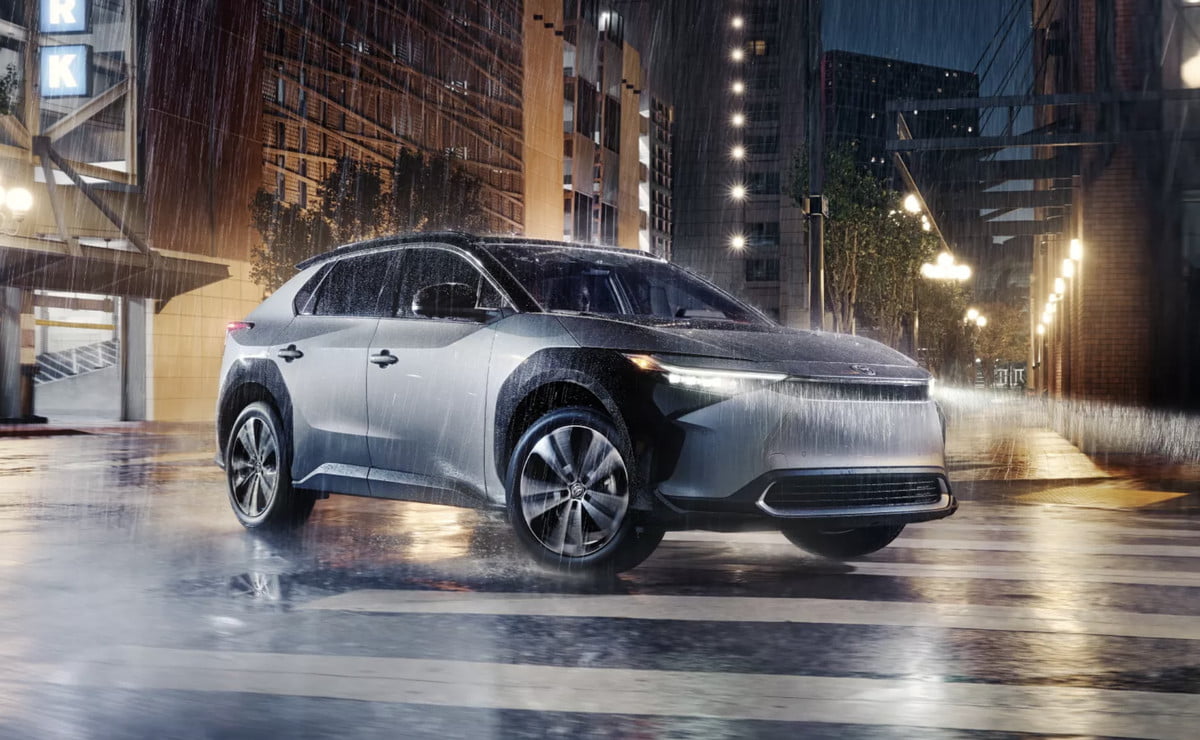
The Toyota bZ4X, which starts at $42,000 for a front-wheel-drive vehicle, shares the same architecture as the Solterra. You’ll have to spend an extra $2,000 for all-wheel drive on the bZ4X, but it’ll still be $1,000 less than Subaru’s equivalent.
Of course, the Solterra and the bZ4X are not the same vehicle. Yes, they have similar or almost equivalent ranges, X-Mode off-road assistance, and infotainment systems (at least when comparing the AWD variants), but Subaru’s vehicle has 0.2 inches more ground clearance.
There are a few stylistic differences between the two vehicles (aside from the fact that they’re available in different colours), particularly around the front; I prefer the Solterra’s headlights and grille, though I’m not sure why.
Tax credit
When comparing costs between the Solterra and the bZ4X, there is a difficulty. Subaru claims that its electric vehicle will qualify for a $7,500 federal tax credit.
While that option is presently available for Toyota consumers, given the company’s large number of electrified vehicles, it is unlikely to remain available for long.
Toyota executives forecast that by October 2022, buyers of the bZ4X will only be eligible for a $3,750 tax credit, and that the incentive will be phased out completely the following year.
Given that Toyota expects relatively limited availability for the bZ4X, getting one before the tax benefits expire may be difficult. If that’s the case, the Solterra’s higher beginning price may become less of a concern.
People will very certainly compare Subaru’s offering against EVs such as the $40,900 Kia EV6, $33,500 Chevy Bolt EUV, $42,690 Tesla Model 3, and possibly even the Rivian.
None of these are ideal comparisons: the Model 3 doesn’t qualify for the tax credit, and getting AWD costs an extra $9,000 (though it does increase the range to a comfortable 334 miles), and the Kia and Chevy aren’t as tough.
It’s also worth noting that, while several manufacturers have electric vehicles on the market, actually purchasing one is now difficult.
Electric vehicles are subject to the same general shortages that make it difficult to find cars in stock, and dealers have been known to slap hefty markups on them. However, it’s difficult to predict if the Solterra will follow suit.
To read our blog on “Chevrolet is making a Corvette that is all electric,” click here