

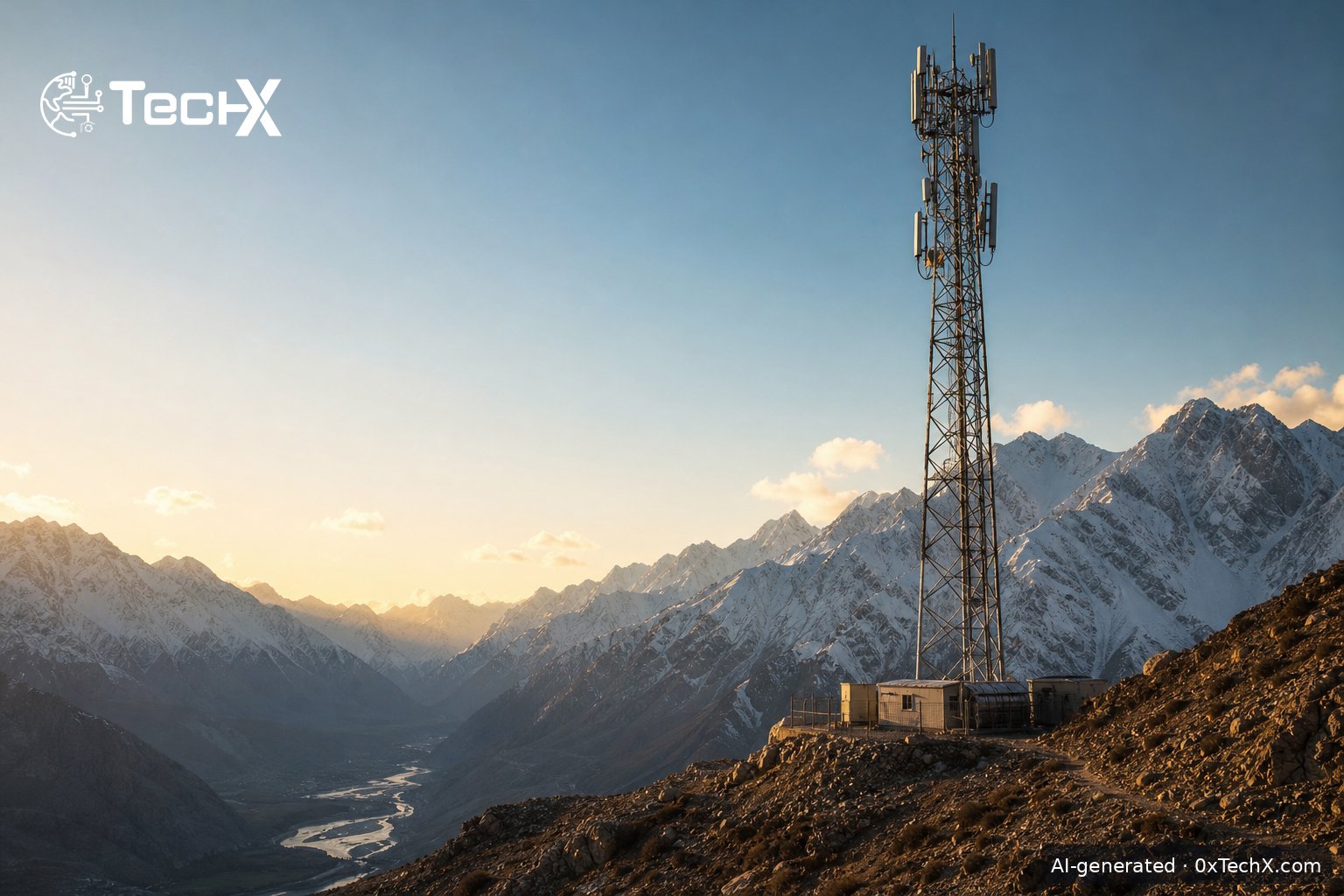
The Kohistan telecom expansion is now a priority for Pakistan’s government as it moves to bring reliable mobile and internet services to one of Khyber Pakhtunkhwa’s most cut-off mountainous regions. Independent News Pakistan (INP) reported on 23 November 2026 that the government is stepping up its rollout to bridge the connectivity gap in Kohistan, a district where basic digital access has long been out of reach for most residents.
Why Kohistan Is So Far Behind on Connectivity
Kohistan sits deep in the mountains of KP, bordered by high peaks and narrow river valleys that make building telecom towers and laying fibre cable extremely difficult and expensive. The challenge is not just geography. Kohistan’s literacy rate hovers around 20%, among the lowest in Pakistan. In Khyber Pakhtunkhwa, Kohistan sits at the very bottom for digital device ownership, with only 2% of households having even one facility such as a computer, laptop, or tablet.
On the ground, the signal situation is stark. In remote areas such as Kohistan, 2G remains the only option for making basic calls and SMS. That means no video calls, no mobile banking, no online classes, and no e-government services for most people living there. A student from the region has to travel kilometres just to find a usable signal.
How the Kohistan Telecom Expansion Will Work
The main engine behind this push is Pakistan’s Universal Service Fund (USF), a government body that collects contributions from telecom operators and uses them to fund connectivity projects in areas that the private market alone would not serve. The USF has been expanding broadband and fibre connectivity in underserved and rural areas, working to narrow the digital divide and promote regional economic integration.
This is not the first time Kohistan has been targeted. A previous project brought 3G to parts of the district, but coverage remained patchy. The USF disbursed Rs 9.5 billion over the 2021-2025 period for telecom projects in Khyber Pakhtunkhwa, covering 2G, 3G, and 4G services across 1,600 mauzas and deploying 1,159 kilometres of optical fibre cable to connect 67 tehsil headquarters, union councils, and towns.
Now the government is pushing harder. The USF Policy Committee has approved a Rs 32.90 billion budget for fiscal year 2026-27 to expand digital connectivity in unserved and underserved areas across Pakistan. The USF currently has 28 projects under implementation, including 17 Next Generation Broadband Service Delivery mobile broadband projects and 11 Next Generation Optical Fiber Network Services projects.
At the national level, the government also plans to go much further. Pakistan plans to lay 3,809 kilometres of optical fibre cable to connect 459 unserved union councils and towns, with Rs 30.8 billion in telecom projects expected to bring connectivity to around 2.8 million people.
The Bigger Picture: Pakistan’s Urban-Rural Divide
Pakistan’s headline numbers look impressive. Pakistan recorded 166.12 million broadband subscriptions in July 2026, with mobile broadband accounting for 161.71 million connections, or about 97% of the total. But those numbers hide a deep split between cities and mountains. Rising national totals do not mean every area has dependable internet, with three recurring barriers in underserved locations: weak commercial viability, unreliable electricity, and limited backhaul infrastructure.
Meanwhile, urban Pakistan is already testing 5G. Pakistan conducted its largest-ever spectrum auction in March 2026, acquiring 480 MHz of spectrum for $509 million, and within six months, 5G services had been launched at more than 1,700 sites across 24 major cities. Kohistan and similar mountain districts are nowhere near that stage yet.
Regulators are also finalising a framework for satellite communications and licensing to facilitate direct-to-device services, which could eventually help the most remote valleys that are simply too hard to reach with traditional towers and cable.
Pakistan’s growing focus on digital inclusion is also visible in international partnerships. The country’s digital expansion goals, including the Pakistan 50-in-5 campaign that recently added global partners, show how seriously the government is treating connectivity as an economic priority, not just a tech goal.
What Real Connectivity Means for Kohistan Residents
For people in Kohistan, a working mobile signal is not a luxury. It means a student can attend an online class without travelling hours to a town. It means a farmer can check prices before selling crops. It means a mother can call a doctor for advice instead of making a full-day journey to the nearest hospital. For many citizens living in remote and underserved areas, connectivity now determines access to opportunity and information.
The Kohistan telecom expansion must also overcome the electricity problem. Many remote mountain areas have unreliable power, which makes running a base station around the clock very hard. The government has flagged this. Additional measures focus on energy efficiency and dedicated power solutions for telecom infrastructure to ensure reliable services nationwide.
The Pakistan Telecommunication Authority (PTA) oversees all licensed operators and monitors coverage targets. Under the USF model, operators that win project contracts must meet network verification standards before they receive payment, which keeps them accountable for actually delivering the signal, not just promising it.
Frequently Asked Questions
What is the Kohistan telecom expansion?
It is a government-backed programme to bring mobile and broadband internet services to Kohistan, a mountainous district in Khyber Pakhtunkhwa that currently has very limited network coverage. The Universal Service Fund finances the rollout by subsidising telecom operators to build towers and lay fibre cable in areas that would not attract private investment on their own.
Which body is funding the Kohistan telecom project?
Pakistan’s Universal Service Fund (USF), which sits under the Ministry of Information Technology and Telecommunication, is the main funder. USF projects follow a turnkey service model, where telecom operators handle the design, procurement, site acquisition, installation, and commissioning of networks. Third-party audits confirm work before payments are made.
When will Kohistan get reliable 4G internet?
No single public deadline has been announced for full 4G coverage in Kohistan. The USF’s FY2026-27 budget covers ongoing and new projects across all underserved regions. Given the terrain and infrastructure challenges, a phased rollout is expected, likely starting with key town centres before expanding to villages.
Why do private telecom companies not build in Kohistan on their own?
Commercial viability, electricity constraints and weak backhaul continue to leave coverage gaps in areas like Kohistan. The return on investment is too low for companies to build there without a government subsidy, which is exactly the gap that the USF was created to fill.