Part 5 of 14 in our Independence Day series.
Youm-e-Azadi: A Day Woven in Green and White
Every year on 14 August, Pakistan comes alive in green and white. Flags flutter from rooftops, cars, school gates, and balconies. The Qaumi Taranah plays on every loudspeaker, and for a few shining moments the whole country seems to beat with one heart. But have you ever stopped to think about the stories behind these two symbols, the flag we raise and the anthem we sing? On this Independence Day, let us take you back to where it all began.
14 August 1947: A Nation Is Born
Pakistan came into being on 14 August 1947, marking the end of British colonial rule and the birth of a homeland for the Muslims of the subcontinent. The journey to this day was driven by the vision of Quaid-e-Azam Muhammad Ali Jinnah, the Tehreek-e-Pakistan, and countless men and women who gave everything they had for a free future. That Independence Day was not just a political event, it was the fulfilment of a dream carried in the hearts of millions.
Interestingly, 14 August 1947 also fell on the 27th of Ramadan in the Islamic calendar, a date regarded as deeply sacred by Muslims, making the moment feel all the more meaningful for the new nation.
The Story of the Pakistani Flag
The Parcham-e-Sitara-o-Hilal, our Flag of the Star and Crescent, is one of the most recognisable flags in the world. But few people know the name of the man who designed it.
Syed Amir-uddin Kedwaii was a Pakistani barrister, politician, and independence activist who is credited with designing the national flag of Pakistan. He studied the flag of the All-India Muslim League and used it as his starting point. The League’s flag already carried the deep green field with a crescent and star, a rallying symbol for Muslim India. Kedwaii’s key addition was bold in its simplicity: a vertical white stripe at the hoist end of the flag, to make clear that minorities would stand alongside the Muslim majority in the new Pakistan.
The flag was formally adopted by the Constituent Assembly of Pakistan on 11 August 1947, just three days before independence. Quaid-e-Azam Muhammad Ali Jinnah approved the design, and it became the official flag of the new nation on the birth of Pakistan.
There is also the unsung hero who actually stitched the flag. Master Afzal Hussain, later known with great affection as Baba-e-Parcham (Father of the Flag), was a humble tailor from Delhi who, together with his younger brother Altaf Hussain, stitched the very first flag of Pakistan. His story was not well known for many years, but the fabric of his work had already been immortalised in history. He passed away in Karachi on 15 July 1987.
There is also a proud footnote to the flag’s story: in the final days before independence, there were suggestions to add the Union Jack to the canton of the flag, as had been done in other newly independent dominions. Quaid-e-Azam refused outright. This flag would carry no mark of colonial rule, its symbols would belong wholly to Pakistan.
What the Flag’s Colours and Symbols Mean
- Dark Green: Represents the Muslim majority of the country.
- White Stripe: Represents the religious minorities, a promise that they are equal citizens of Pakistan.
- The Crescent: A symbol of progress.
- The Five-Pointed Star: A symbol of light and knowledge.
Together, every element of the flag tells the same story: a nation built on faith, unity, and a promise of a better tomorrow for everyone who calls it home.
The Qaumi Taranah: A Song Waited Seven Years
You may be surprised to learn that when Pakistan became independent on 14 August 1947, the nation did not yet have an official national anthem with words. Finding the right melody and the right poetry to represent a new country was not a small task, and it took years of careful work.
In December 1948, the government of Pakistan established the National Anthem Committee (NAC) and gave them the important task of creating the official Qaumi Taranah. The committee received music and poetry from composers and poets across the country.
The melody came first. Ahmed Ghulam Ali Chagla, a Pakistani musician and composer born in Karachi, composed the tune that would become the national anthem in 1949. His composition was selected by the NAC and formally approved. For a time, this tune was played as an instrumental, without any words at all. It is said the anthem was played without lyrics for the first time when the Shah of Iran visited Pakistan in 1950, because the nation needed something to play for a visiting head of state and the lyrics were not yet ready.
Finding the words took even longer. The committee invited renowned poets from across Pakistan to submit lyrics, a competition that drew 723 entries. From all of those submissions, the words written by Abu Al-Asar Hafeez Jalandhari were chosen in 1952 as the best fit for Chagla’s majestic melody.
Finally, on 13 August 1954, the Qaumi Taranah was broadcast for the very first time on Radio Pakistan, with both music and lyrics, sung by the poet Hafeez Jalandhari himself. It was officially adopted as Pakistan’s national anthem on 16 August 1954 by the Ministry of Interior. From that day forward, the anthem has opened every important moment in Pakistan’s national life.
Sadly, Ahmed Ghulam Ali Chagla did not live to see the anthem officially adopted, he passed away in February 1953. His contribution remains one of the most enduring gifts any Pakistani has given to the country.
How Pakistan Celebrates Independence Day Today
On every 14 August, the Qaumi Taranah and the green-and-white flag come together in celebrations from Karachi to Khyber. The main Independence Day ceremony is held in Islamabad, where the national flag is hoisted at the Presidential and Parliament buildings, followed by the national anthem and speeches by the President and Prime Minister. Across the country, flag-hoisting ceremonies, parades, cultural programs, and fireworks mark the day with joy and pride.
And in the digital age, the celebrations have gone far beyond the streets. Millions of Pakistanis share the flag and the anthem on WhatsApp, Instagram, and X (formerly Twitter), flooding timelines with green and white on every Independence Day. Pakistani communities around the world, from London to Toronto to Dubai, hold their own events, proving that the love of this flag and this anthem crosses every border.
On 14 August 2026, Pakistan will celebrate its 79th Independence Day, a moment to reflect on how far we have come and how much more we can build together.
Frequently Asked Questions About Pakistan’s Independence Day
Who designed the flag of Pakistan?
The national flag of Pakistan was designed by Syed Amir-uddin Kedwaii, a Pakistani barrister and independence activist. He based the design on the flag of the All-India Muslim League, adding the white vertical stripe to represent Pakistan’s religious minorities. The flag was adopted by the Constituent Assembly on 11 August 1947.
Who composed the music and wrote the words of the Qaumi Taranah?
The music of Pakistan’s national anthem was composed by Ahmed Ghulam Ali Chagla in 1949. The lyrics were written by the famous poet Abu Al-Asar Hafeez Jalandhari in 1952. The anthem with both music and words was first broadcast on Radio Pakistan on 13 August 1954, and officially adopted on 16 August 1954.
What do the colours and symbols on the Pakistani flag represent?
The dark green field represents the Muslim majority of Pakistan. The white vertical stripe at the hoist represents religious minorities. The crescent moon is a symbol of progress, and the five-pointed star stands for light and knowledge.
Why is Pakistan’s Independence Day celebrated on 14 August?
Pakistan’s Independence Day is celebrated on 14 August because on this date in 1947, the transfer of power formally took place and Pakistan became an independent nation, free from British colonial rule. The date also coincided with the 27th of Ramadan in the Islamic calendar, a day of great spiritual significance.
Pakistan Zindabad
Every time we raise the green and white flag and let the notes of the Qaumi Taranah fill the air, we are honouring the vision of Quaid-e-Azam, the artistry of Kedwaii and Chagla, the poetry of Hafeez Jalandhari, and the quiet dedication of men like Master Afzal Hussain who stitched that first flag with their own hands. These are not just symbols, they are a promise, renewed every Independence Day, that this nation will keep moving forward. Here is to 79 years of Pakistan, and to all the years still to come. Pakistan Zindabad.
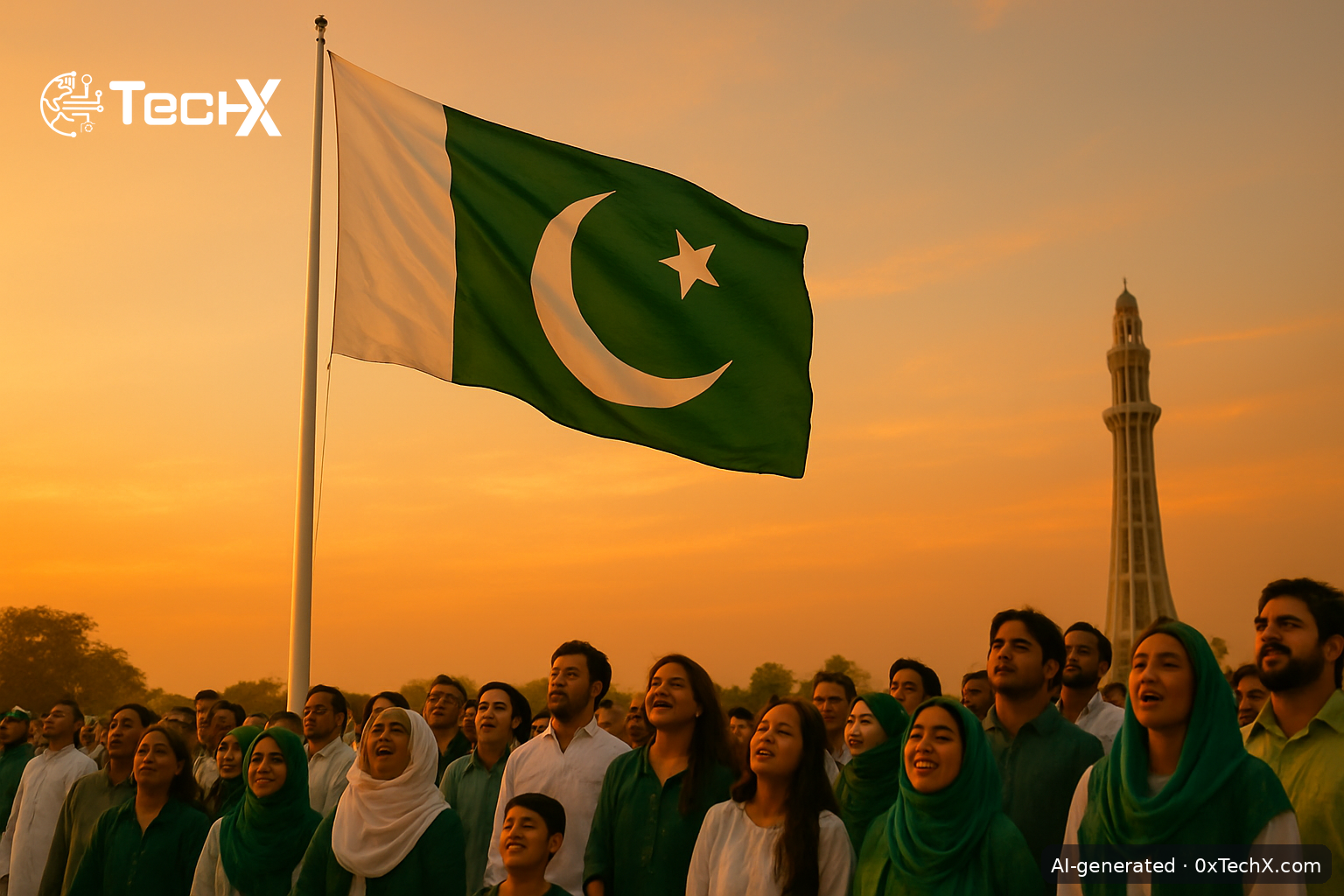
Disclaimer: This article has been compiled from information publicly available on the internet and from published sources. The featured image is AI generated and is for illustration only. If you notice anything that needs correction, please contact us.