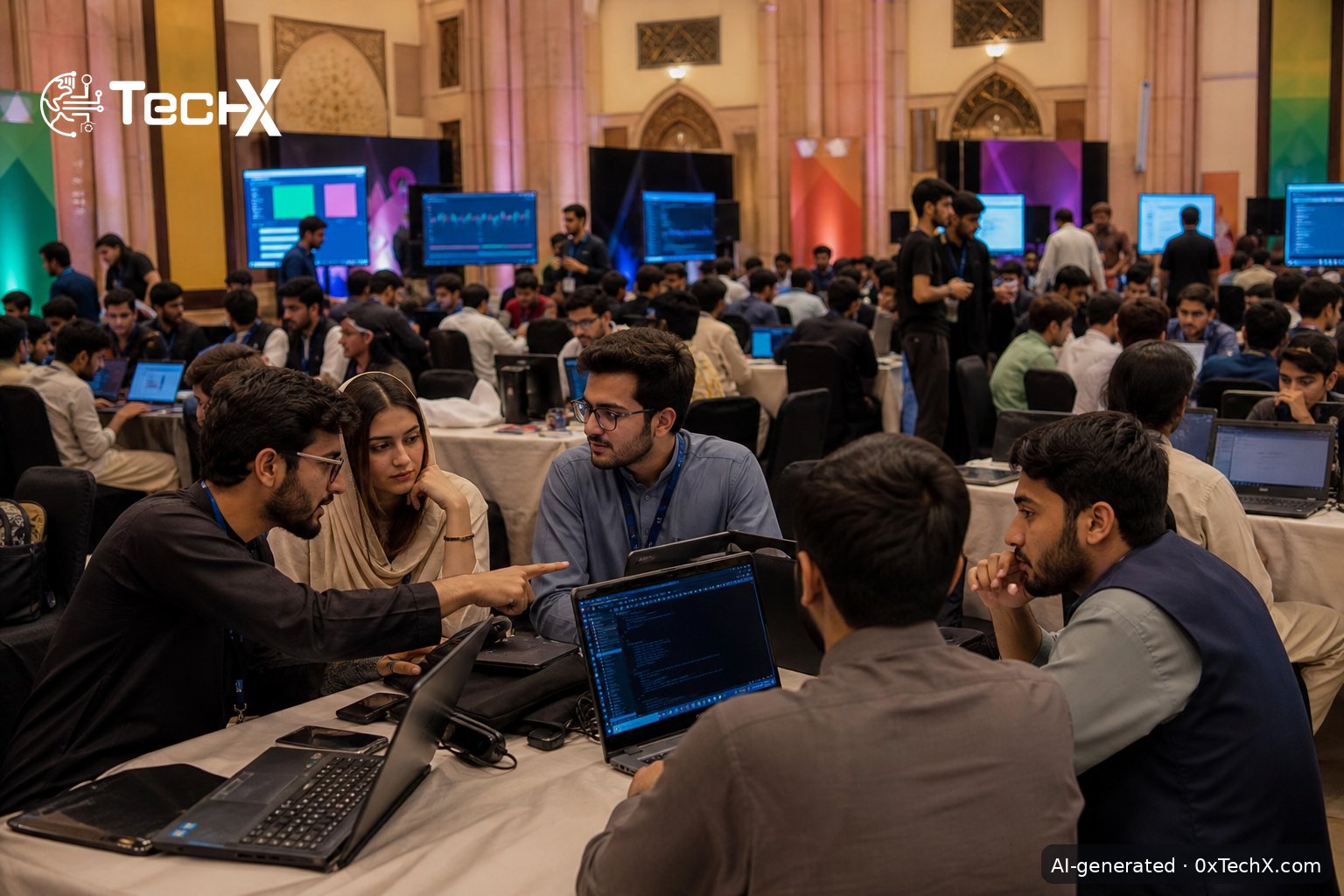
The Pakistan AI hackathon of 2026 has wrapped up, and the numbers tell a clear story about where local tech talent is heading. The Alibaba Cloud AI Hackathon Pakistan 2026 held its grand finale on October 24 at the Pak-China Friendship Centre in Islamabad, drawing 749 finalists who presented 300 working AI projects and competed for a $60,000 prize pool, making it the largest AI competition the country has held so far.
How the Pakistan AI Hackathon Was Structured
The event was organised by Alibaba Cloud, the cloud computing and AI arm of China’s Alibaba Group, in collaboration with Alkhidmat Foundation Pakistan’s Bano Qabil initiative and Cognix. Rather than a single-day sprint, the programme ran three regional rounds: Karachi on 3 October, Islamabad on 11 October, and Lahore on 17 October, before the top teams moved to the national finale in Islamabad.
The competition attracted more than 16,000 applications nationwide, with 749 participants presenting 300 AI projects at the final stage after qualifying through those regional rounds. That funnel, from 16,000 hopefuls down to 749 finalists, shows both the depth of interest and how seriously the organisers filtered for quality.
Six Problem Areas Teams Had to Solve
This was not an open-ended code-fest. Finalists presented AI-powered solutions across six categories: smart agriculture, healthcare, education, financial inclusion, Urdu and regional language technology, and open innovation. The Urdu and regional language track is the one most other coverage skips over, but it may be the most locally significant. Building AI tools that work in Urdu, Sindhi, Punjabi, or Pashto breaks the language barrier that keeps millions of Pakistanis away from digital services.
The competition focused on building working AI products rather than merely presenting ideas, with participants receiving structured training, mentorship, and access to AI development tools. Teams also got AI tools and cloud credits at no charge, which matters a lot for students and early builders who cannot afford costly compute.
From Users to Builders, the Bigger Shift
The real signal here is not just the prize money. Bano Qabil Pakistan CEO Shahid Iqbal said the hackathon aimed to shift youth from merely using AI to creating solutions for local and global challenges. That is a phrase worth sitting with. Pakistan has hundreds of thousands of young people who use AI tools every day, ChatGPT for essays, image generators for design work, coding assistants for freelance projects. The hackathon pushed them to go one step further: to build something new with those tools, something that solves a real problem for a Pakistani user.
The competition reflects wider efforts to strengthen Pakistan’s digital talent. AI applications in financial inclusion could help explore ways to improve access to services, while locally developed tools may address specific needs in agriculture, education, and healthcare. These are not abstract use cases, they map directly to where Pakistan’s biggest development gaps sit.
For more on Pakistan’s growing AI collaboration landscape, see how COMSATS and NERA Pakistan teamed up on AI and cybersecurity as another example of institutions trying to grow local capability.
What Happens Next for Finalist Teams
Winning a hackathon is one thing. Getting a product to market is another. The organisers built in steps beyond the prize table. Selected projects are put in front of investors, industry leaders, and international technology partners, framed as a launchpad, not a finish line. Teams also received mentorship, incubation support, and commercialisation opportunities through collaboration with government entities and industry partners.
That investor-facing pipeline is what separates a mature hackathon from a one-day coding event. It suggests the organisers want at least some of these 300 projects to become real companies. Given that the Alibaba Cloud partnership brings global network access, a strong finalist project here has a realistic path to more than local recognition.
Pakistan’s government has also pushed AI in its own way. The Uraan AI Techathon under the Ministry of Planning is another national initiative running alongside private-sector efforts like this one, showing that both public and private players now see AI talent development as a priority.
Why the Scale of This Hackathon Matters
Numbers in isolation can look impressive without meaning much. But 16,000 applications for a free, nationwide AI competition, in a country where broadband quality is still uneven and many participants had to travel to regional venues, is a real signal of demand. It also shows what happens when participation is made accessible: no entry fee, free cloud credits, and no prior coding experience required, with no-code and low-code tools provided so builders could create working prototypes easily.
The Pakistan AI hackathon ecosystem is now running multiple large events in a single year, from this Alibaba Cloud competition to Google AI Seekho, UBL’s banking hackathon, and government-backed techathons. Each one adds a new cohort of builders with real project experience. Over time, that cohort becomes the talent pool that startups, IT exporters, and multinationals hire from.
Frequently Asked Questions
What was the Alibaba Cloud AI Hackathon Pakistan 2026?
It was the largest Pakistan AI hackathon of 2026, organised by Bano Qabil Pakistan, Alibaba Cloud, and Cognix Solutions. It drew over 16,000 applicants, narrowed down to 749 finalists presenting 300 AI projects, and held its grand finale on October 24 in Islamabad.
What categories did teams compete in?
Teams built AI solutions across six tracks: smart agriculture, healthcare, education, financial inclusion, Urdu and regional language technology, and open innovation. The Urdu language track was a notable local-first addition not common in most international hackathons.
How big was the prize pool?
The prize pool for this Pakistan AI hackathon was $60,000, making it the largest cash prize offered at a Pakistani AI competition to date. Winners also received Alibaba Cloud credits, mentorship, and access to investor networks.
Who could take part in the hackathon?
Students, graduates, developers, designers, researchers, and early-stage teams from across Pakistan were all eligible. Participation was free and no prior coding experience was required, which helped open the door to a much wider range of participants than typical tech competitions.