

E-Band spectrum in Pakistan has now been formally assigned to all four cellular mobile operators (CMOs), Jazz, Zong, Telenor, and Ufone, as the government races to shore up the backhaul infrastructure that 5G networks need to actually deliver fast speeds to users. The move, confirmed by the Pakistan Telecommunication Authority (PTA), comes just months after the country’s landmark 5G spectrum auction in March 2026.
Backhaul is the part of a mobile network that carries data from a tower back to the main network. Think of it as the highway between a cell tower and the internet. Without a wide enough highway, even the most advanced 5G radio equipment cannot deliver the fast speeds and low delays that 5G promises.
What Is E-Band Spectrum and Why Does Pakistan Need It?

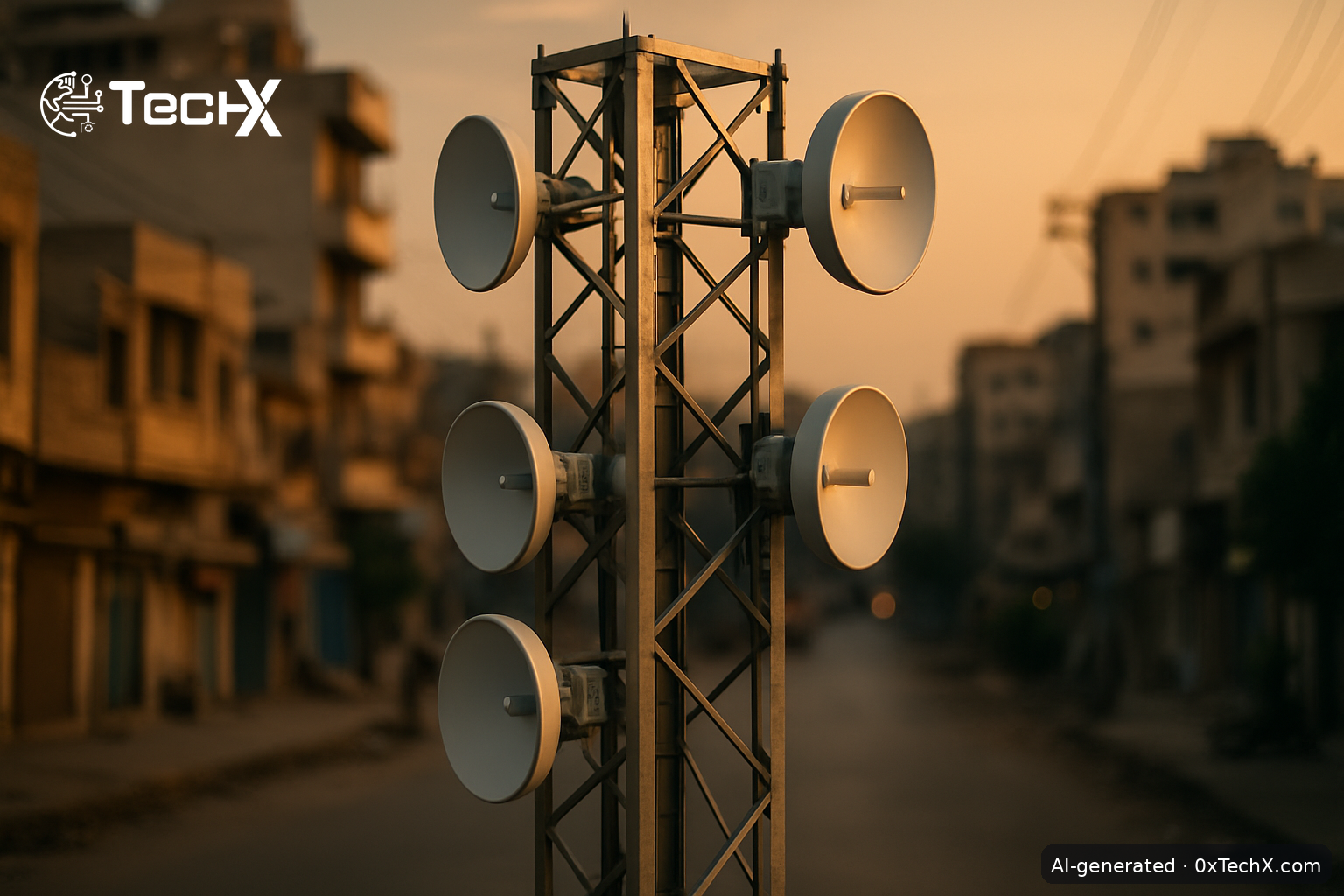
E-Band refers to the millimeter-wave radio frequency range between 71 GHz and 86 GHz. Operating in the higher frequency ranges of between 71 GHz and 86 GHz, and coupled with wide channel sizes, E-Band wireless links can support more than 10 Gbps capacities with low latency. To put that in context, a single E-Band radio link can carry enough data to stream thousands of HD videos at the same time, making it a strong wireless match for what fiber cables normally do.
E-Band technology provides high-capacity wireless backhaul and can connect mobile towers over short distances at very high speeds. It is particularly useful in urban areas, difficult terrain, or locations where fiber infrastructure is not readily available. Pakistan has plenty of all three, crowded city centres where digging roads is expensive, mountainous areas in KPK and GB, and rural zones where fiber simply has not arrived yet.
E-Band connections can carry large volumes of data between telecom towers and network facilities, providing an alternative in areas where laying fiber is expensive, technically difficult, or delayed. However, wireless backhaul is generally viewed as a complementary solution rather than a complete replacement for fiber, particularly in high-traffic areas requiring long-term capacity. So think of E-Band as the bridge Pakistan needs right now, while the longer-term fiber buildout continues.
A practical bonus: no additional spectrum charges are being imposed for the E-Band assignment. That removes a financial barrier and lets operators deploy faster without new regulatory fees eating into their 5G investment budgets.
Where Each Operator Stands on the Fiber Target
The E-Band move is urgent because Pakistan’s tower fiberization is still well below the Phase-I target set under 5G license conditions. The current tower fiberization level across Pakistan’s mobile sector is approximately 17.9 percent. That figure has improved, fiberization of mobile network sites in Pakistan rose by 3.1 percentage points over the past year, reaching 17.9 percent in 2025, up from 14.8 percent in 2024, but it is still not enough.
Under the NGMS/5G licence conditions, all cellular mobile operators are required to raise their Fiber-to-the-Site (FTTS) ratio to at least 20 percent during Phase-I (2026-28), with the target increasing to 35 percent by Phase-IV (2032-35) to ensure sufficient backhaul capacity for expanding 5G networks.
Here is how each operator breaks down:
- Jazz, 22%. Jazz currently leads the sector with 22% tower fiberization, making it the only operator to have crossed the initial 20% benchmark. Jazz is in good shape for Phase-I but cannot slow down as the targets rise.
- Zong, 19%. Zong requires a relatively limited expansion to meet the initial target. Just one percentage point away, this should be achievable quickly.
- Telenor, 16%. Telenor needs to add four percentage points of fiber coverage to reach the 20% line, a meaningful but manageable gap if investment comes in time.
- Ufone, 9%. Ufone remains furthest behind, with only 9% of its tower network fiber-connected. Ufone would need to more than double its current level to comply with the Phase-I requirement. This is the most serious gap in the industry.
The industry-wide average remains 2.1 percentage points below the first-phase benchmark, indicating that operators will need to accelerate investment as 5G coverage expands.
Why This Matters for Everyday Pakistani Users
Most people think 5G is just about getting a new SIM or a new phone. But the real bottleneck is what happens behind the scenes. Installing 5G radio equipment alone does not guarantee improved service. Without sufficient backhaul capacity, towers may struggle to handle increased traffic, potentially limiting speeds and network reliability during periods of high demand.
The fiber shortfall may also result in an uneven rollout, with operators initially concentrating investment in dense urban and commercially attractive areas where fiber infrastructure is already available. That means users in smaller cities and towns could wait much longer for real 5G performance, even if a 5G signal technically reaches them.
E-Band spectrum in Pakistan is therefore not just a technical update for engineers. It is a direct factor in whether a user in Multan, Peshawar, or Quetta ever gets a usable 5G connection, not just a 5G logo on their screen.
According to PTA officials, each telecom operator will decide where fiber deployment is the better option and where E-Band wireless backhaul is a more practical solution. That flexibility is key, operators can move fast in hard-to-wire areas rather than waiting months for civil work permits and road-digging to be finished.
What Happens Next
The Government of Pakistan is also facilitating the provision of Right of Way (RoW) through policy and administrative measures to improve the ease of doing business and accelerate network rollout across the country. Right of Way is a long-standing problem in Pakistan, getting permission to run cables under roads or across private land is slow and bureaucratic. Fixing that process, alongside the E-Band assignment, should help operators move faster on both the wireless and fiber fronts.
The combination of expanded fiber infrastructure and E-Band wireless backhaul is expected to strengthen Pakistan’s 5G infrastructure while improving the quality and coverage of next-generation mobile services.
For Ufone in particular, the E-Band option is a lifeline. Doubling fiber coverage from 9% to 20% in two years is a big ask. Using E-Band links where fiber is not yet available can help the operator stay compliant with its license conditions while the deeper infrastructure buildout continues in the background.
Frequently Asked Questions
What is E-Band spectrum in simple words?
E-Band is a high-frequency radio band (71, 86 GHz) used to send very large amounts of data wirelessly between two points, usually between two telecom towers or between a tower and a data centre. It works like a fiber cable but through the air, and can carry over 10 Gbps of data per link.
Why did Pakistan assign E-Band spectrum to telecom operators?
Pakistan’s 5G networks need fast backhaul connections between towers and the core network. Since fiber is expensive and slow to deploy in many parts of the country, E-Band provides a quicker wireless alternative. The Government of Pakistan has assigned E-Band spectrum to cellular mobile operators to support high-capacity wireless backhaul following the recent launch of 5G services. The move follows the PTA’s auction of 480 MHz of spectrum in March for next-generation mobile services.
Which operator is furthest behind on the fiber target?
Ufone is the most behind, with only 9% tower fiberization against a required 20% for Phase-I (2026-28). Jazz is the only operator that has already crossed the 20% mark, while Zong at 19% and Telenor at 16% are closer to the target.
Will 5G speed improve for users because of this E-Band move?
Yes, over time. E-Band backhaul means that more towers can handle the high data volumes that 5G generates. Without it, 5G towers in non-fiber areas would struggle under traffic load. With E-Band links in place, operators can deliver more consistent speeds to more users across more locations in Pakistan.