

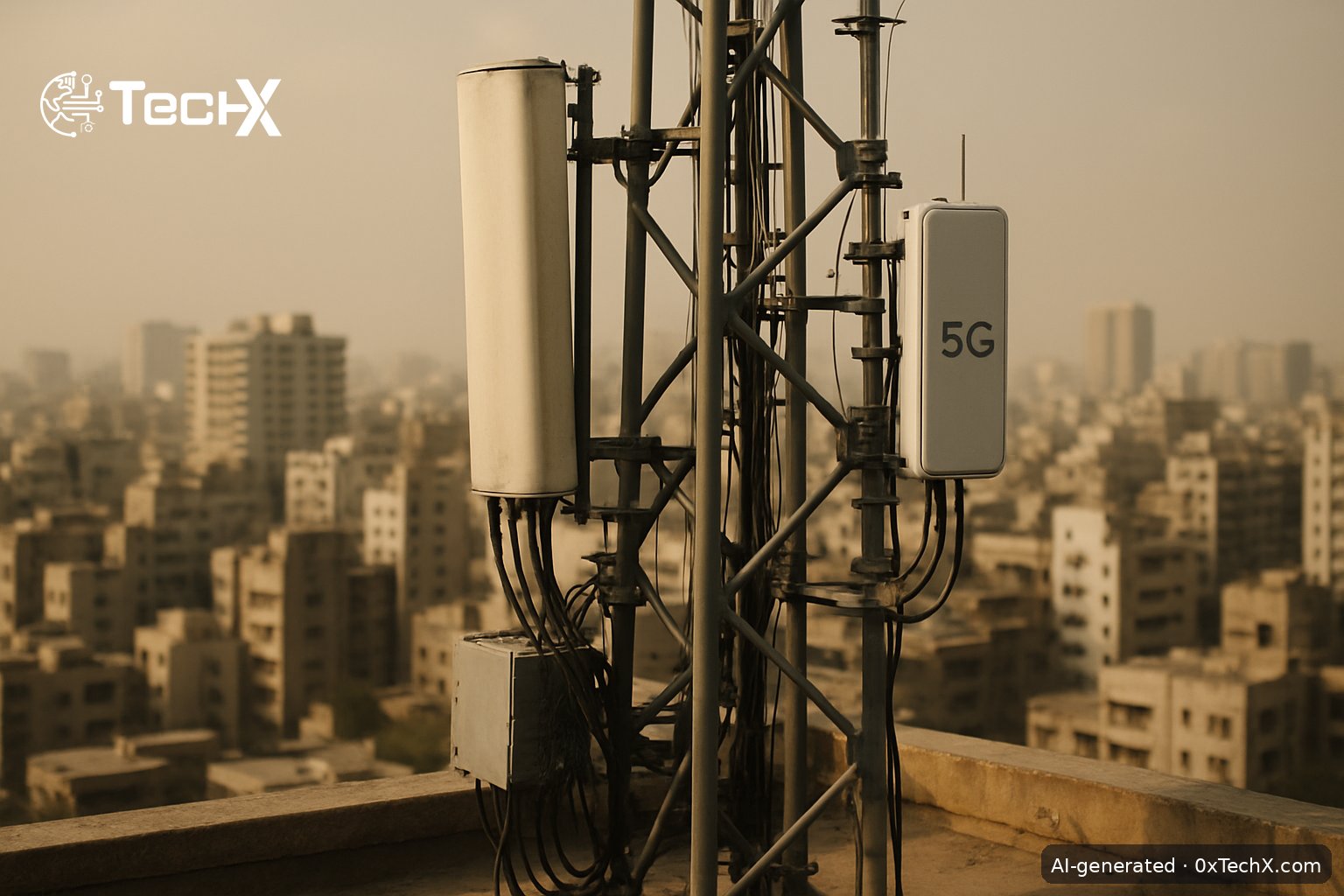
Pakistan 5G infrastructure, as it exists right now, is built on the same towers your 4G signal has always used. The Pakistan Telecommunication Authority (PTA) Chairman told a parliamentary committee in July 2026 that no dedicated new 5G hardware has been installed yet, and that proper new sites are still six to eight months away. If you bought a 5G phone expecting a big speed jump, this is the honest picture of where things stand.
What PTA Told Parliament About Pakistan 5G Infrastructure
PTA briefed the National Assembly Standing Committee on Information Technology and Telecommunication that telecom operators have launched 5G services in 22 cities under the first phase of the rollout, although no new 5G infrastructure has yet been deployed. The PTA Chairman confirmed that services have initially been enabled through existing mobile towers and network infrastructure.
He said dedicated new infrastructure would be deployed gradually in subsequent phases, which is expected to improve internet speed and service quality across the country over the next six to eight months. In plain words, the 5G label on your phone screen is real, but the hardware underneath it is the same old equipment your 4G call runs on today.
Pakistan currently has 449 active 5G tower sites distributed across 22 major cities. This first deployment does not depend on newly built infrastructure. Instead, Jazz, Zong, and Ufone are upgrading their 4G networks and mobile towers to push out initial 5G signals.
Why This Is Called Non-Standalone 5G
The technical term for this approach is Non-Standalone (NSA) 5G. It means the new 5G radio signal piggybacks on the existing 4G core network rather than running on a fully independent 5G system. Most countries that launched 5G early, including the US, UK, and South Korea, started the same way. NSA is cheaper and faster to switch on because towers are already standing. The tradeoff is that you do not get the ultra-low delay and peak speeds that true Standalone (SA) 5G can deliver.
Pakistan is following the same global playbook, but the gap between what consumers read in launch headlines and what they actually experience on their phones is real and worth understanding.
How Much Spectrum Has Pakistan Added?
PTA briefed the Committee that the total available spectrum in the country previously stood at 274 MHz; however, following the 5G spectrum auction, it has increased to 754 MHz, significantly enhancing network capacity. More spectrum means the network can carry more data at the same time, so congestion should ease even before new towers go up. This is a real, near-term benefit that the spectrum auction has already unlocked.
For more context on how telcos are trying to put 5G devices in Pakistani hands, read about the 5G phone installment plan that telcos are pushing alongside the rollout.
Karachi Gets Just 50 Active 5G Sites
Karachi currently has 50 active 5G sites, while Hyderabad has only three. One committee member warned that if deployment continues at the current pace, nationwide 5G rollout may not be completed until 2035, by which time the technology could already be outdated.
The committee, chaired by Syed Amin-ul-Haq, expressed serious concern over the poor state of internet and mobile services, observing that connectivity problems were no longer limited to remote regions and were also affecting major urban centres, including Karachi. This matters because Karachi is Pakistan’s economic engine. Slow internet in the city hurts businesses, freelancers, and students every single day.
Load-Shedding Is Making a Bad Situation Worse
Even the towers that are working face a power problem. The PTA Chairman said power outages of up to 10 hours a day in certain areas were adversely affecting mobile towers and disrupting broadband and cellular connectivity.
He said the issue had been taken up with NEPRA and relevant power distribution companies, while the prime minister has constituted a high-level committee to devise a sustainable mechanism for uninterrupted electricity supply to telecom towers. The parliamentary panel recommended the use of alternative energy sources for telecom infrastructure, particularly wind and solar power.
A tower that runs on 5G-upgraded hardware but goes dark for 10 hours a day delivers zero benefit. Solving the power problem is just as urgent as building new sites.
What the 6 to 8 Month Timeline Really Means
If new dedicated Pakistan 5G infrastructure starts arriving in six to eight months from July 2026, that puts the earliest meaningful upgrade around early 2027. Even then, new towers will roll out gradually, city by city. Under the PTA framework, each telecom operator is required to install at least 1,000 new cell sites every year. At that pace, coverage will build up slowly rather than arriving all at once.
Consumer device compatibility remains a hurdle, as only a small fraction of the current active mobile market consists of 5G-ready smartphones, prompting operators to explore installment-based device plans. So even as infrastructure grows, many Pakistanis will not be able to use it without upgrading their handsets.
For a broader look at how 5G technology works globally and what Standalone architecture means, the GSMA’s official 5G resource page explains the technical differences clearly. Pakistan’s own regulator, the PTA website, publishes rollout updates and spectrum data as they become available.
What This Means for Ordinary Users Right Now
- Your 5G phone will connect in 22 cities, but speeds will be closer to fast 4G than true 5G for now.
- More spectrum means less congestion, so network quality should improve even before new towers arrive.
- New dedicated sites are roughly 6 to 8 months away, so the big speed jump is a 2027 story, not a 2026 one.
- Load-shedding remains a major risk. A 5G tower with no power is no better than no tower at all.
- Karachi, Lahore, and Islamabad will get priority. Smaller cities will wait longer.
Poor connectivity is disrupting businesses, online education, remote work, and everyday communication, raising questions about whether technological progress is translating into tangible improvements for users. The honest answer, based on what PTA told parliament, is: not yet, but the groundwork is being laid.
Frequently Asked Questions
Is 5G actually live in Pakistan right now?
Yes. Under the first phase of the 5G rollout, telecom operators have already launched 5G services in 22 cities. At this stage, no new infrastructure has yet been deployed; instead, 5G services have been enabled on the existing mobile towers and network infrastructure. So 5G is live, but it is running on upgraded 4G hardware.
When will proper dedicated 5G towers arrive in Pakistan?
The PTA Chairman said the services were currently operating on existing mobile towers and network infrastructure, with new 5G infrastructure to be installed gradually over the next six to eight months. From July 2026, that points to early 2027 for the first wave of dedicated sites.
Which cities have 5G service right now?
Pakistan currently has 449 active 5G tower sites operating across 22 cities. The regulator has identified Islamabad, Karachi, Lahore, Peshawar, and Quetta as priority cities for rapid expansion. Sites are being added, but coverage within each city is still thin.
Will my internet speed improve even before new towers are built?
Possibly, yes. The jump in available spectrum from 274 MHz to 754 MHz means the network can handle more traffic at once, which should reduce congestion and improve everyday speeds. Officials informed the Committee that this development is expected to provide considerable relief to consumers and that internet services across the country will gradually improve in the coming months. But the bigger speed gains will only come once dedicated standalone 5G sites are live.