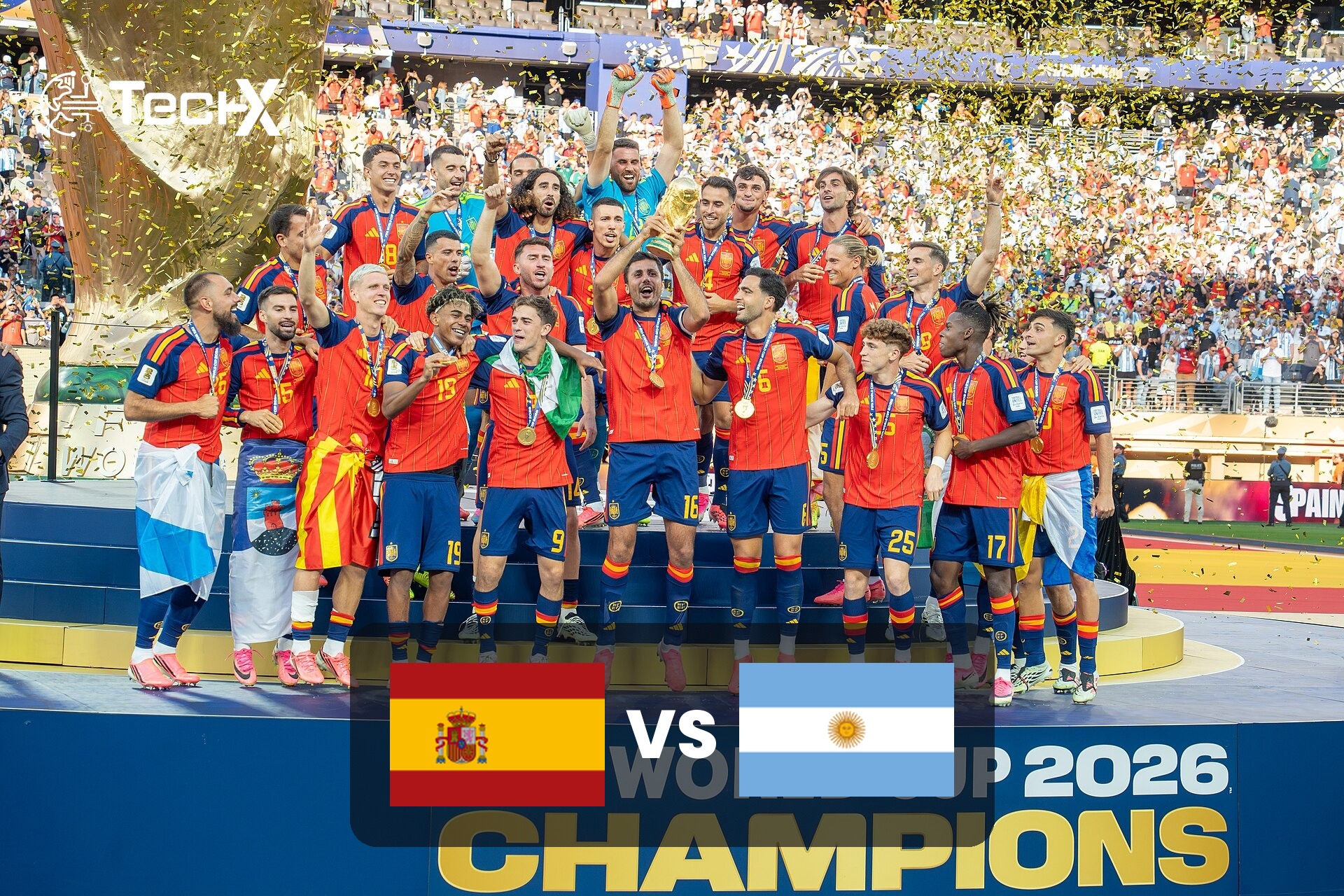
Spain are the 2026 FIFA World Cup champions. In a tense final played on Sunday 19 July at MetLife Stadium in East Rutherford, New Jersey, Spain beat Argentina 1-0 after extra time. Ferran Torres scored the only goal in the 106th minute to end Argentina’s dream of back-to-back World Cup titles. For Pakistani fans who stayed up late to watch, this was one of the most gripping finals in recent memory.
Spain vs Argentina Final Result
| Team | Goals | Shots | Shots on Target |
|---|---|---|---|
| Spain | 1 | 20 | 12 |
| Argentina | 0 | 2 | 0 |
Ferran Torres scored in the 106th minute to lift Spain to their second World Cup title with a 1-0 win in extra time over 10-man Argentina in the final. The win came at MetLife Stadium as a match dominated by Spain at an absurd clip lurched into extra time without a breakthrough.
How the Goal Happened
The match was 0-0 after 90 minutes and the first period of extra time. Then, just 39 seconds into the second period of extra time, the moment everyone was waiting for finally arrived. Pedro Porro curled in an out-swinging cross from the left to the back post, Nico Williams won the header and nodded it back into space, and Torres hammered a half-volley at last past the flailing Martinez.
Barcelona forward Torres, a 62nd-minute substitute for Mikel Oyarzabal, sealed a 1-0 win for the European champions when he struck from close range in the 106th minute, his first goal of this year’s World Cup. He is just the second substitute to score the winning goal in a World Cup final.
Argentina Down to 10 Men
The game turned badly for Argentina just before the final whistle of normal time. The final was marred by Enzo Fernandez’s red card for a reckless foul on Pau Cubarsi. Argentina had been reduced to 10 players at MetLife Stadium following the dismissal of Chelsea midfielder Fernandez after his foul on Cubarsi in the third minute of second-half stoppage time, leaving referee Slavko Vincic with no option but to issue a second yellow card and a red to the 2022 World Cup winner.
Playing with 10 men in extra time made Argentina’s task almost impossible against a Spanish side pressing for the win on every attack.
Emi Martinez Makes History But Cannot Stop Spain
Defending champion Argentina’s brilliant goalkeeper Emiliano Martinez rebuffed every Spanish attempt while setting a record for saves in the World Cup final with 11. However, Martinez could not stop the shot rocketed by Torres after Nico Williams headed a pass his way in extra time.
Luis De La Fuente’s team were deserved winners as they dominated Argentina from the first minute, limiting their opponents to two shots across 120 minutes of action. The stats said it all: Spain had 20 shots and forced Argentina keeper Emi Martinez into a World Cup final record 11 saves.
What This Means for Spain
Spain’s win extended their unbeaten streak to 38 games in all competitions, breaking a tie with Italy (2018-21) for the longest by a men’s national team.
The Spanish finish the World Cup with only one goal allowed, the fewest for a World Cup winner despite playing more games (eight) than any previous champion.
Spain remain the only nation ever to win a European Championship and World Cup in successive tournaments, having now done so a second time.
The win made De La Fuente, at 65, the oldest coach to lead a team to the World Cup title.
The End of Messi’s World Cup Story?
This was an emotional night for Argentine fans. Argentina, aiming to become the first team since Brazil in 1962 to win back-to-back World Cups, were unable to match up to Spain, with even Inter Miami star Messi failing to trouble Luis de la Fuente’s team.
The 39-year-old eight-time Ballon d’Or winner Messi finished the competition with eight goals and four assists, but had little time on the ball in the final. Lionel Messi has said this will be his final World Cup, as he will be 43 years old by the end of the 2030 tournament.
Messi said: “I feel sad. They were better, to be honest.” It was a gracious admission from a true champion.
Tournament at a Glance
The 2026 FIFA World Cup gave us 39 days of non-stop drama and moments from across 16 different cities in Canada, Mexico and the United States. The tournament was the first to feature 48 teams and to be co-hosted by three countries. Some of the key knockout results on the road to the final were:
- Semi-final: Spain 2-0 France (Arlington, USA)
- Semi-final: England 1-2 Argentina (Atlanta, USA)
- England defeated France 6-4 in the third-place match in Miami Gardens to finish third.
- World Cup Final: Spain 1-0 Argentina (New Jersey, USA)
You can check the full official schedule and results on FIFA.com and learn more about the tournament’s history on Wikipedia’s 2026 FIFA World Cup page.
Pakistan Angle
While Pakistan was not part of the 2026 World Cup as a competing nation, millions of Pakistani football fans stayed up through the night to watch Spain vs Argentina. The match kicked off at around 11 PM Pakistan Standard Time (PST) on Sunday night, meaning the winning goal came in well after midnight. Pakistani social media lit up with reactions, with fans split between supporting Messi’s Argentina and Spain’s slick, passing style of play. For Pakistani football fans, this World Cup has been a true spectacle and a reminder of how far the beautiful game’s popularity has grown in the country.
Frequently Asked Questions
Who won the FIFA World Cup 2026 final?
Spain won the 2026 FIFA World Cup final, beating Argentina 1-0 after extra time at MetLife Stadium in New Jersey, USA on July 19, 2026.
Who scored the winning goal in Spain vs Argentina?
Ferran Torres scored the only goal of the match in the 106th minute. He came on as a substitute in the 62nd minute and converted after a cross from Pedro Porro was headed back by Nico Williams.
What time did the Spain vs Argentina final kick off in Pakistan?
The match kicked off at 3:00 PM Eastern Time (ET) in the USA, which is approximately 11:00 PM Pakistan Standard Time (PST) on Sunday night, July 19, 2026.
Was this Lionel Messi’s last World Cup?
Messi has said this was his final World Cup. He will be 43 years old by the time the 2030 World Cup arrives, making it extremely unlikely he will compete again at that level.