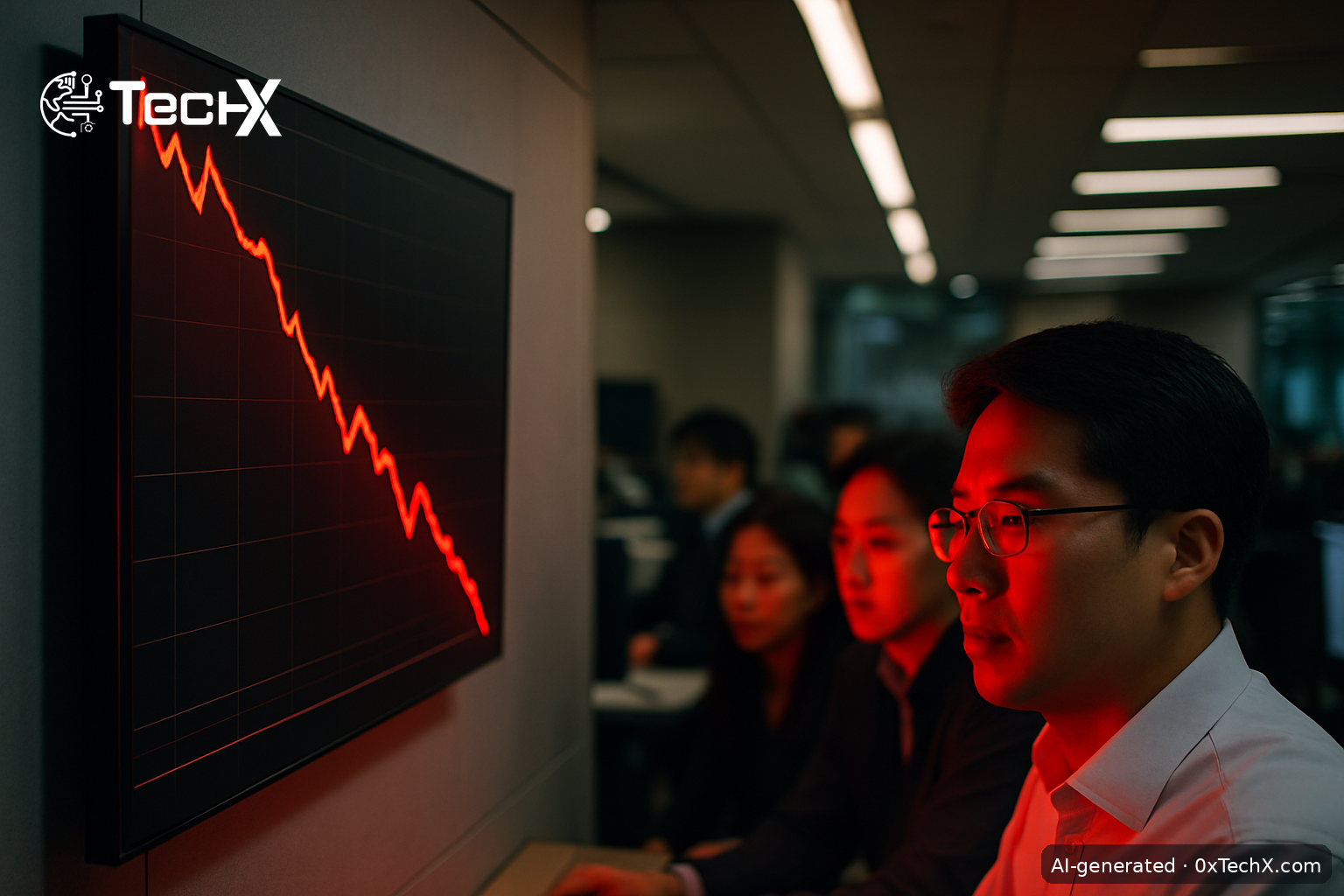
The SK Hynix stock crash on July 16, 2026 wiped more than 11% off the South Korean chipmaker’s share price in a single session, dragging Samsung Electronics, SoftBank and dozens of other Asia tech stocks down with it. The sell-off is the latest jolt in a wild few weeks for the global chip market, and it sends a clear message: the AI memory trade has become one of the most crowded and volatile bets in modern markets.
What Happened With the SK Hynix Stock Crash
SK Hynix has had a breathless few weeks. The company raised over $26 billion on the Nasdaq last week in what became the largest US IPO ever by a foreign firm. Its American Depositary Receipts (ADRs, which let US investors buy a slice of the Korean stock) opened 14% above their $149 offer price and closed their debut day at $168.
Then the wheels came off. SK Hynix stock crash day on Monday, July 14, saw the Seoul-listed shares plunge more than 15%, the biggest single-day fall in the company’s history. The broader chip sector has been under pressure as investors weigh whether AI hardware spending can keep growing at this pace. By Thursday July 16, another wave hit: shares closed 11.5% lower again, reversing the previous session’s 8% bounce.
The pain spread fast. Samsung Electronics dropped more than 8% on Thursday. In Japan, SoftBank Group slid over 6%, Advantest fell nearly 6%, and Renesas Electronics lost 7%. South Korea’s benchmark Kospi index has swung 9% in a single day during this stretch, triggering a 20-minute trading halt earlier in the week.
Why Did Investors Sell So Hard
Three things came together at once.
- Post-IPO profit taking. SK Hynix’s Korean shares had more than tripled in the past year. Once the US listing was done, many investors simply locked in gains. One Seoul analyst described it as a classic “sell the news” reaction after the IPO concluded.
- Earnings worry. A South Korean brokerage report warned that SK Hynix’s operating profit for the current quarter could miss market estimates by about 8%. The reason: SK Hynix earns a large share of its revenue from high-bandwidth memory (HBM), but HBM prices are rising more slowly than prices for ordinary DRAM chips, which SK Hynix makes less of than rival Samsung.
- Overcrowded trade. One trader noted that semiconductors now make up roughly 20% of the S&P 500, a level that is very hard to sustain. During the dot-com bubble in 2000, chips were just over 8% of the index, and their long-run average is between 2% and 5%.
Leveraged exchange-traded funds (ETFs) that bet on SK Hynix with borrowed money made everything worse. These products amplify both gains and losses. Some leveraged ETFs tracking SK Hynix have lost nearly half their value since listing in Seoul in late May.
Is the AI Chip Boom Actually Over
Probably not, but the easy money may be gone. Even as stocks fell Thursday, the Dutch chip equipment giant ASML raised its full-year sales guidance for the second time in 2026, forecasting revenue of 43 to 45 billion euros, above what analysts expected. Strong guidance, falling stock price. That tells you investors had already priced in the good news and then some.
Demand for high-bandwidth memory chips continues to outstrip supply as cloud providers race to build AI data centres. SK Hynix held a 58% revenue share of the HBM market in the first quarter of 2026. That position is not going away. But expectations had run so far ahead of reality that even good results feel like a disappointment. As one Julius Baer analyst put it, elevated volatility is expected through late July as investors rebalance positions after the IPO.
What This Means for Pakistani Buyers of Phones and Laptops
Here is the part most stock-market coverage skips. The same SK Hynix stock crash story is tied directly to what Pakistanis pay at a mobile shop or a laptop store.
Memory chip makers including SK Hynix, Samsung and Micron have been shifting production away from ordinary DRAM and NAND flash (the memory inside your phone or laptop) toward high-margin AI memory. AI data centres need a completely different type of chip called HBM, and making one bit of HBM means giving up several bits of the conventional memory that goes into consumer devices. Major tech firms have guided to about $650 billion in capital spending for 2026 to build AI infrastructure, and those data centres are competing directly with smartphone and PC makers for the same limited supply.
The numbers are sobering. According to Gartner, DRAM and SSD prices could surge around 130% by end of 2026, pushing PC prices up roughly 17% and smartphone prices up roughly 13% compared with 2025. PC vendors including Lenovo, Dell, HP, Acer and ASUS have already warned of 15 to 20% price hikes. IDC expects 2026 DRAM supply growth of only 16% year-on-year, well below the 20 to 30% norms of recent years.
For Pakistan, these global forces pile on top of local pressures. Pakistan imports almost all its consumer electronics, so higher global prices translate quickly into higher rupee prices on shelves. Memory costs rising 130% globally do not shrink by the time they reach Lahore or Karachi.
There is also a hidden risk: shrinkflation in electronics. Some phone makers are quietly putting less RAM into new models at the same price, rather than raising the sticker. A model that shipped with 8 GB RAM last year may come with 6 GB this year. Pakistani buyers should check memory specs carefully before buying any new device in the second half of 2026, because prices are expected to keep rising through Q3 and Q4, with relief unlikely before mid-2027.
The Bigger Picture for the Global Chip Market
The repeated SK Hynix stock crash episodes since its US listing show how thin the line is between hype and reality in the current AI cycle. SK Hynix’s Korean shares are still up more than 500% over the past year. The company is genuinely central to the AI hardware stack: it supplies the high-bandwidth memory that plugs into Nvidia’s AI processors, and no competitor has come close to its 58% revenue share of that market. What has changed is that investors are becoming far more selective as semiconductor valuations stretch higher.
For those who want to understand how memory chips actually get from a factory to your phone, it helps to know that only three companies make almost all the world’s DRAM: Samsung, SK Hynix and Micron. When any of them shifts capacity, every device maker on the planet feels it. Apple’s moves in the AI device space are one example of how big tech decisions ripple down to consumer hardware choices.
Frequently Asked Questions
Why did SK Hynix stock fall so sharply after its Nasdaq IPO?
SK Hynix shares had more than tripled over the past year before the IPO. Once the US listing was complete, many investors sold to lock in profits. A brokerage report also raised concern that second-quarter earnings could miss estimates, adding to the pressure. This is a common pattern called “sell the news.”
Does the Asia chip sell-off mean AI demand is collapsing?
No. Demand for AI chips remains strong, and ASML raised its full-year sales outlook even during the sell-off. The drop reflects investors deciding that chip stocks had been priced for perfection. Even small doubts about earnings growth can trigger big share price moves when valuations are stretched.
How does the SK Hynix stock crash affect phone and laptop prices in Pakistan?
The stock crash itself does not raise prices. What matters is the underlying reason for chip market volatility: memory makers are shifting production to high-margin AI chips, reducing supply of the ordinary DRAM and NAND used in consumer devices. This tightening supply is pushing global memory prices up sharply, which flows through to higher device prices in import-dependent markets like Pakistan.
When might device prices come back down in Pakistan?
Industry analysts point to mid-2027 at the earliest for meaningful memory price relief, as building new chip production capacity takes years. Prices of phones and laptops are expected to keep rising through Q3 and Q4 of 2026. Buying sooner or keeping your current device longer are the most practical options right now.