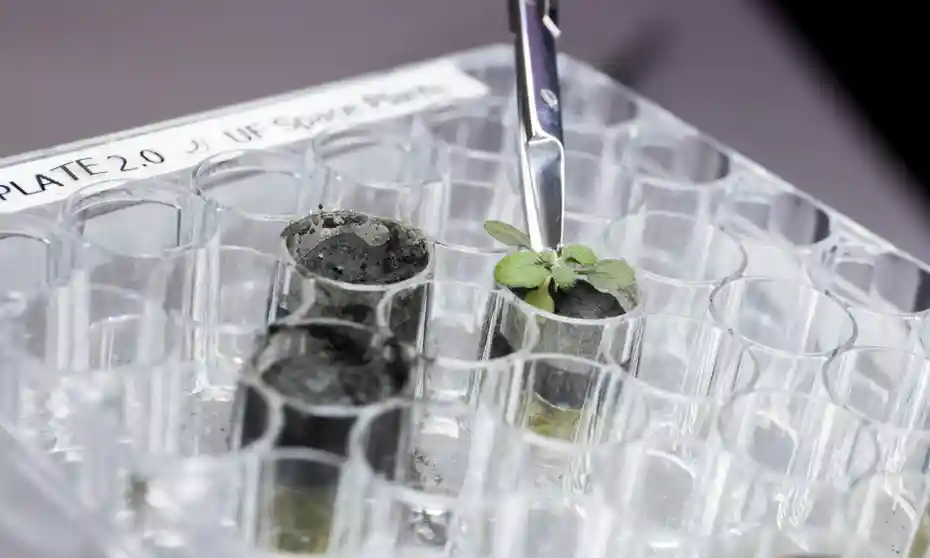
For the first time, scientists at the University of Florida are growing plants in moon soil, utilizing samples from the Apollo 11, 12, and 17 missions.
The researchers revealed that plants may successfully sprout and thrive in lunar soil, or lunar regolith, in the journal “Communications Biology.” This could be a stepping stone toward growing plants on the moon for food and oxygen.
One of the study’s authors and a UF/IFAS horticultural sciences researcher, Anna-Lisa Paul, notes, “Plants helped establish that the soil samples brought back from the moon did not harbor pathogens or other unknown components that would harm terrestrial life, but those plants were only dusted with the lunar regolith and were never actually grown in it”.
The moon provided 842 pounds (382 kilograms) of dirt and rocks, but NASA provided only 12 grams of “lunar regolith” to the researchers.
Plastic plates with small wells, similar to thimbles, were used to cultivate cells in pots. A gram soil with an additional fertilizer solution and a few thale cress (Arabidopsis thaliana) seeds were employed by the researchers.
As a control group, the same seedlings were planted in soil from harsh environments and a material that mimicked lunar soil.
Some of the plants that grew in moon dirt grew slower or smaller, with more size fluctuations. The variation in lunar soil has an effect on plant growth, according to the researchers.
The research was completed with “further characterization and optimization would be required before regolith can be considered a routine in situ resource, particularly in locations where the regolith is highly mature.”
To read our blog on “NASA is preparing to transport Artemis I Moon rocket SLS to Launchpad,” click here.