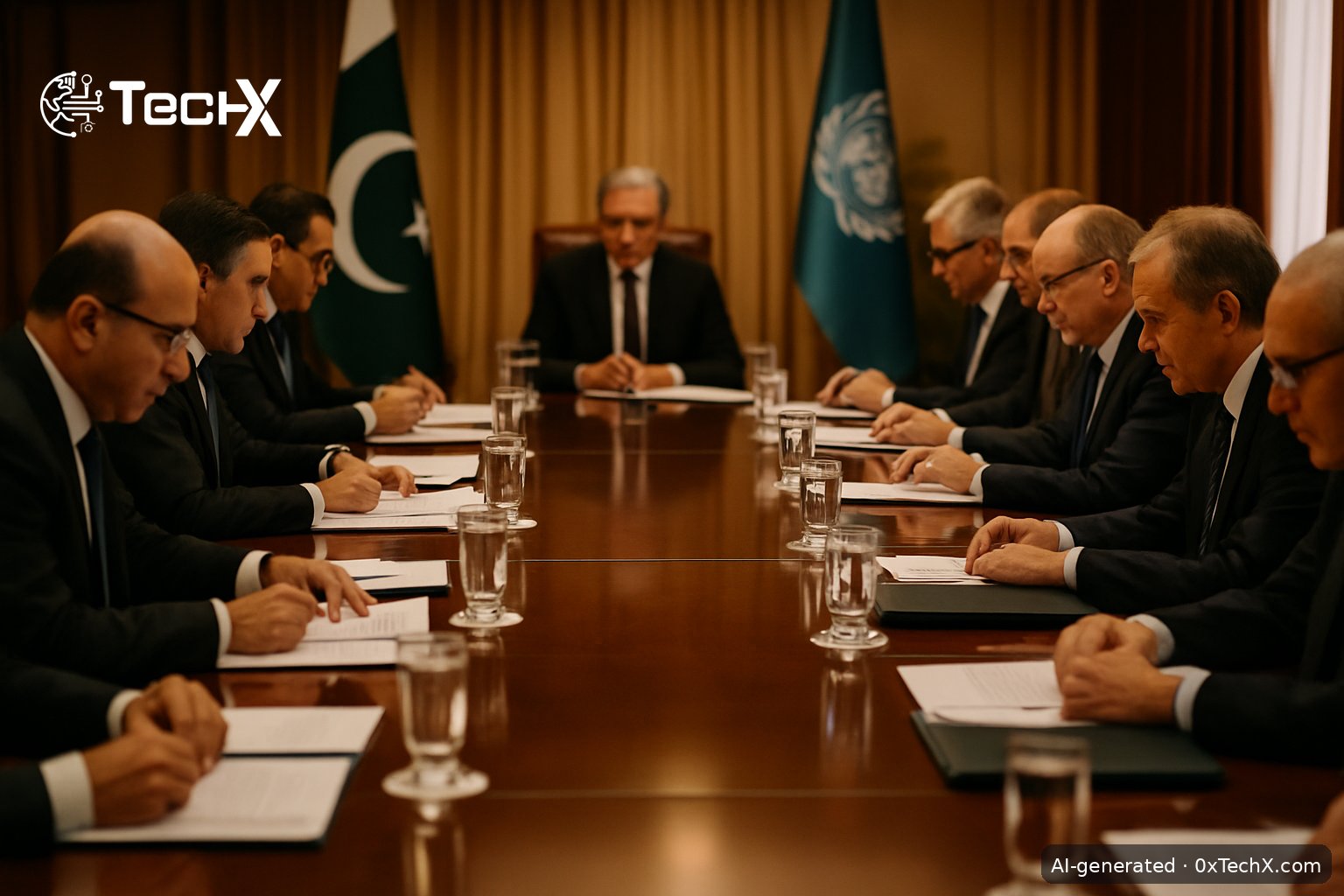
Pakistan IMF green financing talks formally kicked off on 29 September 2026, when Finance Minister Muhammad Aurangzeb sat down with an IMF mission led by Iva Petrova in Islamabad. The talks are running two reviews at the same time, the fourth check of Pakistan’s $7 billion Extended Fund Facility (EFF) and the third review of the separate $1.4 billion Resilience and Sustainability Facility (RSF). If both pass, Pakistan could receive close to $1.2 billion in fresh funds. But beyond the headline number, there is something most coverage is missing: the RSF’s climate conditions are quietly reshaping the rules for Pakistan’s EV and telecom industries.
What Is the EFF and RSF in Simple Terms?
The EFF is Pakistan’s main $7 billion bailout with the IMF, approved in September 2024. It covers tax reform, energy-sector debts, and broader economic targets. Pakistan’s 37-month EFF, worth around $7 billion or SDR 5.32 billion, was approved by the IMF Executive Board in September 2024.
The RSF is different. Pakistan will use the $1.4 billion IMF climate resilience loan to expand fiscal space, embed climate planning into public investment decisions, and unlock private-sector capital for green projects, as part of a broader reform program that helps Pakistan adapt to increasingly frequent and devastating climate shocks.
Crucially, Pakistan is the first country in the Middle East and Central Asia region to access the IMF’s Resilience and Sustainability Facility. That matters because it sets a precedent for how climate money flows into the country’s tech and infrastructure sectors.
What the Pakistan IMF Green Financing Review Covers This Time
The talks cover a review of Pakistan’s 37-month, $7 billion Extended Fund Facility (EFF), approved in September 2024, and a separate review of a $1.4 billion Resilience and Sustainability Facility (RSF). A successful review of the EFF could unlock about $1 billion for Pakistan, while the RSF review could release around $200 million, bringing the combined potential disbursement to roughly $1.2 billion.
The talks are expected to continue for around two weeks and will cover economic developments and programme performance through June 2026. The funds would not be released immediately upon completion of the staff-level review. Any staff-level agreement would subsequently require approval by the IMF Executive Board before the disbursements can be made.
The Green Conditions Most People Are Not Talking About
The RSF is not free money. Each tranche comes with specific climate reform tasks. The climate loan has its own two tasks for this review, both due by end-August 2026. One raises the climate weighting in public project selection to at least 30 per cent. The other sets up a disaster risk financing plan shared by the federal and provincial governments.
Reducing Pakistan’s vulnerability to climate shocks will enhance macroeconomic and fiscal sustainability. Reforms supported by the RSF are helping to strengthen natural disaster response and financing coordination, improve the use of scarce water resources, reflect climate considerations in project selection and budgeting, and improve the climate information architecture.
There is also a direct link to private-sector reporting. The second RSF review confirmed that Pakistan had satisfied its disclosure-related structural benchmarks: the State Bank of Pakistan’s climate-related financial risk guidelines and SECP’s listed company climate disclosure framework. This means any listed telecom or tech company must now report on climate risk, or risk falling outside the reform benchmarks that keep Pakistan’s IMF money flowing.
What This Means for Pakistan’s EV and Telecom Sectors
This is where Pakistan IMF green financing becomes very practical for the tech reader. The government’s own Climate Prosperity Plan, built partly around RSF commitments, puts EV supply chains at its centre. The finance minister said Pakistan is finalising its Climate Prosperity Plan, which includes initiatives linked to electric vehicle supply chains, renewable energy expansion, and green industrial development.
For the telecom sector, the RSF’s requirement to embed climate goals into public investment means big infrastructure decisions, new tower builds, fibre rollouts, data centres, will increasingly need to pass a climate test before getting government approvals or financing. Companies that adopt green practices early will have an easier path. Those that ignore them may find project approvals slower and credit costlier.
For the EV industry, the timing is significant. Pakistan’s auto sector has been in transition, with older combustion models exiting the market (as seen with the discontinuation of the Honda Atlas BR-V after nine years). RSF-linked green investment rules could push more capital toward local EV assembly, charging infrastructure, and battery supply chains, if the private sector moves fast enough to catch the policy window.
Reforms to promote green mobility and transport decarbonization and to strengthen climate information systems and the management of climate-related financial risks are helping to build resilience. In plain terms: the IMF wants Pakistan to price climate risk into every big spending and lending decision. That trickles down to who gets loans, which projects get built, and which companies grow.
Where the Money Has Gone So Far
Pakistan has already received $4.8 billion under the two programmes. The most recent disbursement came in May 2026. The IMF last approved disbursements in May, releasing about $1.1 billion under the economic program and $220 million under the climate facility. The current review, if passed, would add another tranche on top of that total.
What Happens Next
The IMF mission will spend roughly two weeks in Islamabad, checking numbers, benchmarks, and reform progress. The talks come as Pakistan continues to work through several outstanding IMF conditions. The government has previously said implementation of the overall program remains strong, although some conditions related to areas including sugar sector liberalization, health and education spending and other structural reforms have not been fully met.
Subsequent tranches will require Pakistan to show ongoing compliance with its climate reform agenda. Aggregate quality of corporate climate disclosures will be part of how that is assessed. For Pakistan’s tech and EV companies, this is not distant macro policy. It is a deadline-driven compliance environment that is already in motion.
Frequently Asked Questions
What is the difference between the EFF and the RSF?
The EFF is Pakistan’s main $7 billion economic support programme from the IMF, focused on fiscal reform, tax revenue, and energy-sector debt. The RSF is a separate $1.4 billion climate-focused facility that pays out when Pakistan meets specific green reform milestones, such as embedding climate criteria into public investment and building disaster risk plans.
How much money could Pakistan receive from these talks?
Successful completion of the two reviews would make Pakistan eligible for around $1 billion under the EFF and another $200 million under the RSF, taking the potential combined disbursement to approximately $1.2 billion. However, the IMF Executive Board must approve any staff-level deal before funds are actually sent.
How does the IMF’s green financing condition affect Pakistani businesses?
RSF conditions require Pakistan to raise the climate weighting in public project approvals, roll out climate risk guidelines through the State Bank, and enforce climate disclosures for listed companies through SECP. Any telecom company, EV firm, or tech business listed on the Pakistan Stock Exchange now operates inside this framework, meaning their funding and expansion plans are indirectly shaped by whether Pakistan keeps meeting IMF green benchmarks.
When will we know if the review passed?
The mission is expected to work for about two weeks. After that, IMF staff and Pakistani officials need to reach a staff-level agreement. The IMF Executive Board then meets to formally approve it. Based on past timelines, a decision is likely in late October or November 2026 at the earliest.