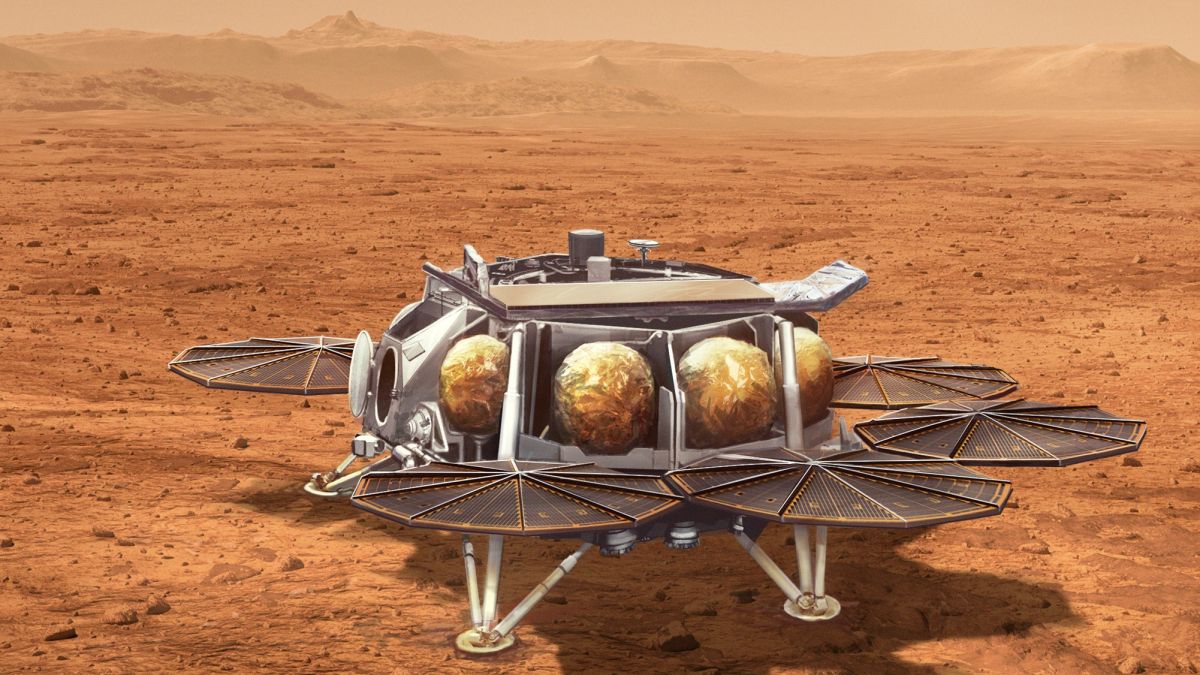
By the middle of the next decade, NASA expects to return Mars core rock samples to Earth as part of its Mars Sample Return (MSR) mission.
The space agency had to alter its initial strategy due to a recent review of the system requirements in order to simplify the mission and improve the likelihood of success.
The performance of the Mars helicopter and Perseverance’s results in the Jezero Crater on the Red Planet were both important factors in the decision to change the mission, according to Thomas Zurbuchen, associate administrator for science at NASA.
On February 18, 2021, Perseverance and its companion chopper, Ingenuity, touched down on Mars, and both have surpassed expectations.
Nearly a dozen interesting rock samples have already been acquired by Perseverance, along with one air sample.
Ingenuity has performed 29 successful flights as of June 11, 2022, compared to the five flights it was anticipated to make over a 30-Martian-day demonstration window.
As a result, the Sample Fetch Rover and its related second later will no longer be part of the MSR effort.
Instead, two Ingenuity-based sample retrieval helicopters will be added to the Sample Retrieval Lander.
The helicopters, according to NASA, will offer a backup method of retrieving samples stashed on the surface of the Red Planet.
The Earth Return Orbiter and other previously anticipated elements like the Capture, Containment, and Return System won’t change from the original designs.
The project will go into the early design phases in October after finishing the conceptual design phase.
Engineers will finish technology development and create prototypes of the mission’s key components throughout this year-long period.
The project is a collaboration between NASA and the European Space Agency.
“ESA is continuing at full speed the development of both the Earth Return Orbiter that will make the historic round-trip from Earth to Mars and back again; and the Sample Transfer Arm that will robotically place the sample tubes aboard the Orbiting Sample Container before its launch from the surface of the Red Planet,” said David Parker, ESA director of Human and Robotic Exploration.
The Earth Return Orbiter is scheduled to launch in the fall of 2027, while the Sample Retrieval Lander will follow in the summer of 2028.
If all goes as planned, the payload will return to Earth in 2033, giving scientists from all over the world the opportunity to study them using equipment that is too big and complicated to travel to Mars.
To read our blog on “NASA’s Mars rover finds an unknown and mysterious item,” click here.