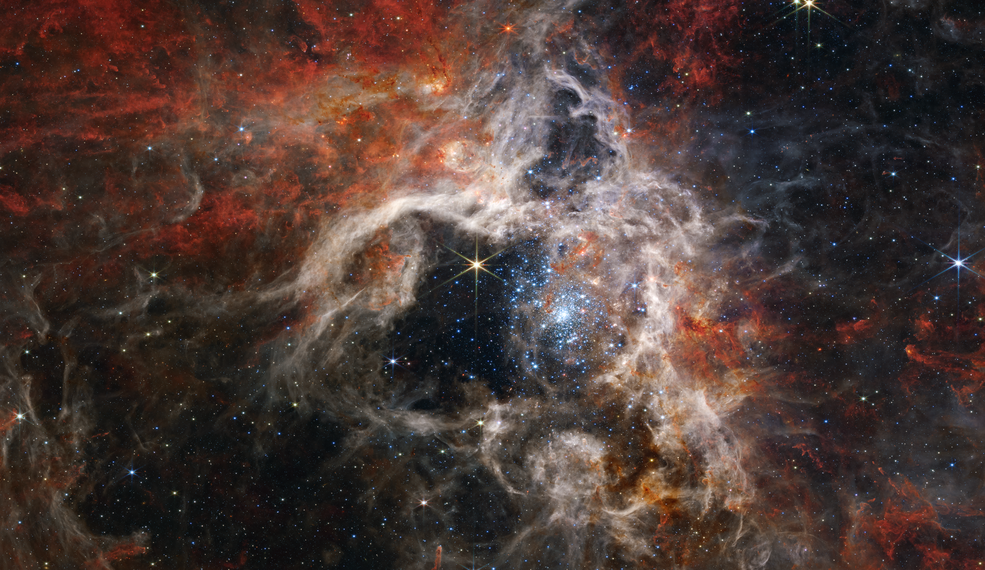
As it continues to relay unseen photos of the cosmos, the James Webb Telescope has drawn attention. A recent image of the vast expanse of swirling gas and dust known as the Tarantula Nebula was made public by NASA.
As per NASA, “at only 161,000 light-years away in the Large Magellanic Cloud galaxy, the Tarantula Nebula is the largest and brightest star-forming region in the Local Group, the galaxies nearest our Milky Way. It is home to the hottest, most massive stars are known.”
Astronomers who are specifically interested in understanding star formation find the photos of the Tarantula Nebula to be of utmost significance.
The brand-new pictures display a cluster of enormous, young stars’ scorching radiation.
With the discoveries, NASA is hopeful that “Webb will provide astronomers the opportunity to compare and contrast observations of star formation in the Tarantula Nebula with the telescope’s deep observations of distant galaxies from the actual era of cosmic noon.”
For mankind, the formation of stars and space, in general, have been mysteries. The James Webb Telescope, the largest space research observatory in the world, is still able to shed light on the unseen aspects of the universe.
To read our blog on “NASA shares a “teaser” image from the James Webb telescope,” click here.