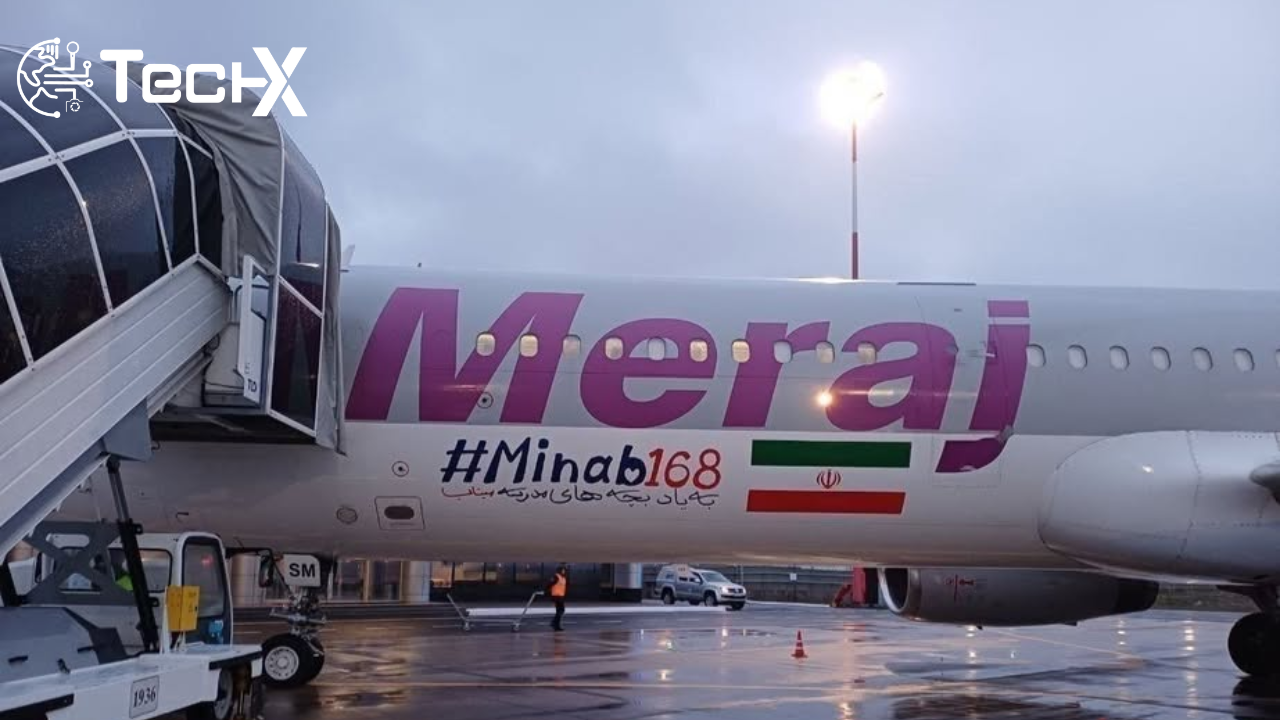
As Iranian Foreign Minister Abbas Araghchi departed for Moscow, his official Meraj Airlines aircraft featured a powerful symbolic message. Painted on the fuselage was the hashtag #Minab168, accompanied by an inscription in Persian that translates to “In memory of the children of the Minab school.” This gesture serves as a “flying memorial” to the 168 students tragically killed during a strike on a school in the Minab region of southern Iran earlier this year, an event that has deeply scarred the nation.
Transforming the Diplomatic Narrative
By branding the Foreign Minister’s official plane with this tribute, Tehran is intentionally shifting the focus of international diplomacy from technical nuclear debates to the humanitarian cost of the ongoing conflict. The presence of the #Minab168 hashtag ensures that everywhere the aircraft lands starting with Moscow the world is reminded of the civilian casualties. This move is designed to put moral pressure on global powers and highlight the devastating impact of aerial campaigns and blockades on the Iranian population.
High-Stakes Negotiations in Moscow
FM Araghchi’s visit to Russia is a critical follow-up to his recent diplomatic mission in Islamabad. In Moscow, he is scheduled to hold high-level talks with President Vladimir Putin and Foreign Minister Sergey Lavrov. The primary objective is to brief Russian leadership on the “written conditions” Iran recently shared with the United States via Pakistan. Tehran is seeking Russia’s backing for its demands, particularly regarding security guarantees that would prevent future tragedies like the one witnessed in Minab.
Demands for Advanced Air Defense Systems
One of the most practical aspects of Araghchi’s agenda in Moscow is the request for enhanced military cooperation. To prevent further civilian losses, Iran is reportedly pushing for the expedited delivery of advanced Russian air defense systems, such as the S-400 or S-500. By linking these military requests to the memory of the 168 children, the Iranian delegation is framing the acquisition of these systems as a humanitarian necessity for protecting schools and infrastructure rather than just a strategic military upgrade.
Regional Coordination and the Islamabad Accord
This Moscow visit is part of a broader “diplomatic marathon” involving Pakistan, Oman, and Qatar. Iran is working to ensure that its regional allies and strategic partners are fully aligned before any formal response is received from the Trump administration. Pakistan’s role as the central mediator remains vital, as Field Marshal Asim Munir continues to facilitate the exchange of terms between Tehran and Washington. The tribute on the plane serves as a reminder to all mediators that Iran’s “red lines” are now deeply tied to the protection of its citizens.
The Fragile Path Toward De-escalation
As the region remains in a state of high tension, the success of these talks hangs in a delicate balance. While the #Minab168 tribute has galvanized domestic support in Iran and created a strong moral case abroad, the fundamental gap between the U.S. demand for denuclearization and Iran’s demand for an end to the blockade persists. The outcome of the meetings in Moscow, combined with the ongoing mediation in Islamabad, will determine if these symbolic gestures can translate into a concrete framework for a lasting ceasefire.