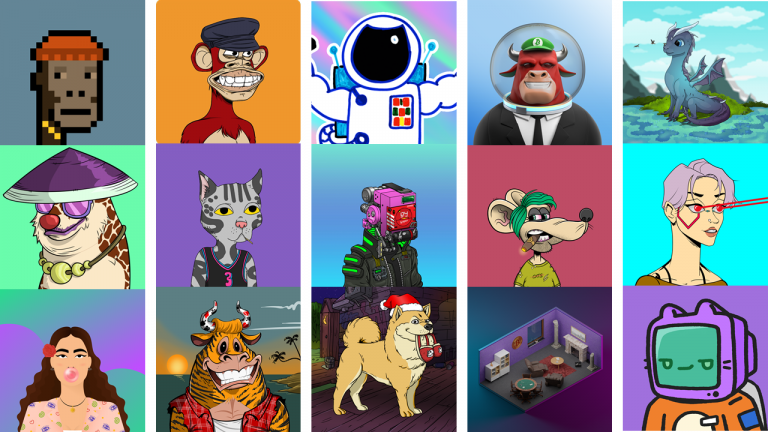
Non-fungible tokens (NFTs) have emerged as one of the most popular cryptocurrencies in recent years, with billions of dollars in trading volume and a slew of celebrity endorsements propelling digital artwork to the forefront of mainstream media outlets.
NFTs can be created directly on NFT platforms, allowing you to mint (the process of creating or producing something) and upload your artwork on a blockchain.
This guide will detail the steps needed to create your first NFT, including how to upload your artwork, choose the right blockchain, and where to list it for sale.
What Exactly Is an NFT, and How Do Make One?
Non-fungible tokens (NFTs) are blockchain-based cryptographic assets with unique identification codes and metadata that distinguish them from one another.
NFTs, unlike cryptocurrencies, cannot be exchanged for one another because each one is unique.
In contrast, cryptocurrency is fungible and can be traded with equivalency. It means that each bitcoin has the same value and can be traded for one another.
Digital artwork, such as pictures, animated videos, or music, is commonly used to represent NFTs. They can be bought and sold on NFT marketplaces, which usually accept cryptocurrency as payment.
An NFT can be created using an NFT marketplace or a crypto exchange that supports NFT minting. To make an NFT from scratch, follow these six steps.
Step 1: Decide What You Want to Make
NFTs are typically associated with a work of digital art. This could be an image, an audio production (like a song), or even a brief video clip (such as an animated GIF).
The goal is to create a one-of-a-kind piece of digital media that can be sold in the same way that a painting can be sold in an art gallery. NFTs add value to creators by being one-of-a-kind, something that cannot be obtained elsewhere.
It’s especially important to make sure you own the rights to the digital media you’re using, because creating an NFT from media you don’t own can lead to legal problems.
Step 2: Select a Blockchain
There are several blockchains where your NFT can be stored. This blockchain will keep a permanent record of your NFT, so choose the one that best meets your needs.
Ethereum
Ethereum, the most popular NFT blockchain, hosts thousands of NFT collections. Ethereum NFTs are built using the ERC-721 standard, which stores the NFT’s metadata on the Ethereum blockchain.
This standard, created by the same teams that created the ERC-20 smart contract, defines the ownership details, security details, and metadata—needed for exchanging and distributing gaming tokens.
This blockchain now uses the proof-of-stake (PoS) consensus mechanism, making it much more environmentally friendly than it was previously.
Although most NFT marketplaces allow the creation of Ethereum NFTs, transferring NFTs on the Ethereum blockchain may incur high gas fees.
Solana
Solana is the closest competitor to the Ethereum blockchain. Solana, designed as a faster, lower-cost alternative to Ethereum, has transaction fees of less than $0.01 and an expanding list of supported NFT apps.
Furthermore, Solana employs both the proof-of-history (PoH) and proof-of-stake (PoS) consensus mechanisms and has much faster transaction speeds than Ethereum.
Other blockchains that support NFTs have their own communities and decentralized apps (dApps) for creators and NFT owners.
Step 3: Create an NFT Wallet
Once you’ve decided on a blockchain, you’ll need a digital wallet that supports that blockchain to keep your NFT safe.
To create a wallet, you must first download the crypto wallet app, enter a username and password, and backup your private keys and recovery phrase offline.
Several well-known wallet apps support multiple blockchains:
MetaMask: It’s a popular cryptocurrency wallet that supports a wide range of cryptocurrencies as well as the Ethereum and Solana blockchains. It is available as a mobile app and as a browser extension.
Coinbase Wallet: Coinbase provides a digital wallet that supports both ERC-721 NFT tokens and Solana NFT collections. It is available as a mobile app or as a browser extension.
Ledger Nano X: The Ledger Nano X is a secure hardware wallet that supports both Ethereum and Solana NFTs.
Step 4: Select an NFT Platform
A growing number of NFT platforms allow you to create an NFT, but the best ones also provide a full-service marketplace for listing and selling NFTs. The following are some of the most popular NFT platforms:
- OpenSea
- Solanart
- Crypto exchanges
Step 5: Construct the NFT
Creating an NFT is fairly simple once you’ve decided on a platform. Here’s an example of an NFT created in OpenSea:
- Connect your wallet: In the OpenSea menu, click the wallet icon and select the digital wallet to which you want to connect. This will necessitate you signing a verification on your wallet app.
- Choose the “Create” option: This displays the NFT creation process menu, which includes an upload section, NFT features, properties, and blockchain.
- Please upload your media file: This is the image or other media that you intend to sell. You can either upload directly or link to a media file hosted elsewhere.
- Fill in the blanks: You must give your NFT a name and a description. You can optionally add unique properties and extra perks, such as an invite to a private Discord channel or discount codes for merchandise.
- Choose your blockchain: This is the blockchain on which your NFT will reside, and it cannot be changed once it has been minted.
- Create the NFT: After filling out the details of your NFT, simply click “Create.”
Your file will upload and the NFT will be created after you click “Create.” However, the NFT is not currently for sale, and the metadata is technically changeable until you list your item for sale.
Step 6: Put the NFT up for sale
It is simple to list an NFT for sale, and most NFT platforms allow you to do so for free.
Once your NFT is created and in your wallet, simply click the “sell” button on the platform of your choice and enter the price you want to list it at and the duration of the sale.
You can create the listing after you have filled in the details of your sale. This will necessitate you signing a few transactions in your digital wallet, which may include paying transaction fees on the blockchain of your choice.
Solana transactions are typically less than $0.01, whereas listing an NFT on the Ethereum blockchain can be much more expensive, depending on network fees at the time of listing.
What Is the Cost of Selling an NFT?
Once listed, the NFT should have a unique URL that you can share with others. When a purchase is made, sellers pay fees to the NFT marketplace, which are typically 1% to 3% of the total transaction.
To read our blog on “Music NFTs will uplift gaming to new heights,” click here