

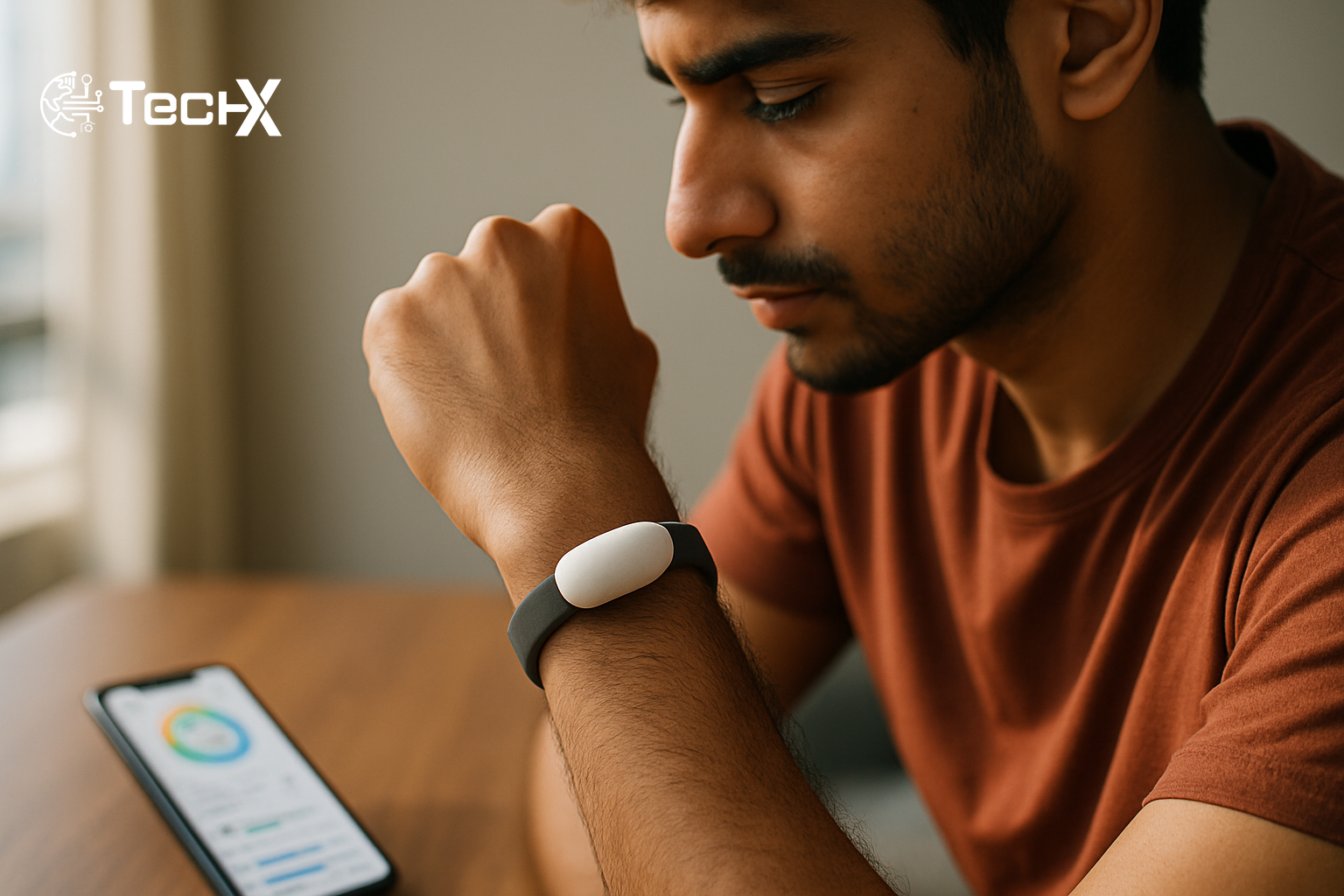
The Fitbit Air screenless health band from Google is now one of the most talked-about wearables of 2026, and for good reason. Fitbit launched the Fitbit Air, a tiny and affordable tracker that monitors your health 24/7. At $99 with no forced subscription, it directly challenges Whoop’s well-known subscription model and brings serious health tracking to a much wider audience.
What Is the Fitbit Air Screenless Band?
Fitbit Air is Google’s smallest tracker yet, a proactive wellness partner that uses high-fidelity sensor technology in a tiny, discreet pebble, enabling advanced health and fitness tracking like 24/7 heart rate, heart rhythm monitoring with AFib alerts, SpO2, resting heart rate, heart rate variability, sleep stages and duration, and more.
The new wearable is noticeably smaller than its predecessors, staying true to the ‘Air’ branding, it is 25% smaller than the Fitbit Luxe and 50% smaller than the Inspire 3. The device weighs 12 grams with the band and 5.2 grams without the band. That is lighter than most earbuds.
It sits silently on your wrist with a screenless design built so you can live in the moment. You have the freedom to explore deep insights from the Google Health app on your phone when you want them, and stay notification-free when you don’t.
Fitbit Air Specs at a Glance
- Sensors: Optical heart rate sensor for 24/7 monitoring, plus red and infrared sensors for SpO2 blood-oxygen monitoring. It also tracks skin temperature, heart rate variability and breathing rate.
- Battery: Up to a week of battery life, and fast charging can deliver a full day of power in just five minutes.
- Water resistance: Water-resistant up to 50 meters.
- Weight: 5.2g without band, 12g with band.
- Price: Compatible with Android and iOS, available for $99.99.
- GPS: The Fitbit Air does not have built-in GPS. Outdoor activity route tracking requires your paired smartphone to be carried with you.
How the AI Health Coach Works
Google also announced that Google Health Coach, its Gemini-powered all-in-one fitness trainer, sleep coach, and health and wellness advisor, is now available for Google Health Premium subscribers. The Google Health Coach can help with tasks like creating custom workout routines based on your goals and available equipment, analyzing your sleep habits, and more.
Here is the key thing: core tracking features are free. Google Health Premium is optional, unlocking the Gemini-powered AI Health Coach and advanced personalised plans. A three-month trial of Google Health Premium is included, giving you full access to Google Health Coach right out of the box. After the trial, Google Health Premium costs $9.99 a month.
Fitbit Air vs Whoop, the Big Difference
The newest Fitbit tracker is a long-awaited competitor to the Whoop 5.0 and Whoop MG. Both are screenless bands focused on continuous health tracking. But the pricing story could not be more different.
For the casual screenless tracker market, the Fitbit Air will pull a significant share of users away from Whoop because the price gap, Fitbit at $99 one-time vs Whoop at $199 to $359 per year, is enormous.
By comparison, the Whoop strap cannot be used without an active subscription, so if you are not in it for the long haul, the Fitbit Air will likely be the better option.
For serious athletes who already use Whoop for training, the Fitbit Air does not yet match Whoop’s analytics depth. Whoop’s specialist position remains intact at the top of the market. So if you are a competitive athlete who needs deep strain scores and a daily behavior journal, Whoop still makes a case. For everyone else, the Fitbit Air is the more practical choice.
The Fitbit Air screenless design also offers some flexibility that Whoop does not. It pairs with the Pixel Watch, which means you could use the larger wearable throughout the day and then switch to the Fitbit Air at night or during workouts for a more comfortable experience.
The Google Health App Rebrand
On May 7, 2026, Google made a move many analysts had been waiting on since it finalised the Fitbit acquisition back in 2021: the Fitbit brand, at least on the software side, is being shelved. Starting May 19, the Fitbit app became Google Health, and the same day brought the launch of the Fitbit Air, a screenless tracker priced at $99.99 designed to stay on your wrist twenty-four hours a day and to talk to a personal coach built on Gemini.
The Google Health app can pull in data from your Fitbit Air, a Pixel Watch, Health Connect, Apple Health, and even your medical records, depending on your region. This makes it one of the most connected health platforms available today. You can learn more about how Google’s hardware ecosystem is expanding on Google’s official store.
What This Means for Pakistani Fitness-Tech Buyers
The Fitbit Air screenless band is not yet officially sold in Pakistan through retail channels, but it is available on the Google Store and through global e-commerce routes. Pakistani buyers who use services like package forwarding from the US or UK can get it for around $99 (roughly Rs27,000 to Rs28,000 at current rates), before shipping.
For Pakistani users, the no-subscription model is the biggest attraction. Paying $199 to $359 a year for Whoop is hard to justify when the rupee is under pressure. The Fitbit Air asks for a one-time payment and still gives you solid health data for free. The optional Rs2,700-per-month premium tier is there if you want the Gemini AI coach, but it is not forced on you.
Pakistani health-conscious users, from students tracking sleep before exams to office workers keeping an eye on heart rate, will find the lightweight, always-on design far less intrusive than a smartwatch. The week-long battery also means you are not hunting for a charger every other day, which matters in a country where power schedules can be unpredictable.
Frequently Asked Questions
Does the Fitbit Air have a screen?
No. The Google Fitbit Air is a screenless wrist-worn health tracker built around a single idea. It is not a traditional smartwatch, it has no display, no buttons, and no screen of any kind. All your data shows up in the Google Health app on your phone.
Do you need to pay a subscription to use the Fitbit Air?
No. The Fitbit Air does not require a subscription to function. Even if you choose not to subscribe to Google Health Premium after the free trial, you can still log your data using the band on the Google Health app’s free tier and use it as a basic, screenless fitness tracker.
How does the Fitbit Air compare to Whoop in price over five years?
There is no doubt about it: over time, the Whoop will be pricier than the Google Fitbit Air by a significant margin. At $99 one-time for the Fitbit Air versus $199 to $349 per year for Whoop, the difference adds up to hundreds of dollars over a few years.
Is the Fitbit Air available in Pakistan?
The Fitbit Air is not officially stocked in Pakistani retail stores yet. However, it is available through the Google Store for international shipping. Pakistani buyers can use package-forwarding services to order it. The device works with both Android and iOS, so it is fully usable with any Pakistani smartphone.