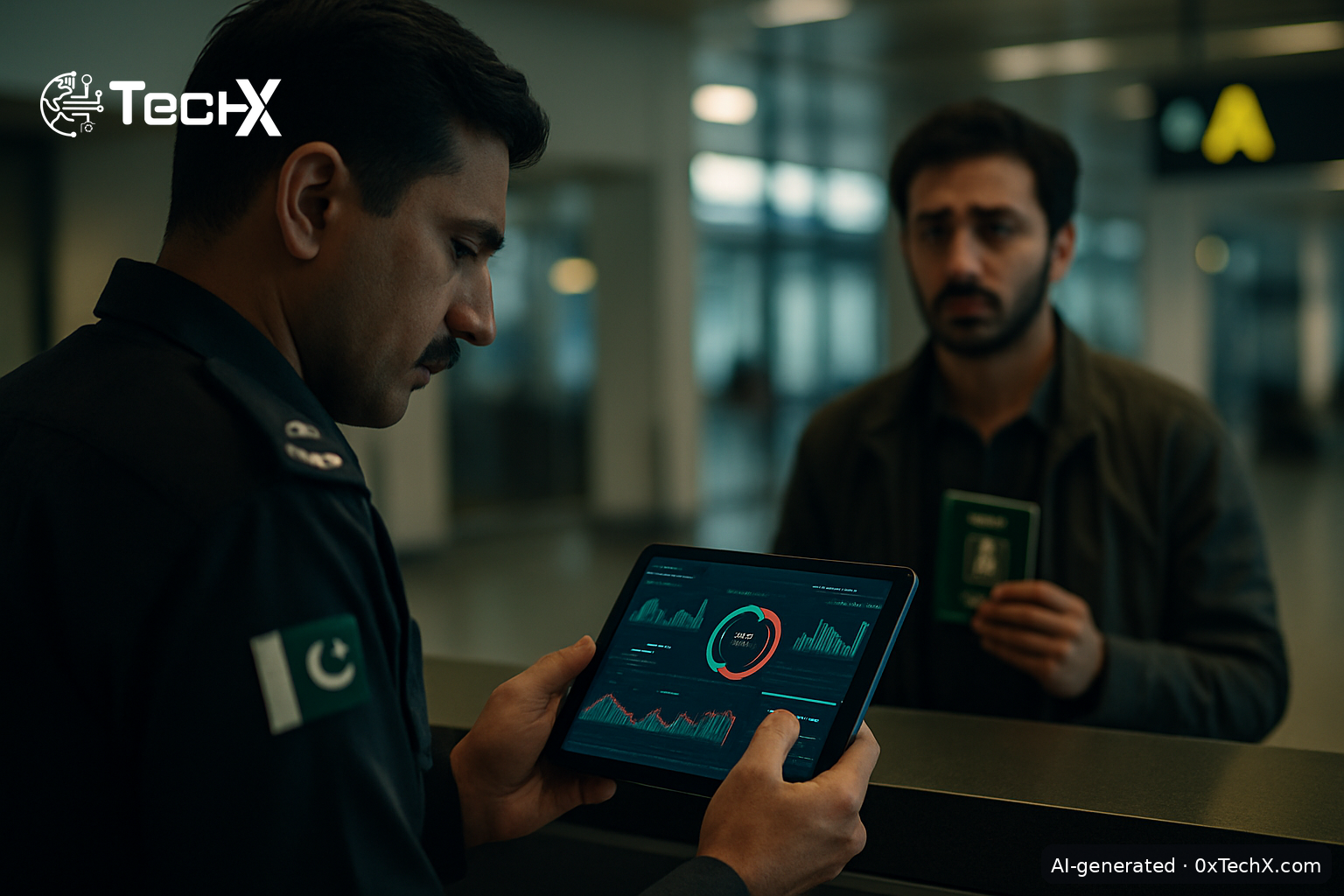
AI passenger profiling at Pakistan’s airports is no longer a future plan, it is already running, and it is already raising hard questions. The Federal Investigation Agency (FIA) has confirmed it uses an AI-powered risk analysis unit to decide, in real time, whether a traveller should be allowed to board a flight or be stopped. Officials say the system is saving lives and cutting human smuggling. Civil society groups say it is making life-changing decisions about citizens without a proper legal safety net.
How the FIA’s AI Passenger Profiling System Works
Pakistan has stepped up its use of artificial intelligence at border points to detect suspicious travel patterns and strengthen screening. A senior FIA immigration official confirmed: “We have started profiling passengers. We have a risk analysis unit that continuously feeds us data, and the data is processed through AI.”
The official said that AI helps the agency decide whether to stop a passenger from boarding, and that passengers who are prevented from boarding can challenge the decision through legal channels. In practice, that means a traveller can be turned back at the gate based on an algorithmic score, before any human officer has independently reviewed their case.
The FIA’s Immigration Risk Assessment Unit plays a central role. It creates profiles of high-risk or flight-risk passengers, people who may try to leave through illegal channels such as human smuggling networks. With AI-driven profiling and pre-arrival data, the unit aims to spot suspicious travel patterns and focus attention on a smaller number of cases, without slowing down the process for ordinary passengers.
The FIA has also finalised plans for an AI-powered mobile application that will transform immigration clearance at Pakistani airports by reducing processing time to about 10 seconds. Machine learning tools will generate passenger profiles after verification, strengthening risk assessment and screening functions at border points.
A pilot at Islamabad International Airport started in January 2026 for six months, with plans to scale to Lahore and Karachi by late 2027, alongside new e-gate installations by the Pakistan Airports Authority.
Why the FIA Says It Needs AI Profiling
The human cost of illegal migration is the FIA’s main justification. The technology-driven strategy follows the June 2023 capsizing of an overcrowded migrant boat off the Greek town of Pylos that killed 262 Pakistanis among about 650 migrants aboard. That disaster pushed the government to act faster on border controls.
The numbers behind the problem are striking. According to FIA data, about 15,800 Pakistanis travelled to Cyprus on visit visas between January 2025 and April 2026, but only 3,553 had returned by the end of the period. More than 57,000 travelled to Azerbaijan, with over 3,000 remaining abroad after the expiry of their visit visas.
FIA Karachi Deputy Director Immigration Shahzad Akbar warned that passengers from high-risk to low-risk categories and all passport categories will be strictly checked amid concerns over illegal agents and human smuggling networks. A recent example shows the system in action: the FIA stopped four passengers at Islamabad International Airport after officials suspected they were using Umrah travel to Saudi Arabia as cover for an illegal journey to Europe. Officials said digital evidence pointed to a route through Baku and Serbia.
Officials also point to scale as a reason to automate. The pilot targets a country confronting 143 wanted traffickers on the FIA’s Red Book. Pakistan processed nearly 27 million air passengers last year, creating real pressure for automation.
The Big Gap: No Data Protection Law
Here is the part most reporting on this story misses. Pakistan’s AI passenger profiling system is operating without a comprehensive data protection law. As of May 2026, Pakistan has no comprehensive, enacted personal data protection law. The closest equivalent is PECA 2016, a criminal statute that criminalises specific forms of data misuse but does not establish a general framework for how data must be collected, processed, stored, or shared.
There is no mandatory breach notification requirement, no data subject rights framework, and no dedicated data protection authority currently in operation. This means a passenger whose travel data feeds the AI risk score has no formal right to see that data, correct it, or demand to know how the algorithm scored them.
Importantly, the pending Personal Data Protection Bill, still not passed as law, does include a key protection. The Bill gives data subjects the right to not be subject to a decision based solely on automated processing, including profiling. Until that bill becomes law, that right does not legally exist for Pakistani travellers.
For context on the broader regulatory push, see how Pakistan is approaching new AI-related legislation and the need for updated digital laws.
Civil Society Groups Push Back
Rights organisations are watching this closely. Civil society groups like the Digital Rights Foundation and the Human Rights Commission of Pakistan have expressed concern over the potential use of AI surveillance tools, including profiling, with little transparency or safeguarding procedures in place.
Amnesty International has called on Pakistani authorities to ensure AI regulation follows human rights standards, and has specifically called for bans on AI-based practices including risk assessment and profiling tools that violate the rights of people, including migrants and asylum seekers.
In Pakistan, data-intensive technologies are often adopted without privacy impact assessments or community feedback. For example, the deployment of Safe City projects in Lahore and Islamabad occurred under executive orders without parliamentary debate or civil society involvement. Critics say the airport AI system is following the same top-down pattern.
The FIA’s answer to the accountability question is the appeals process. “We don’t take arbitrary decisions at all. There would be human error, but there are appellate authorities. If an aggrieved party thinks they have been offloaded on unjustified grounds, they can appeal.” Critics say that is not enough, an appeal after you have missed your flight is cold comfort, and there is no clear, public-facing process explaining exactly how to file one or how long it takes.
What This Means for Pakistani Travellers Right Now
If you are a Pakistani traveller, the practical reality is this: an AI system may score your travel history, visa records, destination, and other data points before you reach the counter. If the score is high, you may be pulled aside or stopped. You do have the right to appeal, but the process is not yet transparent or well-publicised.
The FIA says ordinary travellers with clean records should see faster clearance, not slower. The FIA’s Immigration Risk Assessment Unit will continue profiling high-risk passengers, including those attempting to leave through illegal means, while the new systems aim to strengthen border security and offer a faster, more efficient experience for legitimate travellers.
The best advice for now: carry complete, consistent travel documents; keep proof of your purpose of travel (hotel bookings, visa approvals, return tickets); and pre-register details in the FIA’s system if the app is available on your route.
Frequently Asked Questions
What is AI passenger profiling at Pakistan airports?
It is a system run by the FIA that uses machine learning to give each traveller a risk score based on their travel history, destination, visa records, and other data. A high score can trigger extra checks or stop a passenger from boarding. The goal is to detect human smuggling and illegal migration before a flight departs.
Can the FIA stop me from flying based on an AI decision alone?
Yes, currently it can. The FIA has confirmed that AI helps its officers decide whether to offload a passenger. If you are stopped, you have the right to appeal through the FIA’s appellate process, but Pakistan does not yet have a law that explicitly bans decisions based solely on automated profiling.
Is my travel data protected under Pakistani law?
Not fully. As of mid-2026, Pakistan has no enacted comprehensive data protection law. The Personal Data Protection Bill is still pending in parliament. Once passed, it would give citizens the right to challenge automated decisions about them. Until then, there is no formal legal framework governing how the FIA stores or uses your profiling data.
Who is pushing back against AI passenger profiling in Pakistan?
The Digital Rights Foundation, the Human Rights Commission of Pakistan, and Amnesty International have all raised concerns. They want transparency about how the algorithm works, independent oversight of the system, and a legal framework that protects travellers from errors or misuse before the technology is rolled out nationwide.