

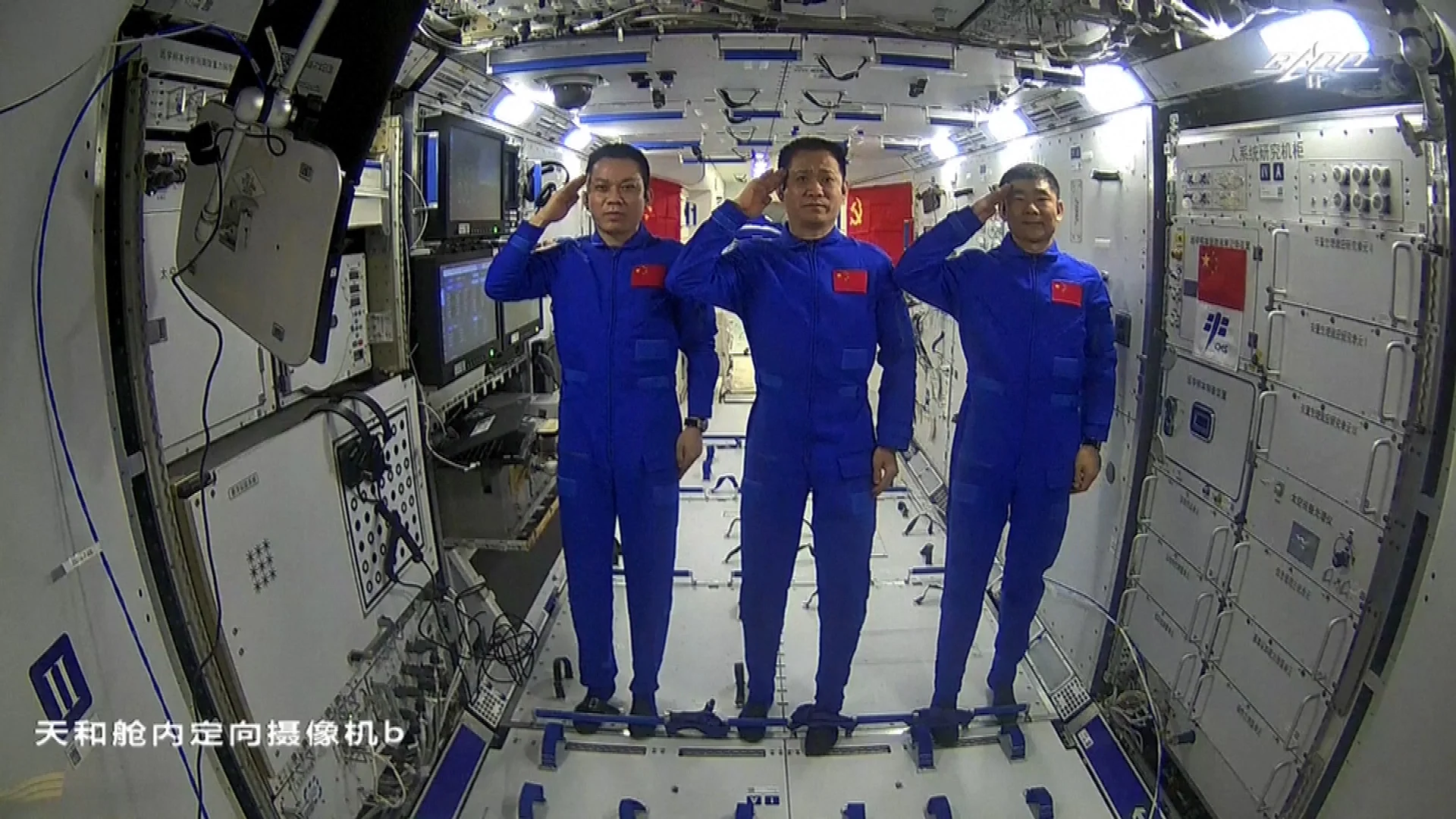
A significant step toward finishing the orbiting lab by the end of the year was made on Monday when astronauts boarded the new lab module of China’s space station for the first time.
The station is one of Beijing’s ambitious space program’s crowning achievements, which also includes the landing of robotic rovers on Mars and the Moon and the third-ever manned space mission by China.
Once finished, Tiangong, or the “heavenly palace,” will be permanently manned by alternating crews of three astronauts who will carry out research and test new technology.
After successfully launching from southern China the day before, Wentian, the second of Tiangong’s three main parts, docked with the station’s core module Tianhe on Monday, according to official media.
The three astronauts, who have been residing in the core module since June, opened the hatch a few hours after docking and entered Wentian, according to CCTV footage.
Blue jumpsuit-clad crew members were seen floating around the well-lit module before turning to face the camera and saluting.
According to the official news agency Xinhua, Wentian will concentrate on life sciences and biotechnology research, including cell research and growth tests on plants, fruit flies, and zebrafish.
According to state media, the module would house up to six people during crew changes because it has a living room for three more astronauts.
Launch plans call for the third and final module, another lab called Mengtian, to take off in October.
Once finished, Tiangong is anticipated to spend at least 10 years in a low orbit 400–450 km (250–280 miles) above Earth.
A space telescope with a field of vision 350 times larger than NASA’s Hubble Space Telescope will also be launched by China the following year.
Since the telescope will be in the same orbit as Tiangong, the space station will be able to dock with it when it needs to be refueled and serviced.
The International Space Station (ISS), a joint project of the United States, Russia, Canada, Europe, and Japan, is scheduled for retirement in 2024, while Nasa has indicated it may continue to operate as late as 2028.
To read our blog on “Moon mission series of NASA the Artemis will be initiated in August,” click here.