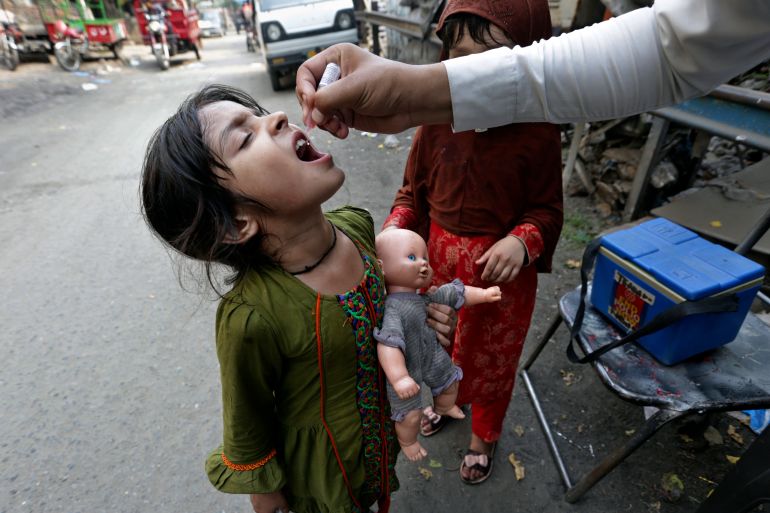
Pakistan’s National Polio Laboratory at the National Institute of Health (NIH) reported on Tuesday that a strain of Type-1 Wild Poliovirus (WPV1) genetically linked to Afghanistan has been found in Peshawar district.
This year’s total now stands at 11, thanks to the virus being found in sewage samples. For the seventh time, a strain with ties to the Afghan genome has been discovered in Pakistan, pointing to ongoing transboundary spread.
The Naray Khuwar collecting location, located just outside of Peshawar, is where the NIH says they obtained their environmental sample.
The fourth positive sample from Peshawar this year comes from the same collecting site as the previous three. An representative from the NIH informed a local news channel that in May, a positive strain was found at the Larama collection location.
The polio virus must be eradicated
The sample found is a YB3A cluster, a very dangerous form of Type 1 polio if not treated immediately. The genetic similarity to the September 2022 Asadabad (Afghanistan) environmental sample is 99.11 percent.
According to the official, in 2023 there was just one incidence of the disease reported in Bannu. The final case of virus in the area was reported in July of that year.
He elaborated on how collecting sewage samples from various parts of a district is a fundamental metric for tracking the efficacy of anti-polio campaigns. Children’s immune levels can be monitored, and the likelihood of illness transmission can be estimated.
Every month, the Pakistan Polio Programme conducts virus testing at 114 permanent environmental sites across the country.
To read our article about “Naegleria has claimed its 1st victim in Lahore” click here.