

The Pakistan-China digital corridor is now at the centre of CPEC 2.0, pushing the partnership beyond motorways and power plants into artificial intelligence, cloud computing, fibre-optic networks and cross-border digital trade. Pakistan recorded a record $4.6 billion in IT exports in FY2025-26, and this new digital layer of CPEC could determine whether that number doubles or stalls in the years ahead.
From Roads to Algorithms: What CPEC 2.0 Actually Is
The first phase of CPEC was about physical building blocks: roads, ports, and power plants. CPEC 2.0 is a different story. Pakistan and China formally agreed in July 2026 to deepen cooperation in trade, the digital economy, and artificial intelligence, with both sides calling for high-quality development under the new phase.
The shift is not just symbolic. CPEC 2.0 is expanding into data, AI, cloud infrastructure, e-commerce, cybersecurity, digital payments and industrial automation. The idea is that a digital corridor will sit alongside the physical one, cutting transaction costs and opening global markets to smaller Pakistani businesses that could never afford a physical presence abroad.
Pakistan-China Digital Corridor: The Building Blocks
The Pakistan-China digital corridor rests on several layers of infrastructure that are already taking shape:
- Fibre-optic networks and 5G. The framework calls for deploying high-speed connectivity, including links to China’s BeiDou satellite navigation system, to create a low-latency backbone for cross-border digital services.
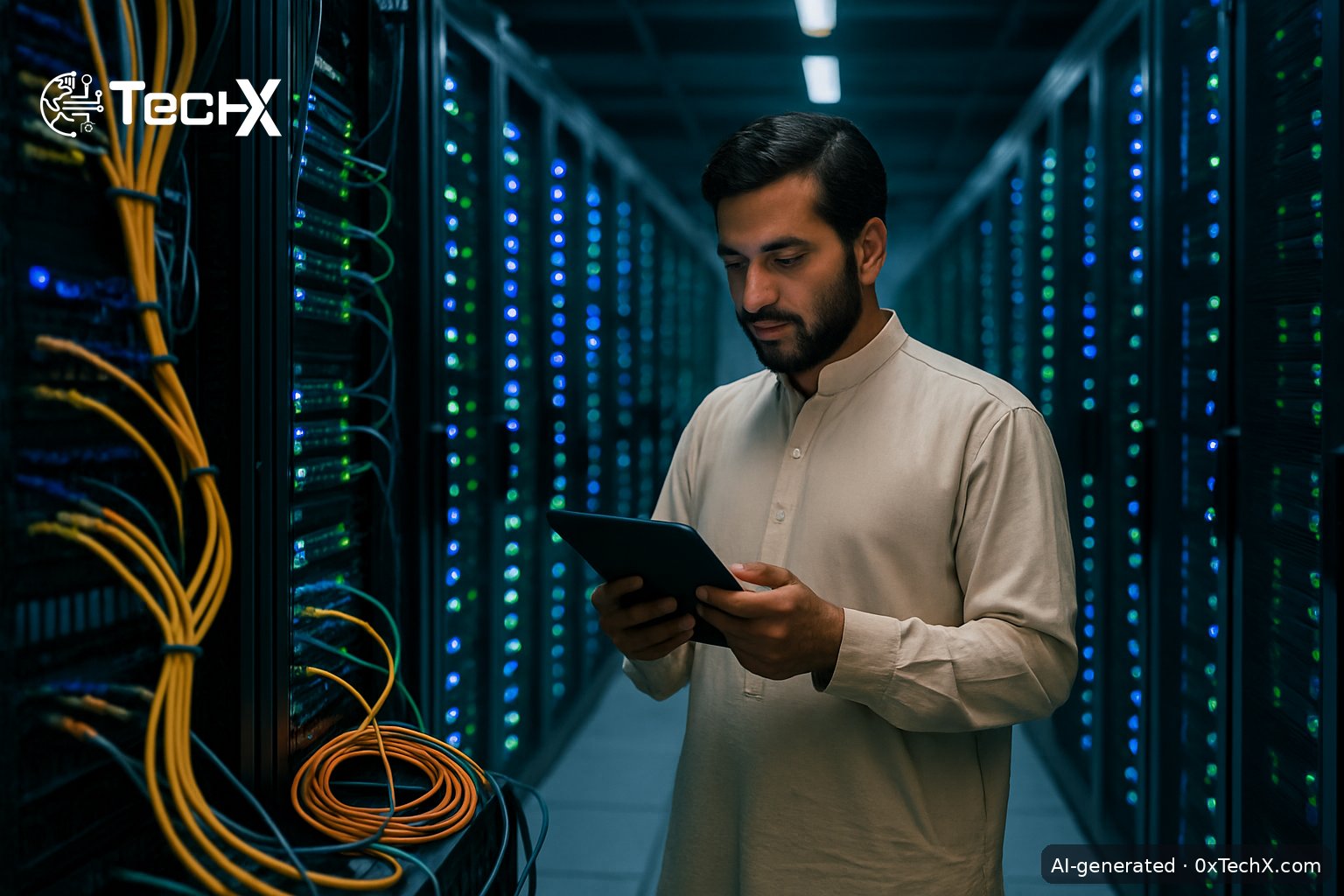
- Data centres. In July 2026, Pakistan inaugurated the Sky47 “Karakoram-01” facility at Capital Smart City near Islamabad, described as the country’s largest AI-ready Tier III data centre with 8.5 MW of power capacity, built with Chinese firm ZTE. A second 5 MW facility is planned at Port Qasim in Karachi.
- AI research. The Sino-Pak Centre for Artificial Intelligence in Haripur and the National Centre of Artificial Intelligence at NUST are already running joint research programmes. Pakistan is also pursuing a broader AI partnership with China covering computing infrastructure, skills development, start-up support and responsible governance.
- E-commerce and digital payments. The corridor framework includes harmonising cross-border payment systems and digital identities to reduce friction for Pakistani sellers reaching Chinese consumers and vice versa.
Pakistan’s $4.6 Billion IT Sector: The Asset China Needs
Here is what most coverage of CPEC 2.0 misses: Pakistan is not just a passive recipient of Chinese digital investment. It brings something real to the table.
Pakistan’s IT and ICT exports reached a record $4.6 billion in FY2025-26, up 21 percent from $3.8 billion the year before, according to State Bank of Pakistan data. The sector posted a trade surplus of $3.9 billion, the highest ever in Pakistan’s services history. Freelancer remittances alone jumped 78 percent, crossing $1.76 billion for the first time.
That talent base matters directly for the digital corridor. A software team in Lahore could serve a Chinese client remotely just as easily as it serves a client in London. In January 2026, Pakistan’s Embassy in Beijing organised a job fair with the China Overseas Development Association and China International Intellectech Group, creating a first practical link between Pakistani professionals and Chinese firms. In May 2026, Chinese group IBI Beijing United Technology announced it would set up a Pakistan Digital Economy Headquarters after a meeting with Prime Minister Shehbaz Sharif.
For freelancers and small IT firms across Pakistan, this matters. The US and European markets are crowded. The Chinese market, with its massive enterprise base and growing appetite for outsourced digital services, is largely untapped by Pakistani providers. The Pakistan-China digital corridor is the infrastructure that could change that.
What CPEC 2.0 Plans to Spend and Build
The scale of planned investment is significant. CPEC 2.0 comes with $65 billion in overall planned investment, of which roughly $26 billion has already been deployed. The new phase includes a $1 billion AI fund to support research and sovereign computing initiatives through 2030. Pakistan’s government has also agreed to revise the original CPEC Long-Term Plan during FY2026-27 to formally embed digital technology, space cooperation, and green development as core priorities alongside traditional infrastructure.
Five strategic corridors form the new framework: Growth, Innovation, Green Development, Livelihood, and Regional Connectivity. The digital economy sits across all five. The updated plan also calls for a stronger Joint Working Group mechanism with fixed meeting schedules and standardised reporting to actually track whether projects are delivering.
This is relevant for Pakistani tech companies and the hosting sector. More data centres, more fibre, and more Chinese enterprise clients all increase demand for reliable local digital infrastructure. If you want to understand what Pakistan’s broader digital economy needs to support this growth, the Pakistan tech delegation’s work in Silicon Valley shows that local startups are already building the kind of globally competitive products that could serve both Western and Chinese clients under CPEC 2.0.
The Honest Questions Pakistan Must Answer
No serious analysis of the Pakistan-China digital corridor is complete without asking the harder questions. Chinese AI frameworks, telecom equipment and cloud systems are becoming embedded in Pakistani institutions. That raises real questions about data sovereignty: when Pakistani government data or business data sits on Chinese-built infrastructure, who sets the rules?
Pakistan risks becoming a consumer of imported technology rather than a producer if technology transfer is not built into digital cooperation agreements as a legal requirement. Joint ventures in AI, cloud computing and semiconductor assembly should include mandatory provisions for local skills development, university partnerships and localised research. Without those conditions written into contracts, the digital corridor could widen Pakistan’s dependence rather than reduce it.
Special Economic Zones also need a serious digital upgrade. Several zones underperformed in CPEC’s first phase because physical infrastructure alone did not attract sustained investment. The next generation of SEZs should be built as smart industrial clusters with automation, high-speed connectivity and AI-enabled manufacturing support built in from day one, not added later.
Frequently Asked Questions
What is the Pakistan-China digital corridor?
The Pakistan-China digital corridor is the technology component of CPEC 2.0. It covers fibre-optic networks, data centres, AI research partnerships, cloud computing infrastructure, e-commerce links and digital payment systems between the two countries. It is designed to complement the physical infrastructure built under CPEC’s first phase.
How does CPEC 2.0 affect Pakistan’s IT industry?
CPEC 2.0 opens a new potential market for Pakistani IT firms and freelancers: Chinese enterprises. With Pakistan’s IT exports already at a record $4.6 billion and a growing pool of software, AI and digital services talent, the corridor provides a framework for Pakistani providers to serve Chinese clients remotely without relocating. It also brings Chinese investment into local data centres and AI research.
What data centres are being built under this framework?
Pakistan’s largest AI-ready Tier III data centre, Sky47 “Karakoram-01,” was inaugurated in July 2026 at Capital Smart City near Islamabad, built in partnership with Chinese firm ZTE at 8.5 MW capacity. A second 5 MW facility is planned at Port Qasim, Karachi. Both form part of the digital infrastructure layer of CPEC 2.0.
What are the risks for Pakistan in the digital corridor?
The main concerns are data sovereignty and technology dependency. If Pakistani government and business data sits on Chinese-built platforms without clear local data protection rules, strategic information could be exposed. Analysts also warn that without mandatory technology transfer clauses in cooperation agreements, Pakistan may remain a buyer of Chinese tech rather than building its own capabilities.