
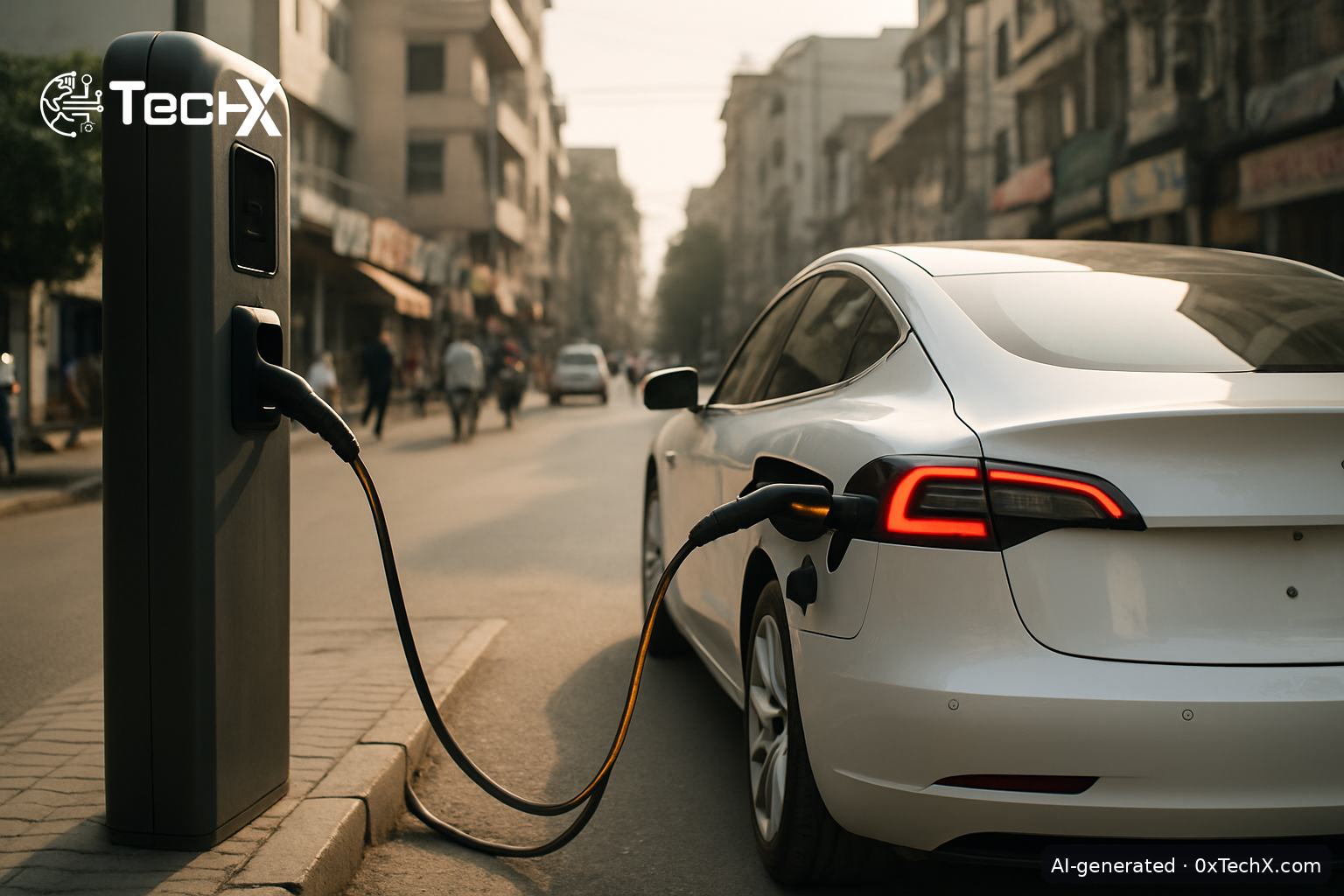
Pakistan EV charging infrastructure is at a crossroads. Carmakers are flooding the market with electric and hybrid models at a pace the country’s charging network simply cannot match yet. Industry data shows roughly 87% of new vehicle launches planned for the second half of 2026 will be electric or hybrid, but a buyer outside Karachi, Lahore, or Islamabad may struggle to find a single public charger near home.
87% of New Launches Are Electric or Hybrid, The Numbers
According to data compiled by brokerage firm Arif Habib Limited, approximately 23 new vehicle models are scheduled to enter the Pakistani market between June and December 2026. Of these, nine are fully electric vehicles, while 11 belong to the plug-in hybrid or range-extended electric vehicle categories. That leaves only three models running on a conventional petrol engine alone.
Automobile analyst Shafiq Ahmed Shaikh says the sector’s shift began under the Auto Industry Development and Export Policy 2021, 26, with automakers increasingly redirecting investment away from internal combustion engines toward EVs, hybrids, and battery-powered technologies. Pakistan’s push toward electric mobility is also aimed at reducing dependence on imported fuels.
The results are already visible at the low end of the market, the number of electric vehicles in Pakistan has risen from just 567 in 2021 to over 80,000 by June 2025. By July 2025, a total of 65 manufacturers had secured certificates to produce electric two- and three-wheelers locally, while two certificates were issued for local assembly of electric cars and SUVs.
Pakistan EV Charging Network Is Dangerously Thin
Here is the problem. Car launches are moving fast. Charging stations are not. Pakistan’s public EV charging network is extremely limited, as of 2025, there are just over 20 publicly accessible charging stations nationwide, mostly in big cities. More recent estimates put the figure slightly higher, but independent market sources count between 30 and 50 publicly accessible EV charging stations across the whole country, with most concentrated in Karachi, Lahore, Islamabad, and Rawalpindi.
Even with recent growth, Pakistan’s charging network is still very limited compared to demand potential, nations with similar population sizes have hundreds to thousands of public chargers. Limited rural penetration remains a core problem, with most charging infrastructure urban and very few chargers available in smaller towns.
There is also a second layer to this problem that most coverage ignores: load-shedding. Even where a charger exists, an unreliable grid means it may not actually be usable at the moment a driver needs it. This makes the real effective coverage even thinner than the raw station count suggests.
What the Government Plans to Do
The government is aware of the gap. Pakistan’s New Energy Vehicle (NEV) Policy was officially launched in June 2025, emphasising green mobility, local manufacturing growth, and energy security. Its headline targets are 30% of all new vehicle sales to be electric by 2030, rising to 50% by 2040.
On the infrastructure side, the plans are ambitious. The government aims for 3,000 charging stations by 2030, starting with 40 fast chargers along key highways. At the heart of the highway plan are 40 Level 3 fast charging stations along major motorways and the N-5 highway, spaced roughly 120 km apart, a distance designed to reduce range anxiety for drivers travelling between cities.
Around 240 stations are planned in the current fiscal year, with government and regulators coordinating the rollout through NEECA and other agencies. The Sindh government has also approved over 600 EV charging stations to be installed in key cities and on highways, showing localized commitment to the national goal.
To make running a charging station financially sensible, the Power Division introduced roughly a 44% discount on electricity tariffs for certified EV charging stations, cutting the price from approximately PKR 71 per unit to PKR 39.70 per unit. Clear regulations also give investors and operators a more predictable environment to build this network, with standards, safety requirements, and tariff frameworks that help make charging stations commercially viable.
Where Things Are Stalling
The gap between policy and reality is still wide. NEECA has issued 13 licences for charging stations and five units have arrived at sites, but progress is slow because of red tape, with imports, customs duties, and approvals from different agencies holding back the rollout.
Grid and approval delays are another bottleneck, licences may be granted, but grid connectivity, meter installations, and local NOCs slow down the actual opening of stations. Until those back-end processes speed up, the number on paper will keep outpacing chargers in the ground.
Islamabad currently offers Pakistan’s most EV-friendly environment, Lahore is emerging as a strong contender with rapidly expanding infrastructure, while Karachi buyers are advised to secure a dependable home charging setup before switching to electric. For buyers anywhere outside these three cities, the advice is even more cautious.
What This Means for the Average Pakistani Buyer
If you are thinking about buying one of the many new EVs or plug-in hybrids launching this year, the honest picture is this: the running costs can be lower. Driving around 40 km daily and switching from a petrol sedan to an EV can potentially save up to Rs. 40,000 per month, depending on your charging method and usage. But those savings mostly apply to people with home charging, which requires a stable electricity supply and a setup cost many households cannot easily absorb.
The figures underline a significant industry-wide pivot toward cleaner technologies, despite ongoing concerns surrounding charging infrastructure, electricity availability, and the high cost of EV ownership in Pakistan. The 87% electrification wave in launches is a real shift in industry direction, but the charging network needs to grow far faster, especially outside major cities, for ordinary buyers to feel confident making the switch.
For readers interested in the broader digital and tech policy changes shaping Pakistan’s economy, our coverage of Pakistan’s emerging digital assets policy shows similar patterns of ambitious targets meeting on-the-ground readiness gaps.
Frequently Asked Questions
How many public EV charging stations are in Pakistan right now?
Current estimates put the number of publicly accessible EV charging stations between 30 and 50 across the entire country, concentrated almost entirely in Karachi, Lahore, and Islamabad. Rural areas and smaller cities have very limited or no public charging access.
What is the government’s plan to expand Pakistan EV charging infrastructure?
Under the NEV Policy 2025, 2030, the government is targeting 3,000 charging stations by 2030. The immediate plan includes 40 Level 3 fast chargers on major motorways and the N-5 highway, placed about 120 km apart. NEECA, the National Energy Efficiency and Conservation Authority, regulates and licences all charging station operators. Pakistan’s official EV policy framework is also available through the Ministry of Industries and Production.
Why are so many new car launches in Pakistan electric or hybrid in 2026?
Automakers are responding to government incentives introduced under the Auto Industry Development and Export Policy 2021, 26, rising fuel costs, and growing consumer interest in lower running costs. Industry data shows 20 of 23 planned new models in the second half of 2026 feature electric or hybrid powertrains, roughly 87% of all launches.
Is it practical to buy an EV in Pakistan today if you live outside a major city?
Not easily. Charging access outside Karachi, Lahore, and Islamabad is very limited. Buyers in smaller cities or rural areas should plan for home charging as their primary option and check whether their local grid is stable enough to support overnight charging reliably. The situation is expected to improve as new stations come online, but meaningful rural coverage is still a few years away.