

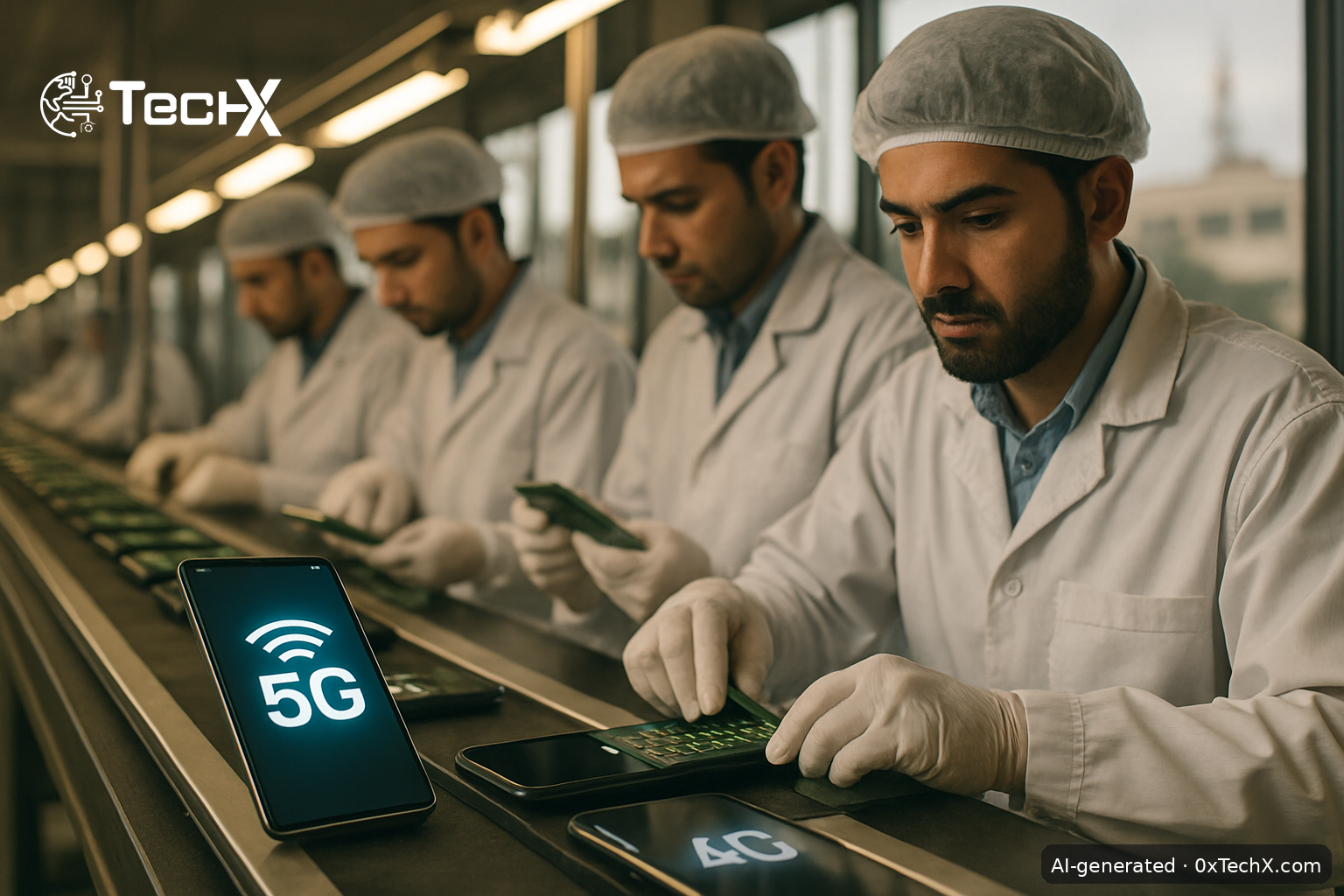
Pakistan mobile phone imports hit $1.89 billion in FY2025-26, a 26.6% jump from the previous year, even as local assembly plants churned out handsets at a record pace and 5G-ready device production reached a clear turning point. The numbers, drawn from official data, tell a story about a market moving in two directions at once: more spending on imported phones, and a fast-growing local industry quietly building the device base that Pakistan’s new 5G networks will need.
Pakistan Mobile Phone Imports: The Full FY26 Picture
Pakistan’s mobile phone imports rose 26.55% to $1.889 billion in FY2025-26, compared with $1.492 billion in the preceding fiscal year, according to official data. In rupee terms, handset imports increased 27.24% to Rs530.492 billion from Rs416.937 billion in FY2024-25.
This is a strong rebound. The increase reflects a recovery in commercial handset imports after a decline during fiscal year 2024-25, when the country imported mobile phones worth around $1.494 billion, down more than 21% from $1.898 billion in FY2023-24. In short, demand was suppressed for a year, likely because of import restrictions and a weak rupee, and it came back with force in FY26.
Overall telecom imports reached $2.690 billion during FY2025-26, up 27.97% from $2.102 billion a year earlier. This broader figure includes network equipment and other telecom gear, suggesting that operators were also spending heavily on infrastructure alongside consumer demand for handsets.
Even at month level, the trend stayed strong to the end. Imports also increased in June, rising 11.88% month-on-month to $141.556 million from $126.527 million in May 2026.
Why Are Imports Rising When Local Assembly Is Booming?
This is the question most headlines skip. The answer is simple: local plants mostly make budget to mid-range phones, while people who want a premium or flagship device still buy imported ones. Volume goes local; value stays imported.
Pakistan’s local manufacturing and assembly plants produced 11.17 million mobile handsets during the first five months of 2026, compared with 1.91 million units imported commercially during the same period. That is roughly a six-to-one ratio in unit terms, yet the import bill is still close to $1.9 billion. The gap shows that imported phones carry a much higher price tag per unit.
Of the locally assembled devices, 4.92 million were smartphones, while 6.25 million were 2G feature phones. Feature phones are cheap and high-volume; they keep the assembly numbers large but add little to the import bill, because most of the parts and finished designs are made locally or under local licence.
For a broader sense of scale: during the full calendar year 2025, local manufacturers assembled 30.21 million mobile handsets, while commercially imported devices stood at 2.37 million. Local assembly is not a small side story, it is the main channel through which most Pakistanis actually get their phones.
The 5G Assembly Shift Nobody Is Talking About
Here is the most interesting number in the whole dataset. Pakistan also assembled 101,005 5G-enabled handsets in May 2026, compared with 553,079 units during the whole of 2025. That means in a single month, local plants produced roughly one-fifth of what they made in the entire previous year. If you annualise May’s pace, it comes to over 1.2 million 5G devices a year, more than double 2025’s full-year output.
The monthly data backs this up. Monthly production increased steadily during 2026, rising from 32,581 units in January and 36,306 units in February to 76,315 units in March and 162,040 units in April. April’s 162,040 units was the peak so far. May’s 101,005 was slightly lower but still well above earlier months. The ramp-up is real and accelerating.
According to official data, local manufacturers produced 961,326 5G smartphones by the end of May 2026, reflecting increasing investment by global smartphone companies in Pakistan’s domestic assembly sector. The brands doing this are well-known names. Samsung, through Lucky Motor Corporation, assembled 396,268 devices, accounting for more than 41% of total locally produced 5G handsets. Vivo ranked second with 248,508 smartphones, while Infinix and Tecno produced 216,560 5G devices.
This matters because it closes a gap in Pakistan’s 5G story. A network without affordable devices is just expensive infrastructure. The regulator said the growing availability of locally assembled 5G smartphones is expected to improve affordability and support wider adoption of 5G services across Pakistan.
Pakistan’s 5G Networks Are Already Live
The device surge is happening alongside a real network rollout. Pakistan officially entered the 5G era following the March 2026 spectrum auction, during which 480 MHz of spectrum was allocated, generating around $510 million, approximately Rs141 billion, in government revenue. Commercial 5G services were initially launched in major cities including Islamabad, Rawalpindi, Lahore, and Karachi, with expansion to additional urban centres planned in phases.
Early speed results are promising. Average 5G download speeds were recorded at 135.42 Mbps on Jazz, 133.65 Mbps on Ufone, and 108.66 Mbps on Zong. Those are real-world speeds that would transform mobile internet use for most Pakistani consumers, who are used to far slower 4G connections.
But to get those speeds, you need a 5G-capable phone. Consumers will need handsets that support the assigned 5G spectrum bands to access next-generation mobile services, and the regulator also noted that some compatible devices may require software updates before 5G functionality can be enabled.
There is still a gap between supply and demand. The PTA reported that 3.81 million 5G compatible devices have been registered across the country. With over 180 million mobile subscribers in Pakistan, the 5G-ready share is still small, but it is growing fast. You can read more about the challenges facing Pakistan’s broader 5G rollout, including fiberization targets, in our earlier coverage of Pakistan’s 5G tower fiberization progress and operator targets.
What This Means for Pakistani Consumers
PTA data shows that smartphones now account for 72.3% of devices operating on mobile networks, while 2G phones represent the remaining 27.7%. That 27.7% is still tens of millions of people on very basic phones. As locally assembled 5G devices get cheaper, that group could leapfrog from 2G all the way to 5G-capable smartphones, skipping 3G and 4G entirely, much like rural Pakistan once leapfrogged landlines for mobile.
Pakistan’s overall digital connectivity picture is also relevant here. The country’s low ICT development score, noted in our piece on Pakistan’s ITU ICT Development Index ranking and device gaps, shows that affordable locally assembled 5G phones could be one of the most direct tools for improving that score.
The import bill will stay high as long as Pakistanis want premium devices that are not yet made locally. But the 5G assembly ramp-up shows the gap is closing.
Frequently Asked Questions
How much did Pakistan spend on mobile phone imports in FY2026?
Pakistan mobile phone imports totalled $1.889 billion in FY2025-26, a 26.55% rise from $1.492 billion in the previous year. In rupee terms, the bill was Rs530.492 billion.
How many 5G phones are being made locally in Pakistan?
Local plants assembled 961,326 5G smartphones by end of May 2026. In May alone, they produced 101,005 units, compared with 553,079 in the whole of 2025. Samsung, Vivo, Infinix, and Tecno lead local 5G production.
Why are phone imports rising even though local assembly is growing?
Local plants focus on budget and mid-range phones at high volume. Consumers who want flagship or premium handsets still buy imported models, which cost far more per unit. So local assembly dominates unit numbers while imports dominate import value.
Are 5G networks already running in Pakistan?
Yes. After the March 2026 spectrum auction, commercial 5G services launched in Islamabad, Rawalpindi, Lahore, and Karachi. Average speeds are above 100 Mbps on all three operators. More cities are planned in phases.