


Astronomers have created a map of the universe’s dark matter that covers a fourth of the sky. The findings demonstrate that the formation of huge structures and gravitational lensing follow the traditional cosmological model, putting Einstein’s theories to the test over the universe’s lifetime.
Dark matter is an enigmatic element that does not interact with light but only with gravity.
After weighing all of the visible stars within the galaxy, the visible galaxies in the sky are more massive than they appear to be.
The degree of gravitational lensing caused by galaxy clusters, which amplifies light from even more distant sources, reveals the concentration of dark matter within the cluster.
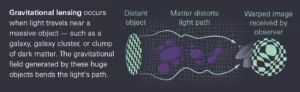
The Atacama Cosmology Telescope (ACT) consortium, which included academics from several universities across the world, created the map.
Dark Matter Map Results
The results have been reported in several papers that have been sent to the Journal of Cosmology and Astroparticle Physics. On the ACT website, pre-print versions of the study are accessible.
With measurements of light from the Cosmic Dawn, a time of strong star formation roughly 380,000 years after the Big Bang, the map shows the distribution or clumpiness of dark matter.
The Atacama Cosmology Telescope in Chile’s Andes provided the information for the map.
Astronomers have carefully monitored how dark matter warps the Cosmic Microwave Background (CMB) on its 14 billion lightyear journey to Earth. The CMB is the light from before the Cosmic Dawn.
The results indicate that dark matter distribution in the universe is, in fact, consistent with predictions made by the conventional cosmological model.
Cosmologist Blake Sherwin says, “We have mapped the invisible dark matter across the sky to the largest distances, and clearly see features of this invisible world that are hundreds of millions of light-years across. It looks just as our theories predict.”
Astronomers have carefully monitored how dark matter warps the Cosmic Microwave Background (CMB) on its 14 billion lightyear journey to Earth. The CMB is the light from before the Cosmic Dawn.
The results indicate that dark matter distribution in the universe is, in fact, consistent with predictions made by the conventional cosmological model.
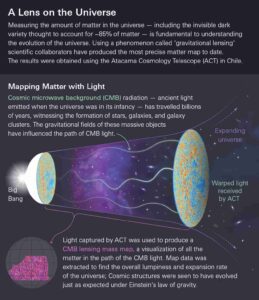
Lead author of one of the papers, Mathew Madhavacheril says, “We’ve made a new mass map using distortions of light left over from the Big Bang. Remarkably, it provides measurements that show that both the ‘lumpiness’ of the universe and the rate at which it is growing after 14 billion years of evolution are just what you’d expect from our standard model of cosmology based on Einstein’s theory of gravity.”
Director of ACT, Suzanne Staggs says, “It’s a bit like silhouetting, but instead of just having black in the silhouette, you have texture and lumps of dark matter, as if the light were streaming through a fabric curtain that had lots of knots and bumps in it.
Astrophysicist Neelima Sehgal says, “This ACT result showcases the precision that can be obtained with measurements of the gravitational lensing of the microwave background, as well as the promise of future more sensitive CMB experiments in terms of furthering our understanding of the physics of the Universe.”
The famous blue and yellow CMB image is a snapshot of what the universe was like in a single epoch, about 13 billion years ago, and now this is giving us the information about all the epochs since.”
After 15 years of use, the ACT instrument was decommissioned in 2022. However, it is anticipated that conclusions based on the observations will continue to be released.
At the same location, a new instrument called the Simons Observatory is being built, and it will start operating in 2024. Ten times more quickly than ACT, the telescope will be able to map the sky.
To read our blog on “How To connect with oneself in a parallel universe,” click here.