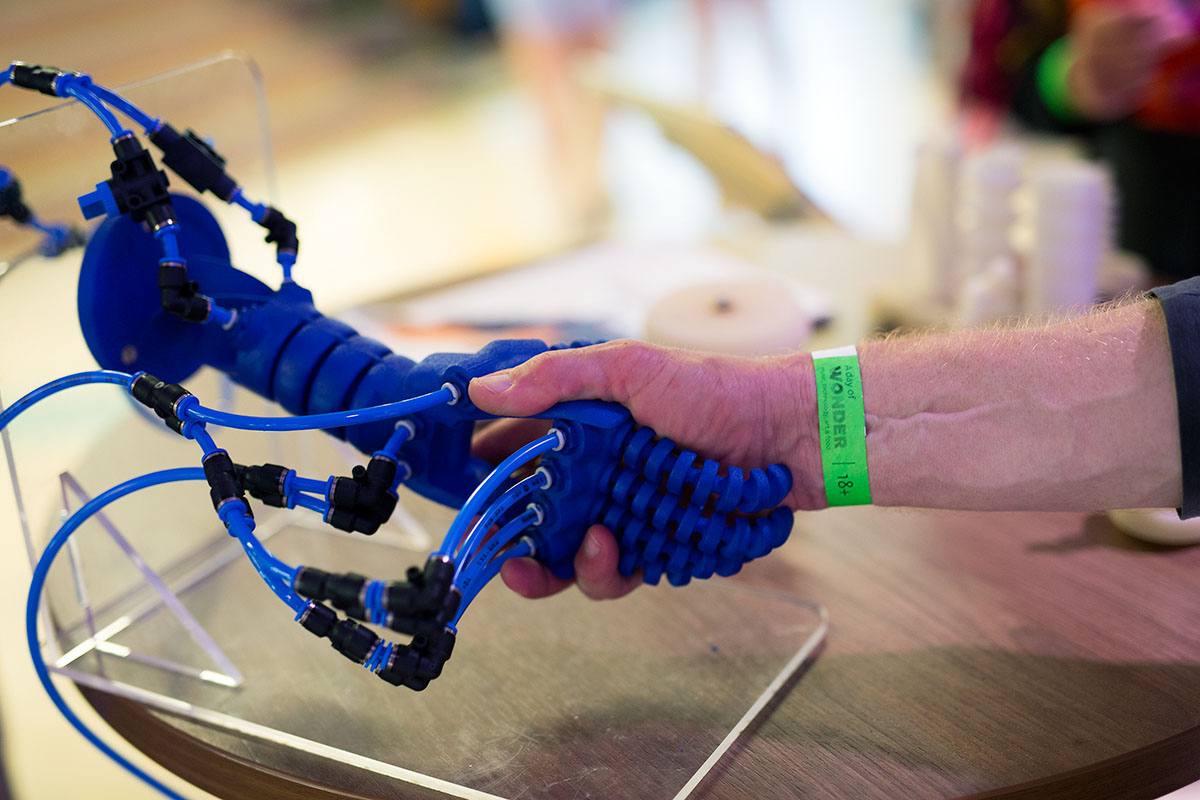
The subfield of robotics known as “soft robotics” is finding increasing use in a wide range of settings, from healthcare and manufacturing to emergency response and beyond.
The use of soft robots in medicine could improve surgical accuracy and patient safety. They can be used to make factories safer and more productive by protecting workers from dangerous tools.
Soft robots can be used to reach inaccessible areas during disaster response, making rescue efforts more efficient.
However, it has proven difficult to accommodate all of these different use cases. It is important for the materials used in soft robotics to be malleable, conformable, and tear- and strain-resistant.
Because of the need for integrated sensing, actuation, and the execution of artificial intelligence algorithms, it is not uncommon for these same materials to also need to be electrically conductive.
The use of silicones, elastomers, hydrogels, and shape memory alloys has been explored extensively, but these materials rarely satisfy all of the criteria required for a soft robot to perform at its best.
Carnegie Mellon University Engineers Find Breakthrough in Soft Robots
Carnegie Mellon University engineers in the Soft Machines Lab have recently described a novel self-healing, electrically conductive organogel composite material.
This material’s properties show promise for use in a variety of soft robotics applications. It can self-heal after being damaged to restore its mechanical strength and has a low stiffness and a high degree of stretchability.
The material was also developed to be highly electrically conductive in order to facilitate complex operations.
Silver microflakes and gallium-based liquid metal microdroplets have been infused into a polyvinyl alcohol-sodium borate base to create an organogel composite.
Doing so creates a percolating network within the material that is both highly conductive and resistant to loss of continuity.
Hydrogels are susceptible to drying out, so the water was replaced with the organic solvent ethylene glycol.
Extensive testing has shown that this formula can maintain its beneficial effects against dehydration and other undesirable property changes for more than 24 hours.
Using the conductive organogel to power a soft robotic snail was a great way to showcase the material’s novel qualities.
They demonstrated that they could almost completely cut the link, and the snail would keep moving, albeit more slowly.
A simple finger press demonstrated how the robot’s self-healing capability works by restoring full functionality in an instant.
By severing connections on purpose and reattaching in a different way by pressing the loose ends together, this self-healing property can be used to create reconfigurable circuits.
The engineers demonstrated how this could be used to add new functionality to a toy car by temporarily cutting power to the motor and then using spare bits of the material to power an LED on the car’s roof.
Finally, the team showed that by applying the material to human skin, they could obtain electromyography readings from different parts of the body.
In this study, we took readings of your hands, forearms, and calves to see how active you were.
The promising results of these tests suggest that the gel could be used as a bioelectrode to interface with body-mounted electronics in future wearable devices.
The group’s next step will be to integrate this research with their ongoing efforts to create artificial muscles. They envision a future where entire robots can be crafted from pliable substances.
To read our blog on “200 check-in robots soon to be deployed by Emirates airlines,” click here.