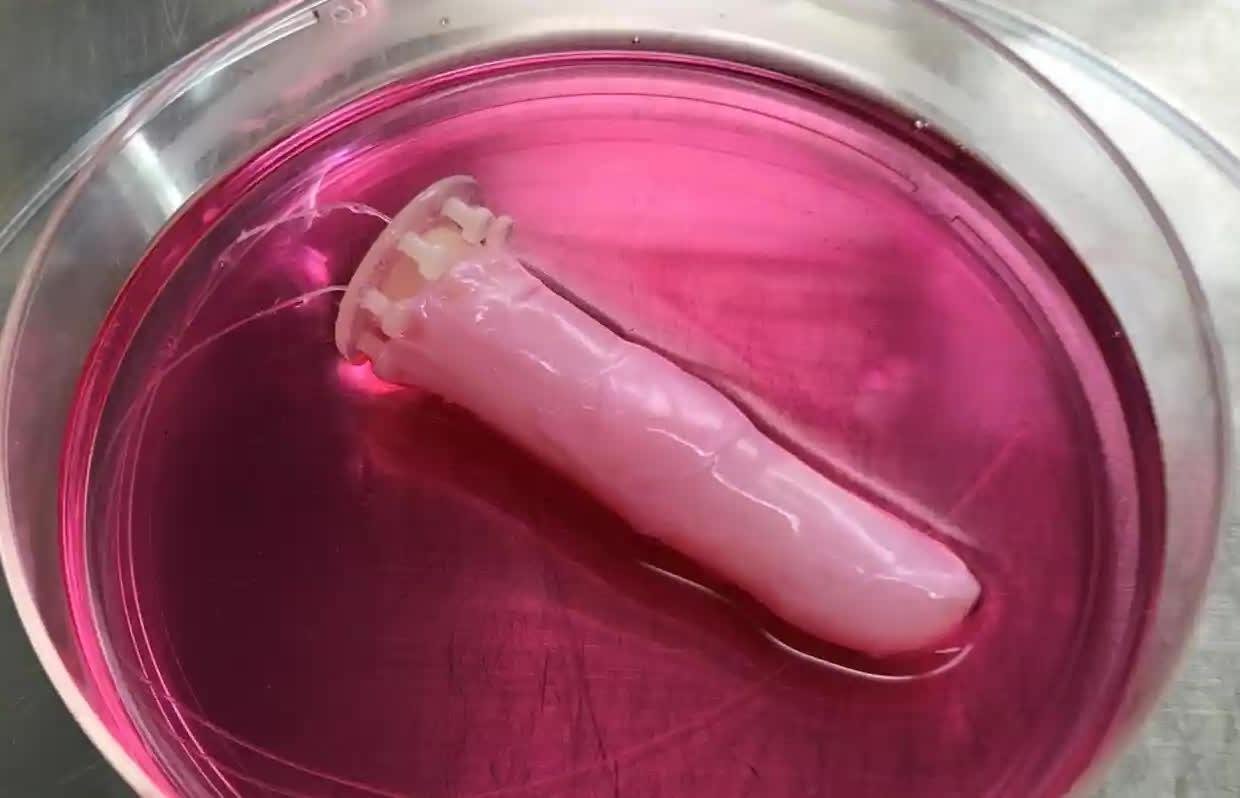
Japanese scientists have discovered a technique to wrap living skin over a robotic finger, making it feel unnervingly lifelike and “slightly sweaty,” bringing humanity one step closer to human-like robots that will not wipe us all out.
An article on the subject was published in the journal Matter by the University of Tokyo team. It recounts how a robotic finger was immersed in a cylinder filled with collagen and human dermal fibroblasts, which are located in the connective tissue of the skin.
This creates a layer for human epidermal keratinocytes to adhere to—a key epidermal cell type that also generates keratin, which binds skin cells together and creates a waterproof barrier.
In addition to resembling a human finger in appearance and feel, the scientists discovered that the skin could heal itself after being severed, though it did so with the help of a band-aid-like coating of collagen.
“The finger looks slightly sweaty straight out of the culture medium,” said University of Tokyo professor Shoji Takeuchi. “Since the finger is driven by an electric motor, it is also interesting to hear the clicking sounds of the motor in harmony with a finger that looks just like a real one.”
Before the skin can accurately replicate the skin of a human, further work needs to be done. It isn’t as tough as human skin, and the lack of a circulatory system to deliver water and nutrients necessitates keeping it moist.
The researchers want to overcome this by implanting channels beneath the dermis that function similarly to blood arteries.
Future enhancements to the realism include artificial sweat glands, sensory neurons, hair follicles, and nails.
You might be asking why we’re making such human-like robots that cause the uncanny valley effect and fears of machine revolts. However, as Takeuchi notes, “I think living skin is the ultimate solution to give robots the look and touch of living creatures since it is exactly the same material that covers animal bodies.” He said this will help “build a new relationship between humans and robots.”
The researchers are also developing a skin-covered robot face that will be soon announced.
To read our blog on “World’s tiniest remote-controlled walking robot created by researchers,” click here.