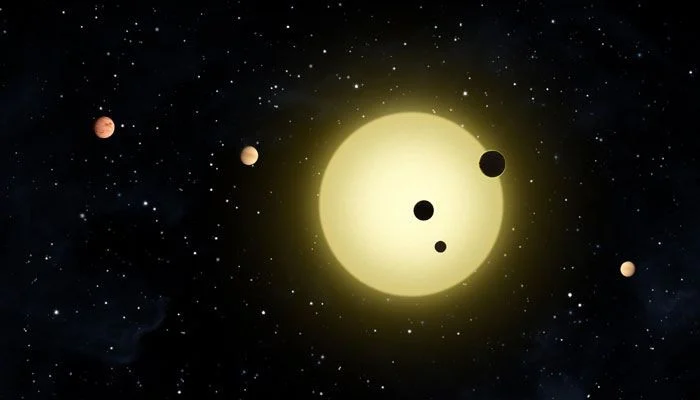
The atmosphere of an exoplanet has been discovered for the first time to contain the rare metal terbium. A brand-new technique for analyzing exoplanets has also been created by researchers at a University in Sweden, allowing for a more thorough examination of these planets.
The galaxy’s hottest exoplanet, KELT-9 b, orbits a far-off star at a distance of around 670 light years from Earth. Since its discovery in 2016, the celestial body, which has an incredible average temperature of 4,000 degrees Celsius, has inspired astronomers all around the world.
The heated, strange object’s atmosphere is revealed in the new study published in Astronomy & Astrophysics.
“We have developed a new method that makes it possible to obtain more detailed information. Using this, we have discovered seven metals, including the rare metal terbium, which has never before been found in any exoplanet’s atmosphere”, says Nicholas Borsato, PhD student in astrophysics at Sweden University.
Rare Metal Terbium
The group of rare earth elements known as lanthanoids includes terbium. The chemical was found in the Ytterby mine in the Stockholm archipelago in 1843 by the Swedish chemist Carl Gustaf Mosander.

Terbium is extremely uncommon in nature, and now, the Bayan Obo mining region in Inner Mongolia produces 99 percent of the world’s supply.
“Finding terbium in an exoplanet’s atmosphere is very surprising”, says Nicholas Borsato.
By measuring how bright stars shine, scientists are able to find the majority of exoplanets. The brightness of an exoplanet star lowers as it approaches its star.
The researchers were able to remove the dominating signals from the atmosphere of KELT-9 b using their sophisticated measurement technique. This creates the opportunity to learn more about other exoplanets’ atmospheres.
“Learning more about the heavier elements helps us, among other things, to determine the age of the exoplanets and how they were formed”, explains Nicholas Borsato.
Planets outside of our solar system are known as exoplanets, often known as extrasolar planets. The first exoplanet orbiting a neutron star was found with certainty in 1992.
The first exoplanet with a sun-like star was found three years later. More than 5,000 exoplanets have been discovered since then. Exoplanets frequently cause people to wonder whether there is life elsewhere in the universe.
Another step towards understanding how planet atmospheres function is finding heavy metals in the atmospheres of ultra-hot exoplanets.
“The better we get to know these planets, the greater chance we have of finding Earth 2.0 in the future”, concludes Nicholas Borsato.
To read our blog on “Soft robots, A new breakthrough of 2023,” click here.