
AI is undeniably everywhere, powering our devices, answering our questions, and even assisting us in creating essays and articles.
Because of its broad breadth, AI is also vulnerable to harmful use, which could be a concern in the future.
A recent study by cybersecurity firm Home Security Heroes highlighted the possible use of AI for password cracking.
The study emphasises the speed and efficacy of AI in password cracking, using the new AI-driven application PassGAN as an example, and raises password security concerns.
PassGAN was used by the researchers in the study to analyse over 15.6 million passwords.
The tool cracks 51% of typical passwords in less than a minute, 65% in less than an hour, 71% in less than a day, and 81% in less than a month, according to the data.
However, there is no need to fear just yet, since the company has supplied a table outlining the most difficult passwords to crack.
A 12-character password with uppercase and lowercase characters, for example, could take the tool 289 years to crack.
Adding numbers to the mix would extend the duration to 2,000 years, and symbols would make it even more difficult to break, taking up to 30,000 years.
Check out the table below
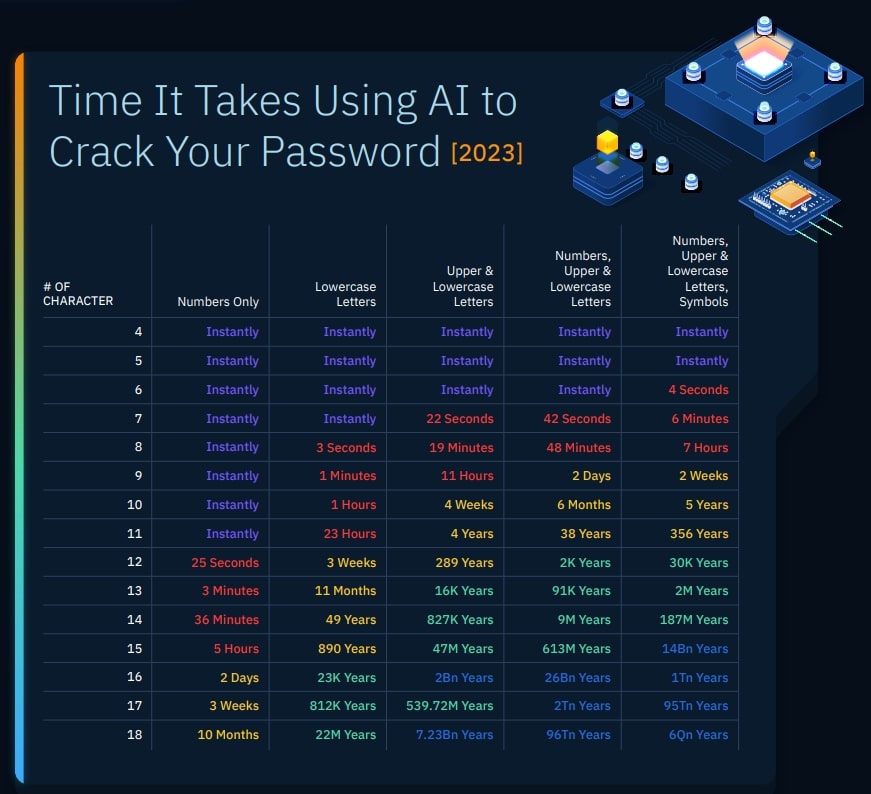
Passwords that are at least 12 characters long and not merely made up of simple numbers are recommended by the cybersecurity business since they are difficult to crack.
The website provides a tool that assesses how long it would take to crack a randomly generated password to assist users in creating strong passwords.
AI Tools & Instagram
An AI tool developed by a third-party business, Yoti, that calculates your age simply by scanning your face is one of the new techniques Instagram is exploring allowing users to confirm their age.
Creating an Instagram account requires that you be at least 13 years old, although the business has historically done little to enforce this requirement. It didn’t even bother to ask new users their birthday before to 2019, much less make an effort to validate this information.
However, Instagram has added an increasing number of age-verification tools and ways to distinguish between younger users and adults after receiving criticism from privacy and child safety experts.
Instagram now only prompts users to confirm their age when adolescents attempt to alter their birth date to reflect that they are 18 or older.
Users may send in images of different ID cards to prove their age, and as of right now, users in the US will now have two more options: social vouching and AI estimation.
Instagram will ask three of the user’s mutual followers to authenticate their age for the first technique, social vouching.
The reciprocal followers have three days to answer to Instagram’s request and must be over the age of 18. The second technique, known as AI estimation, is submitting a video selfie to Yoti, a third-party business that use machine learning to determine an individual’s age.
AI Tool will identify Pictures
With its Metaverse dreams in tatters, Meta is now looking to artificial intelligence to drive its next stage of development.
The Segment Anything Model is one of Meta’s most recent ideas, which the social media company revealed on Wednesday.
With a few clicks, Segment Anything allows users to identify certain things in an image.
While still in demo mode, Segment Anything can take a snapshot and individually identify the pixels that make up everything in the image, allowing one or more items to be isolated from the rest of the image.
To read our blog on “Google’s new AI tool can create photorealistic images from words,” click here