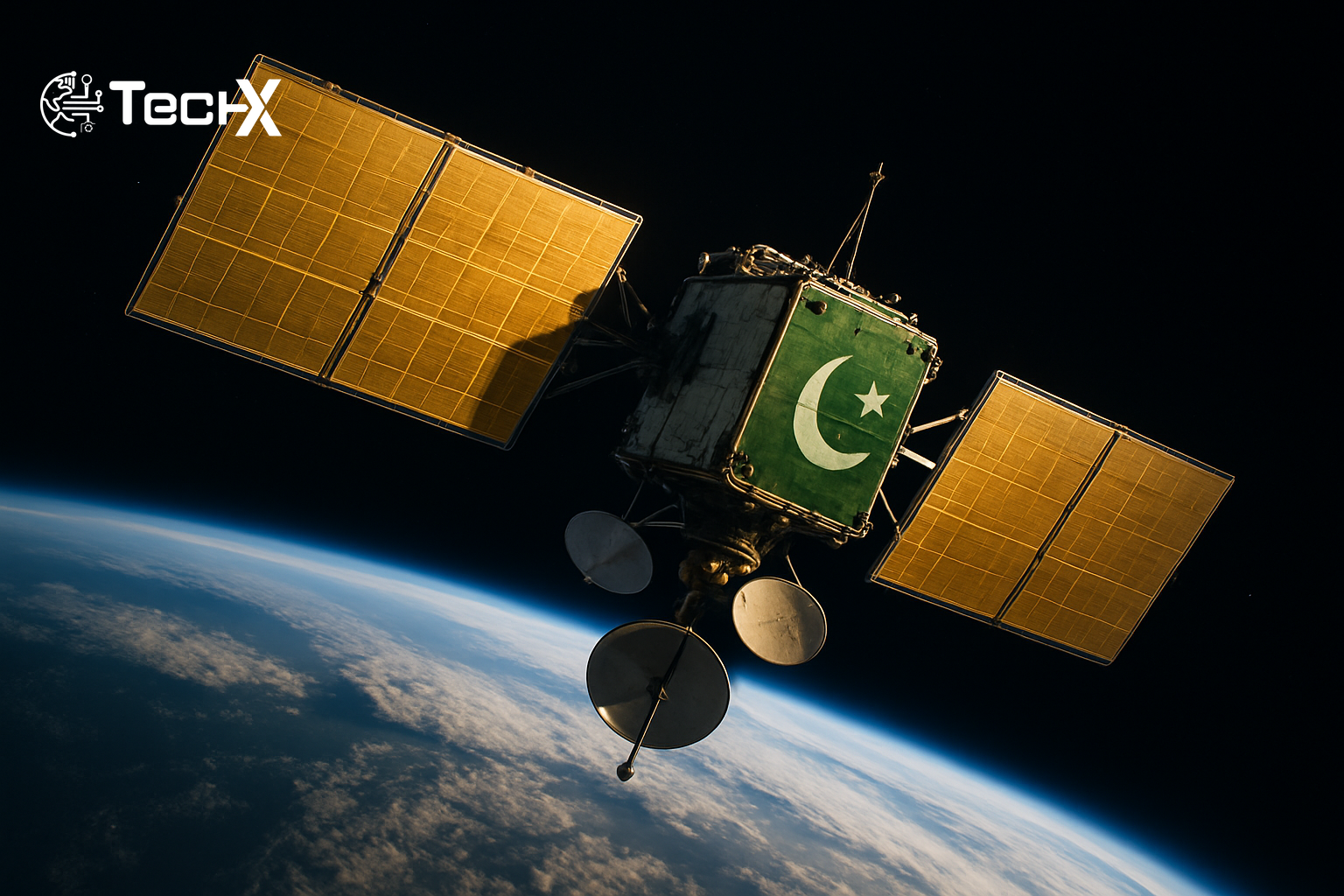
The PakSat-2 satellite project has cleared its first major government hurdle, with Pakistan’s Central Development Working Party (CDWP) giving it in-principle approval and sending it to the Executive Committee of the National Economic Council (ECNEC) for final sign-off. The project is budgeted at Rs37.19 billion and is now one of the most time-sensitive space decisions Pakistan has ever had to make.
What Is the PakSat-2 Satellite Project?
The PakSat-2 project covers the development and deployment of a communication satellite in Geostationary Orbit (GEO), along with upgrading existing ground control and operations centres at Lahore and Karachi. In simple terms, Pakistan is building a new satellite to keep its place in space and improve national communications.
The project will enhance satellite command, control, tracking, and operational capabilities by using SUPARCO’s existing technical expertise and infrastructure. SUPARCO (Space and Upper Atmosphere Research Commission) is Pakistan’s national space agency and will lead the effort.
This development will enhance national communications, improve navigation, and aid in natural disaster management. That covers a wide range of benefits for everyday Pakistanis, from better TV signals in remote areas to emergency communications during floods.
What Does PakSat-2 Replace?
The decision was taken at a CDWP meeting which backed the launch of PakSat-2 at an estimated cost of Rs37.192 billion, to replace PakSat-1R, which is set to complete its 15-year life later this year.
PakSat-1R has been Pakistan’s workhorse satellite since 2011. Launched on the Long March 3B launch vehicle, the satellite has a design life of 15 years with initial goals to provide broadband internet access, digital television broadcasting, remote and rural telephony, emergency communications, tele-education, and tele-medicine services across South Asia and Central Asia, Eastern Europe, East Africa, and the Far East.
The satellite has 30 transponders: 18 in Ku-band and 12 in C-band. To ensure high reliability, two fully redundant Satellite Ground Control Stations were established in Karachi and Lahore. PakSat-2 will take over at the same critical slot in orbit while upgrading these same ground stations.
It is also worth noting that Pakistan already launched PakSat-MM1 in 2024. PakSat-MM1 is a Pakistani communication satellite launched on 30 May 2024, in a joint effort of SUPARCO and the China Aerospace Science and Technology Corporation, from China’s Xichang Satellite Launch Centre. But PakSat-MM1 occupies a slightly different slot at 38.2° East. PakSat-2 is aimed at the primary 38° East position that PakSat-1R currently holds. Both slots together form the backbone of Pakistan’s satellite fleet.
Why the Orbital Slot Is the Real Urgency
This is not just about having a new satellite. It is about not losing a piece of space that Pakistan has held for decades.
It was reported that besides these objectives, the satellite launch was critical to protect Pakistan’s satellite slot, which could be lost forever if it remained vacant for three years.
Orbital slots in geostationary orbit are regulated by the International Telecommunication Union (ITU). Countries must keep a satellite operating at their registered position, or they risk losing that right permanently to another nation. At the centre of Pakistan’s satellite journey lies the 38° East geostationary orbital slot, home to the Paksat satellite system, managed by SUPARCO. This orbital position plays a strategic role in broadcasting, telecommunications, internet backhaul, and national digital infrastructure, not only for Pakistan but also for large parts of South Asia, the Middle East, Africa, and beyond.
Losing this slot would mean Pakistan could no longer broadcast to its own population from its own satellite position. It would have to pay to use other countries’ satellites for basic services, which is both expensive and a loss of digital sovereignty.
Pakistan has faced this exact risk before. In 2001, the country scrambled to lease a foreign satellite just to keep its 38° East slot active. That leased satellite was eventually replaced by PakSat-1R in 2011. Now history is repeating itself, and PakSat-2 is the answer.
What the PakSat-2 Satellite Project Includes
The project is more than just a new satellite. Here is what is planned:
- A new geostationary communication satellite to hold the 38° East orbital slot.
- Upgraded ground control centres in both Lahore and Karachi to handle satellite command and control.
- Enhanced capabilities for tracking, monitoring, and operating the satellite from Pakistan.
- Use of SUPARCO’s existing technical teams and infrastructure to keep costs managed.
The PakSat-2 project seeks to enhance national satellite communication capabilities through the deployment of a new communications satellite and the upgradation of ground control facilities.
CDWP Approval: What It Means and What Comes Next
The Pakistan Communication Satellite-2 (PakSat-2) worth Rs37.192 billion was accorded in-principle approval and recommended to ECNEC for further consideration. ECNEC is the body that gives final approval for big government projects. Once ECNEC clears PakSat-2, the government can begin procurement and contracts.
The CDWP on Thursday approved 15 development projects worth Rs34.74 billion and recommended nine major projects, with a cumulative cost of Rs431.02 billion, to ECNEC for final approval, underscoring the government’s focus on technology, connectivity, and infrastructure-led growth. PakSat-2 was one of the biggest tech-sector items on that list.
This CDWP meeting was busy. Among the other approvals was a Rs13 billion National AI Ecosystem Development Programme and a Rs7.93 billion Emerging Technologies Data Centre for sovereign AI infrastructure. If you want to read about another project cleared at the same session, check out our coverage of the government 4G network for 10,000 officials that also received CDWP clearance.
What This Means for Pakistan’s Digital Future
A satellite is not just a piece of metal in space. For Pakistan, it is a tool for connectivity in places where fibre cables cannot reach. Rural schools use satellite links for online classes. Remote hospitals rely on them for telemedicine. Disaster-struck areas depend on them when ground networks go down.
Beyond that, having your own satellite means you are not dependent on another country’s goodwill for basic communications. That is what digital sovereignty means in practice.
Pakistan has stepped up efforts to expand its digital infrastructure as part of a broader strategy to boost economic growth, improve public services, and attract investment, prioritizing AI, digital governance, and broadband connectivity. PakSat-2 fits squarely into that plan.
The clock is ticking, though. With PakSat-1R reaching the end of its designed life in 2026, the government needs ECNEC to approve funding quickly so that procurement and launch preparations can begin without delay. A gap in the 38° East slot, even a short one, carries real risk under international satellite rules.
Frequently Asked Questions
What is PakSat-2?
PakSat-2 is Pakistan’s next planned communication satellite. It will be placed in geostationary orbit at 38° East to replace PakSat-1R, which ends its operational life in 2026. The project was given in-principle approval by the CDWP at a cost of Rs37.19 billion and now needs final ECNEC clearance.
Why does Pakistan need a new satellite so urgently?
PakSat-1R was launched in 2011 with a designed life of 15 years. That life ends in 2026. If Pakistan leaves its orbital slot at 38° East empty for three years, international rules allow other countries to claim it permanently. The PakSat-2 project is meant to prevent that from happening.
What services does the 38° East satellite slot support?
The 38° East slot supports TV broadcasting, broadband internet in rural areas, government communications, telemedicine, tele-education, and emergency response services across Pakistan. It also covers parts of the Middle East, South Asia, East Africa, and Europe.
Who runs Pakistan’s satellites?
SUPARCO, Pakistan’s national space agency, owns and operates the country’s satellites. The commercial marketing of satellite capacity is done through Paksat International, which is a subsidiary of SUPARCO and serves broadcasters, cellular operators, and internet providers across three continents.