Pakistan launched 5G services in early 2026 after a landmark $507 million spectrum auction, but only around 18% of the country’s 58,423 cell sites are connected to fibre optic backhaul. Without fibre, 5G towers cannot deliver the real-world speed gains consumers expect — and experts warn that at least 60% fibrisation is needed before ordinary Pakistanis feel a genuine difference. Here is a clear breakdown of why the fibre backhaul gap is the most critical obstacle standing between Pakistan and a true 5G future.
What Happened at the Spectrum Auction?
On March 9–10, 2026, the Pakistan Telecommunication Authority (PTA) held what many are calling a watershed moment for Pakistan’s telecoms sector. In three rounds, the country raised $507 million by assigning 480 MHz of spectrum to Jazz, Ufone, and Zong — with Jazz buying 190 MHz, Ufone 180 MHz, and Zong 110 MHz.
This marks a near-tripling of the total spectrum assigned to mobile operators, expanding it from 274 MHz to over 750 MHz. The PTA mandated that commercial 5G services must go live within three to six months of the auction’s conclusion, and operators must deploy 1,000 new sites annually, with at least 200 targeting existing coverage gaps in underserved areas.
On paper, this is a genuine breakthrough. The auction nearly tripled Pakistan’s usable spectrum — a critical step given that between 2022 and 2025, 46 million new subscribers had joined without any matching increase in spectrum. But spectrum alone tells only half the story.
Pakistan 5G Fibre Backhaul: The Hidden Bottleneck
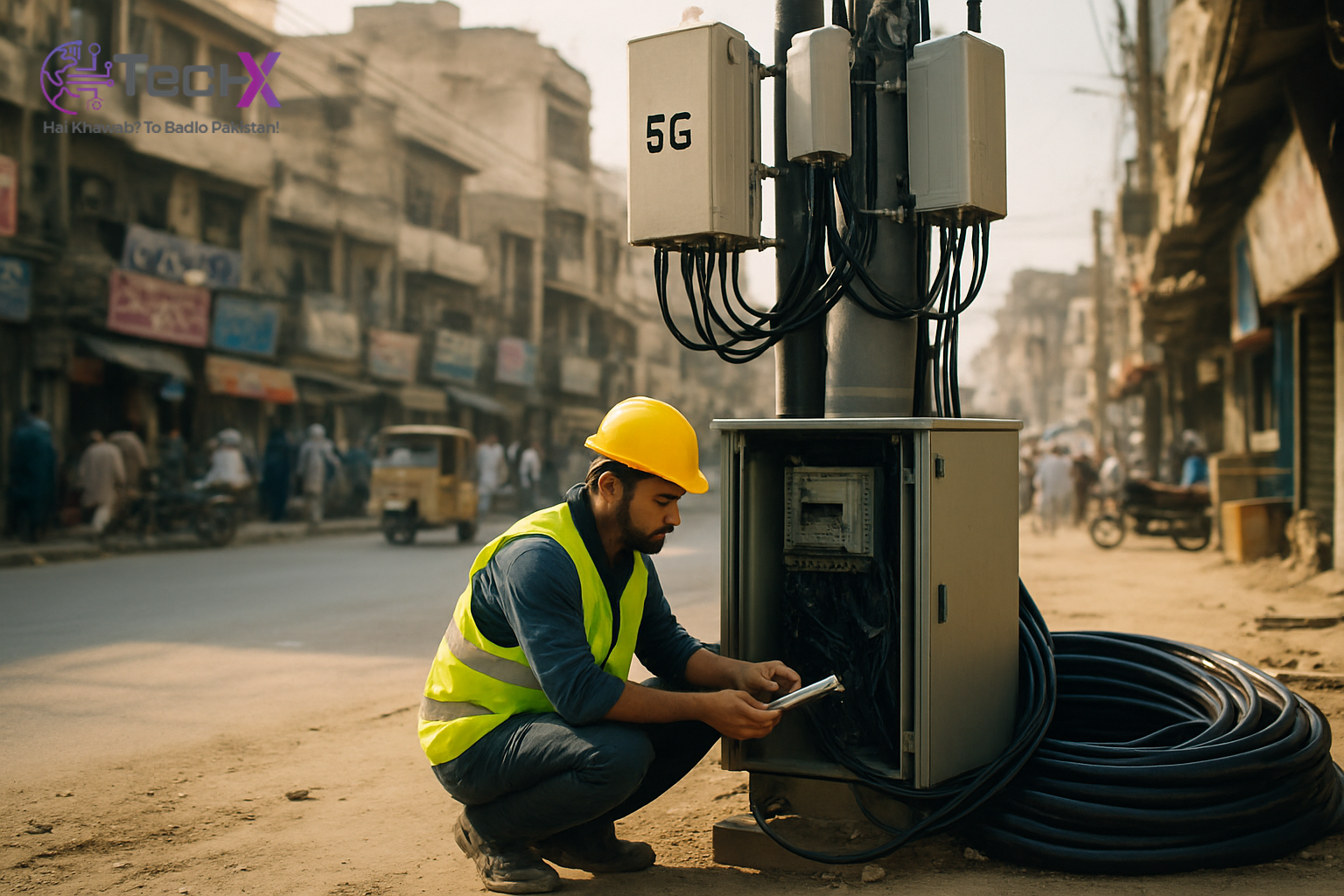
The uncomfortable truth is that buying spectrum is the easy part. The harder, more expensive challenge is making sure cell towers can actually carry 5G traffic — and that requires fibre optic backhaul: the physical cable that connects a tower to the wider internet.
The most pressing challenge lies in the physical infrastructure required to carry 5G signals. Towers alone are not enough; the real bottleneck is the backhaul — the network that connects cell sites to the core.
Globally, fibre-optic cable is the gold standard, capable of carrying terabits per second with latency measured in fractions of a millisecond. For 5G standalone networks, backhaul bandwidth above 10 Gbps per site and round-trip times under 5 milliseconds are essential.
Pakistan is far from meeting those requirements. Only 18% of the country’s 58,423 cell sites had been fibrised as of June 2025, and Pakistan currently has around 234,752 kilometres of deployed optical fibre cable, including 77,851 km of long-haul fibre and 156,901 km of metro fibre. Experts say this remains insufficient for the country’s rising digital requirements.
The remaining 85 percent of sites rely on microwave radio links — links that have fixed capacity ceilings, degrade in bad weather, and cannot scale to the traffic loads that 5G will generate.
What Does This Mean for Pakistani Consumers?
A 5G icon appearing on your phone’s screen does not mean you are getting 5G speeds. If your nearest tower runs on a microwave backhaul link, the data bottleneck sits a step behind the tower itself.
Pakistan is already ranked among the slower countries for mobile internet. According to Ookla’s Speedtest Global Index, Pakistan sits at around 98th for mobile internet, with average download speeds of about 25 Mbps — while India ranks 27th, Sri Lanka 78th, and Bangladesh 92nd. Worldwide, average mobile internet speeds are around 60 Mbps — meaning Pakistan is running at less than half the global average even on 4G.
Less than 2% of Pakistani mobile users currently own 5G-capable handsets, which cost between Rs 40,000 and Rs 100,000, putting them well out of reach for most consumers. Even as operators flip the switch on 5G-capable towers, the mass market will not feel the benefit for some time.
During early trials, the technical potential is clearly there: Jazz 5G testing in Islamabad recorded average download speeds of 1,452 Mbps and average upload speeds of 68 Mbps during trials. But real consumer performance will depend on rollout density, device compatibility, and how much spectrum is activated in live networks.
The Cost of Catching Up
Fibrising Pakistan’s tower network is expensive work. Fiberizing a single site costs between $10,000 and $20,000 — and with tens of thousands of sites needing upgrades, the capital commitment extends well beyond the half-billion dollars raised in the auction.
There is also a regulatory dimension. Right-of-way approvals remain one of the principal barriers to expansion, with multiple authorities — including municipalities, cantonments, and development bodies — involved in the process. This fragmentation causes delays of 12 to 18 months and raises costs, although the government’s recent decision to abolish right-of-way charges on key corridors has provided some relief.
Other constraints include high capital expenditure, inflation, low average revenue per user, and taxation — all of which discourage faster investment in trenching and last-mile fibre.
What the Government Is Targeting
Officials are not ignoring the problem. IT Minister Shaza Fatima Khawaja has been unusually direct about the scale of the challenge. Speaking at the EU–Pakistan Business Forum 2026, she said: “Only 16 percent of our towers are fiberized at this point. Our target is that in the next three years, we will increase that to almost 60 percent.” She added that Pakistan is also working to expand fiberized home passes from around 2–3 million to at least 10 million within the next two years.
The government’s abolition of Right of Way charges for fibre deployment — reduced from Rs 36,000 per kilometre to zero — removes a significant barrier to the backhaul buildout that 5G requires.
Out of a total allocation of Rs 141 billion, the government has earmarked Rs 35.7 billion for telecom operators under the Universal Service Fund (USF) to expand optical fibre cable networks in different regions.
Analysts note that the trajectory of improvement, while real, is gradual. In 2024, Pakistan had 55,777 total cell sites with 14.8% fibrisation. In 2023, the figure stood at 13.2% — meaning the country is adding roughly 1.5–3 percentage points per year. At that pace, hitting 60% would take far longer than three years without a significant step-change in investment and policy execution.
For a broader picture of Pakistan’s digital infrastructure ambitions and the data challenges that underpin policy decisions like these, see Pakistan’s First IT Census: Why the Data Gap Matters.
What Needs to Happen Next
- Accelerate fibre trenching: The RoW charge abolition is a strong start, but permitting fragmentation across municipal and cantonment bodies needs a single-window solution.
- Expand USF investment in fibre: Rural and peri-urban towers are the hardest and most expensive to fibrize — public funding through the USF is critical here.
- Make 5G handsets affordable: With under 2% of users owning 5G-capable phones, import duty structures and local assembly incentives for mid-range 5G devices are essential to create demand.
- Tower-sharing models: Shared infrastructure lowers the per-site capital cost for multiple operators simultaneously.
- Skilled workforce: The rapid deployment of advanced 5G infrastructure is being hindered by a shortage of skilled and experienced workers in the telecom sector.
Frequently Asked Questions
Has Pakistan officially launched 5G?
Yes. Pakistan crossed a long-awaited milestone with the launch of 5G services in select parts of the country, following the government’s spectrum auction held on March 9–10 in Islamabad, where 480 MHz of spectrum was sold for $507 million. Commercial services are rolling out in major urban centres, though nationwide coverage remains years away.
Why does fibre backhaul matter for 5G?
Only 15–18% of Pakistan’s cell towers are connected to fibre optic backhaul, and without fibre, towers simply cannot deliver the speeds that 5G promises — regardless of how much spectrum they hold. Microwave backhaul, used by the majority of towers, cannot handle the multi-gigabit throughput that 5G standards demand.
When will average Pakistanis experience real 5G speeds?
The honest answer is: not immediately. In practice, the real consumer story over the next year may not begin with a 5G icon. It may begin with whether 4G feels less congested and more consistent. Widespread 5G benefits are contingent on hitting the government’s 60% fibrisation target — a multi-year infrastructure project, not a switch that gets flipped overnight.
What is Pakistan’s internet speed ranking globally?
Pakistan is falling behind its neighbours in digital connectivity, ranking near the bottom globally for both mobile and fixed broadband speeds according to Ookla’s Speedtest Global Index — sitting at around 98th for mobile internet with average download speeds of about 25 Mbps. For context, the global average mobile download speed is roughly 60 Mbps, meaning Pakistan operates at less than half that benchmark even before 5G is factored in.