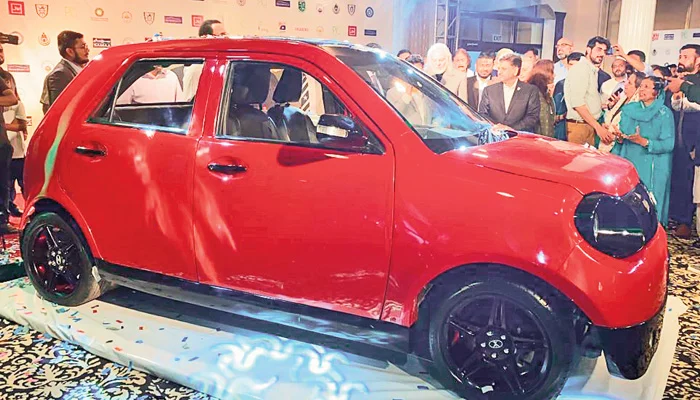
On the occasion of Pakistan’s Independence Day, DICE Foundation introduced the Nur-E 75, the country’s first electric vehicle, at the Beach Luxury Hotel in Karachi.
The vehicle, billed as the nation’s first indigenous electric vehicle, was created and developed by the DICE Foundation, a US-based non-profit organization led by Pakistanis living abroad in the US, EU, etc., with assistance from the local academic community and business community.
Dr. Khurshid Qureshi, the chairman and founder of the DICE Foundation and a specialist in the development of autonomous vehicles, stated during a presentation that Pakistan has only imported innovation since it is founding 75 years ago, whereas South Korea and China have grown exponentially during that time.
“South Korea learned to make television from Japan and now it is making better TVs,” he said during the ceremony. “I cannot stress enough on the significance of this innovation and how it will be a game-changer both for Pakistan’s economy as well as for the well-being of the people.”
He added that EVs were the way of the future for the car industry and that “we have wasted enough time importing.”
He revealed information regarding the hatchback Nur-E 75 and stated that the start of commercial production is anticipated for the final quarter of 2024. The business is called Jaxeri in honor of a Muslim scientist.
“This electric car will play a phenomenal role in the context of the environment and climate change and will help us move away from non-renewable fuel consumption. This prototype is a 5-seater hatchback, but we also have plans to develop a sedan and small SUV on the same platform,” said Dr. Qureshi.
Additionally, he expressed gratitude to all the project’s collaborators, including NEDUET, DSU, NCA, TEVTA Punjab, NUST, SSUET, Amreli Steels, PSG, and Kruddson Aluminum.
“Around $60-$80 million financing is needed for this project to complete.”
According to Dr. Qureshi, the car will use 60% locally made components when it is commercially built, and that percentage will rise to 80% over the following few years.
He acknowledged that the nation would still require raw resources like lithium, which is made in a small number of nations, including China, Chile, Australia, and Argentina. Lithium is utilized in electric batteries.
“Even Tesla is importing batteries from China,” he said.
“Other auto companies only assemble cars here and only manufacture some parts while the designs are made by their parent companies abroad,” he said.
To read our blog on “Xiaomi will introduce its first electric vehicle in Aug,” click here.