Intel’s bottom line is suffering this year, in contrast to other IT behemoths like Microsoft and Google. The company’s $2.8 billion loss in the first quarter was the largest in its history and a significant blow as it tries to make the shift to an open foundry model and secure its future.
With the new plan, CEO Pat Gelsinger took a lot of risks and thinks they will pay off handsomely, but we’ll have to wait and see.
Currently, company is not in great shape. The computer giant reported its greatest revenue decline in its 55-year history in Q1 2023, a 36 percent year-over-year decline to $11.7 billion.
Investors Concerned About Long-Term Profitability of Intel
Investors are concerned about the company’s long-term profitability despite the fact that it did pay over $1.5 billion in dividends, since its gross margin fell from 50.4 percent in Q1 to 34.2 percent in Q1 of 2023.
One thing is certain: unlike the heyday of the infamous Wintel empire, Intel and Microsoft’s fortunes have been diverging over the past few years.
The Redmond behemoth is faring better than most computer behemoths in these trying times, and in recent years, its tech culture and focus have undergone significant transformation.
Despite expectations that Pat Gelsinger’s return to the firm would have the same impact as Steve Jobs’ when he went back to Apple, Intel has yet to undergo the same change.
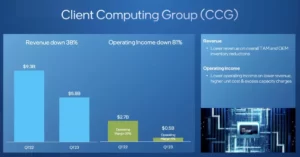
Zooming in on the most recent financial report reveals shocking numbers for the firm. In the first three months of 2023, The Client Computing Group (CCG) reported $5.8 billion in revenue, a dramatic year-over-year fall of 28%.
The Santa Clara company, like Samsung, attributes the outcome to low customer demand and inventory adjustments at OEMs.
Even so, CCG continues to be the main source of revenue, and CEO Pat Gelsinger voiced confidence in a potential uptick in consumer and business spending on PC and server processors.
Also noteworthy is the recent splitting of company’s GPU division into two more manageable parts that are now each a part of the Client Computing Group and the Data Centre and AI Group, respectively.
In order to compete aggressively in the discrete GPU market, Intel has developed the Battlemage and Celestial dubbed 2nd and 3rd generation Arc GPUs.
It has so far only been able to take 6% of the worldwide laptop and desktop GPU market, which is a solid beginning but not terrific for the bottom line.
Earlier this year, Intel Fellow Tom Petersen acknowledged that the business is compromising profit margins in order to increase market dominance, and that the GPU segment lost at least $3.5 billion between Q1 2021 and its most recent reorganization in Q4 2022.
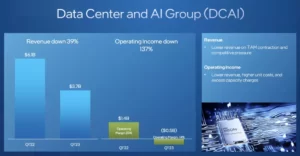
The Data Centre and AI Group (DCAI), on the other hand, saw revenue of $3.7 billion in the first three months of 2023, a startling 39 percent decrease from the same time in the previous year. It’s easy to understand why Gelsinger thinks things will get worse in this area.
Amazon, Facebook, and other tech giants are eager to adopt custom hardware based on Arm designs despite the fact that overall sales of x86 server chips are down, OEMs have excess inventory, and AMD is gleefully eating away at Intel’s market share.
Though it still experienced a 30 percent year-over-year decline to $1.5 billion in Q1 2023, The Network and Edge Group (NEX) fared marginally better.
Intel Foundry Services (IFS), on the other hand, generated meagre sales of just $118 overall and lost $140 million, which Intel attributes to rising costs for constructing new fabs.
IFS is essential to Intel’s long-term strategy since it will help it catch up to rivals like TSMC by 2025 and establish itself as a sought-after contract chip producer for both large and small businesses.
In an otherwise depressing financial report, MobilEye—a business Intel acquired in 2017 to develop self-driving technology—is the lone shining example. In the first quarter of 2023, it reported revenues of $458 million, a respectable year-over-year rise of 16 percent.
In a brief statement made during an investor call, Intel said that while development of Intel 3, Intel 20A, and Intel 18A is continuing as planned, it is currently ramping up production on Intel 4 wafers.
The Meteor Lake CPUs will be the first to leverage TSMC nodes for the GPU, SoC, and I/O tiles in addition to Intel’s own process technology, and we anticipate the company will introduce them in the second half of this year.
To read our blog on “Why Meteor Lake desktop CPUs of Intel could be a big regret?” click here.