

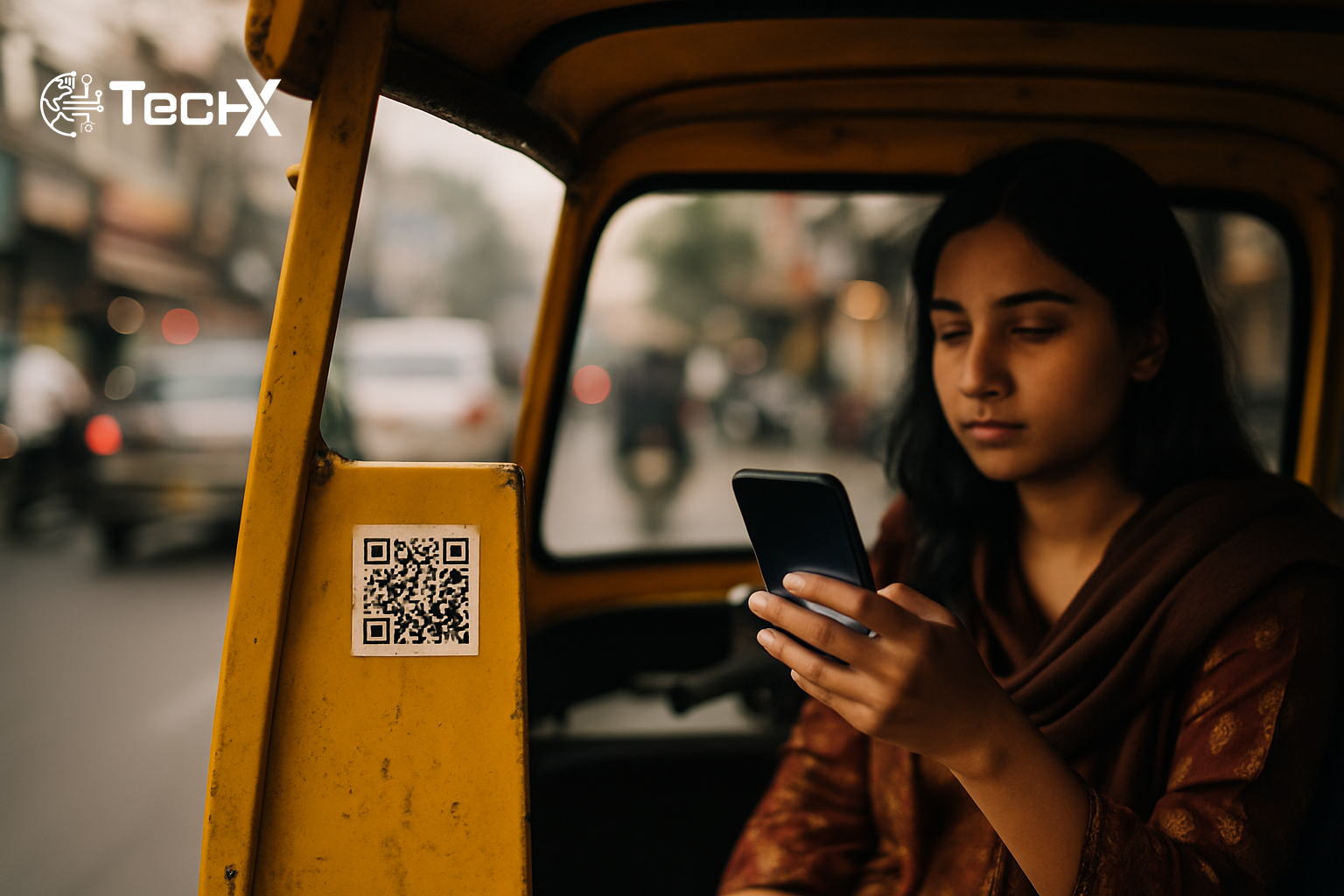
The QR panic button has a hard deadline for Lahore’s public transport operators: comply by June 30 or face legal action from July 1. Lahore Traffic Police will launch a crackdown from July 1 against public transport vehicles that fail to install mandatory QR panic buttons and other required security features. The move affects hundreds of thousands of daily commuters and brings a new layer of digital safety to the city’s streets.
What Is the QR Panic Button and How Does It Work?
The QR panic button is a small QR code sticker placed inside a public transport vehicle. When a passenger scans it with a phone, it opens a safety dashboard linked directly to law enforcement.
The QR Panic Button System integrates 12 safety features, including emergency and video calling, live chat and location sharing, vehicle verification, driver and owner information, family sharing, and instant police response.
The safety system connects commuters directly to law enforcement during emergencies. Passengers facing danger can scan the code to transmit their live location and specific vehicle details immediately to the police and the Punjab Safe Cities Authority (PSCA).
In the event of any emergency, harassment, accident, or security threat, passengers can contact Emergency 15 immediately through the QR panic button. Citizens can report incidents and seek assistance via voice call, video call, or live chat.
The system works for drivers too. Public transport drivers will also be able to use the QR panic button to seek immediate help in case of robbery, disputes, accidents, or other threatening situations while on duty.
Who Launched It and Is It Free?
Launched by the Punjab Safe Cities Authority (PSCA) under Chief Minister Maryam Nawaz’s Digital Punjab initiative, the system connects public transport vehicles with the province’s digital safety infrastructure. The Punjab Safe Cities Authority built the entire platform in-house.
The Punjab Safe Cities Authority developed this system entirely in-house, eliminating any additional financial burden on the government or transport owners. Vehicle owners and drivers can obtain the QR panic button free of cost through the Public Safety App or the Punjab Safe Cities Authority website.
This means drivers have no excuse to skip installation. The cost barrier is zero, and pickup points are spread across the city.
The July 1 Crackdown: Who Must Comply?
Chief Traffic Officer (CTO) Syed Abdul Rahim Shirazi said all rickshaw unions, taxi operators, online cab services, and other public transport providers have been given until June 30 to comply. That deadline expires tonight, and enforcement begins in the morning.
Vehicles found operating without the required security measures after the deadline will face legal action. The CTO has been clear that no extensions are on the table.
To make compliance easy before the deadline, the traffic police are installing QR panic buttons at 45 locations across the city. Drivers can walk in, get their sticker, and be done in minutes.
Dedicated teams have also been deployed in every traffic sector, including 12 teams assigned exclusively to rickshaws. The CTO said more than 6,000 rickshaws have already been equipped with QR panic buttons during the ongoing campaign.
Four additional licensing centres have also been established to speed up the registration process following requests from rickshaw unions.
Why This Matters for Women, Students, and Daily Commuters
Pakistan’s public transport sector has long faced criticism over passenger safety, especially for women and students. This system directly addresses that gap by putting a digital safety line inside every vehicle.
Punjab IGP Abdul Karim said the QR panic button will prove to be an effective means of immediate communication between the police and citizens, and will play an important role in the protection of millions of people who travel daily, including women, senior citizens, and students.
The system will automatically transmit the passenger’s live location and vehicle information to the Safe City Control Room. Using its advanced Command and Control System and citywide surveillance cameras, the Punjab Safe Cities Authority will monitor the situation in real time and dispatch the nearest police unit for immediate assistance.
There is also a built-in check against fraud. If a vehicle changes ownership, the existing QR panic button will be deactivated automatically, and a new code will be issued once the ownership records are updated. This keeps the driver information on every sticker accurate and verified.
Rolling Out Beyond Lahore
Lahore is the enforcement frontrunner, but the rollout is a province-wide plan. Rawalpindi Traffic Police has launched the installation of QR panic buttons and GPS tracking systems in public transport vehicles to strengthen passenger safety. The rollout of the CM Punjab QR Panic Button system has formally begun across the city.
The initiative aligns with Punjab’s broader plan to expand smart surveillance and Safe City systems across multiple urban centres, following the success of earlier projects in Lahore and other major cities.
The Punjab Police has framed this as a step toward technology-driven law enforcement across the whole province, not just a one-city experiment.
How to Get the QR Panic Button
For transport operators who have not yet installed the sticker, here is what to do before the July 1 deadline:
- Download the Public Safety App on your smartphone and register your vehicle details.
- Visit one of 45 installation points set up by Lahore Traffic Police across the city.
- Check the PSCA website to generate and download a QR code linked to verified vehicle and driver records.
- Attend one of the four new licensing centres set up at the request of rickshaw unions for faster registration.
The process is free, and consultations have been held with online taxi companies and rickshaw associations to ensure smooth implementation of the safety system.
Frequently Asked Questions
What happens if a vehicle does not have a QR panic button after July 1?
Lahore Traffic Police will launch enforcement from July 1 against public transport vehicles that have not installed the mandatory QR panic button. Vehicles found without the required security measures will face legal action.
Does the passenger need a special app to use the QR panic button?
The feature will be made available free of cost through the Public Safety App and the Safe City web portal. A standard smartphone camera can scan the QR code to open the safety interface.
Can drivers also use the QR panic button for their own safety?
Yes. The facility is not limited to passengers alone. Public transport drivers will also be able to use the QR panic button to seek immediate help in case of robbery, disputes, emergencies, or any other threatening situation while on duty.
Is this system only for Lahore?
No. QR panic buttons will be installed in buses, wagons, rickshaws, taxis, and other public transport vehicles across Punjab. Rawalpindi has already started its own rollout, and other cities are expected to follow under the same Digital Punjab framework.