
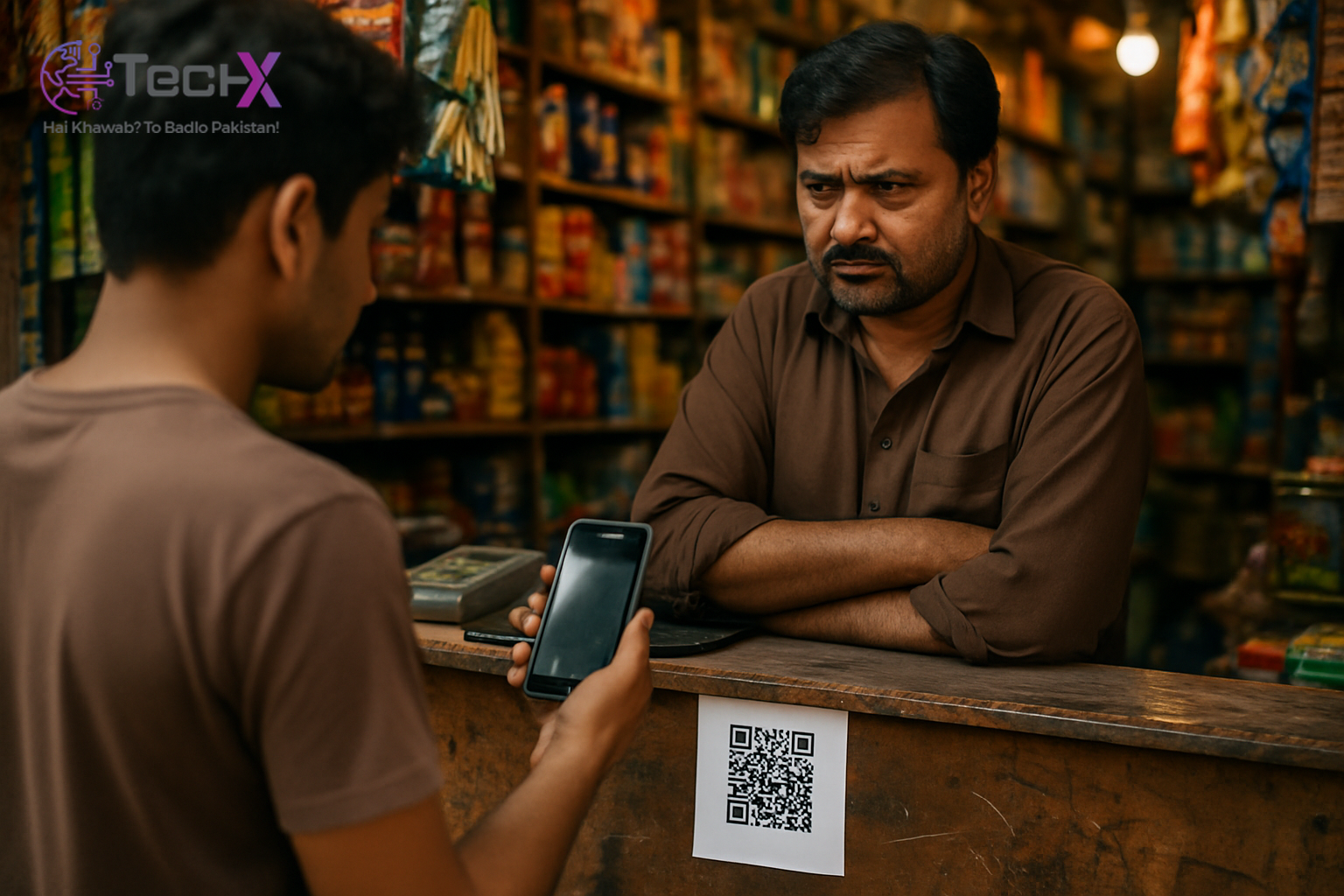
Raast P2M merchant adoption is Pakistan’s most urgent digital payments problem — and it is happening against a dazzling backdrop. Pakistan’s instant payment system, Raast, is projected to process over $500 billion (Rs140 trillion) in transactions during 2026, a figure that would actually exceed the country’s entire GDP. Yet walk into almost any Karachi kiryana store, a Lahore street-food stall, or a Peshawar auto-parts shop and you will find the QR code either missing from the counter, ignored by the shopkeeper, or quietly redirected to a personal P2P transfer instead. The gap between Raast’s headline numbers and its reality on the merchant floor is Pakistan’s defining fintech story of 2026.
Raast’s P2P Triumph — and Its P2M Blind Spot
The P2P success story is genuinely impressive. The first trillion rupees in Raast transactions once took 360 days to process; today, the same volume is settled every nine days. On a peak day, Raast now handles 10–11 million transactions worth more than Rs500 billion — a pace that puts it on track for that Rs140 trillion full-year projection. During just the second quarter of FY26 (October–December 2025), 646 million transactions worth Rs18 trillion were processed through the platform.
But strip away the P2P and government-to-person (G2P) bulk payments and the picture dims sharply. A UN-commissioned study, Merchant Payments on RAAST: Responsible Pricing for Impact and Inclusion, found that merchant usage accounts for only a fraction of Raast’s total volume. The SBP’s own Deputy Governor Saleem Ullah has acknowledged the gap, calling the push to fix it an aggressive priority.
For a deeper background on how Raast works as a system, see our explainer on the Raast payment system and Pakistan’s digital future.
Why Raast P2M Merchant Adoption Is Broken
The barriers are structural, cultural, and economic — and they reinforce each other.
1. The Tax Visibility Problem
This is the elephant in the room. Pakistan’s informal economy is vast, and over 85% of all transactions in the country are still conducted in cash, costing trillions of rupees annually in lost taxes, cash-handling expenses, and idle liquidity. Informal businesses — which make up the overwhelming majority of Pakistan’s 3–4 million merchant base — fear that accepting traceable digital payments will put them on the FBR’s radar. That fear is rational, not paranoid, and no QR sticker on a counter fixes it.
2. Fee Resistance at the Thinnest Margins
Small retailers operating on razor-thin margins resist transaction charges even as low as 0.25%. The irony is that the current Merchant Discount Rate (MDR) on Raast P2M is effectively zero — but merchants either do not know this, or they distrust that it will stay free. The Better Than Cash Alliance (BTCA) has recommended formalising a 0.35% MDR floor to give acquirers a commercially viable business model, while also proposing a zero-fee threshold for microtransactions below Rs300 to protect the smallest vendors.
3. The P2P Cannibalisation Trap
Perhaps the most counter-intuitive barrier is Raast’s own P2P success. Because P2P transfers remain completely free and are universally available, many merchants simply encourage customers to send money via a personal IBAN transfer rather than scan a formal P2M QR code. This workaround lets the merchant stay off the merchant ledger, avoids any MDR discussion, and keeps transactions invisible. It is a direct cannibalisation of the P2M use case — and it is happening at scale.
4. Infrastructure Gaps Beyond Urban Cores
Rural and peri-urban Pakistan faces an additional layer of friction: inconsistent mobile data connectivity, low smartphone penetration among older shopkeepers, and limited awareness of how QR onboarding even works. There are also widespread trust deficits — both in the technology and in the institutions behind it.
What the Government and SBP Are Doing
The response has been multi-pronged. The federal government, under the Prime Minister’s Cashless Economy initiative, approved a Rs3.5 billion subsidy covering September 2025 to June 2026 — part of a three-year support programme. Under the scheme, financial institutions are reimbursed at 0.5% of each P2M QR transaction value, or Rs100, whichever is lower, effectively bringing the merchant’s net cost to zero during the subsidy window.
The SBP has also committed to routing all government payments through Raast by the close of FY26 — a move that would dramatically increase transaction volume and normalise digital payment habits across public-sector supply chains.
More structurally significant, however, is what is coming on the technology side.
Tokenisation and PISP: The Real Fix Raast Needs
Speaking at the 19th Mobile Commerce Conference in Karachi, Raast Payments Pakistan CEO Ahson Saeed outlined two components that could fundamentally change the merchant equation. First, tokenisation technology is being layered onto the Raast rail to enhance transaction security and reduce friction at the point of sale. Second — and more transformative — is the forthcoming PISP (Payment Initiation Service Provider) framework.
Under the PISP model, businesses and service providers will be able to collect payments directly from customers’ bank accounts using a consent-based ‘pull payment’ architecture. The customer pre-authorises a payment; the merchant or service provider then pulls the funds at the point of purchase without the customer needing to open an app, scan a QR, or confirm again. Saeed confirmed this is already in testing and is close to launch.
This matters enormously for merchant adoption because it removes the single biggest UX obstacle: the multi-step customer action at checkout. A rickshaw driver or a grocery store owner does not want a payment system that requires a confused customer to navigate three app screens. A pre-consented pull payment — secured by tokenisation — collapses that to a single tap or even a background process.
Faisal Mahmood of Karandaaz Pakistan framed the challenge precisely: Pakistan has already built the foundational digital infrastructure. The question now is how to generate real economic value from it by scaling adoption — not just adding more rails.
What Needs to Change for QR Payments to Work at Pakistan’s Shops
- Tax amnesty clarity for early adopters: The BTCA study explicitly recommends assuring merchants that P2M transaction data will not be used for tax enforcement during the early adoption phase. Without this commitment, the informal economy will stay in cash.
- Formalised, transparent pricing: The current zero-MDR period creates uncertainty. A clear, published, long-term pricing framework — even at a modest 0.35% — gives acquirers a reason to invest in merchant onboarding at scale.
- Merchant-side financial literacy: Subsidies alone do not build habits. Street-level onboarding campaigns, conducted in Urdu and regional languages, are essential for small vendors and rickshaw drivers who have never interacted with a banking app.
- Rapid PISP rollout: The consent-based pull payment framework must move from testing to live deployment quickly. Every month of delay is another month of P2P cannibalisation.
- Interoperability enforcement: Every Raast-enabled banking app must seamlessly scan every merchant QR — and that standard must be enforced in practice, not just on paper.
Pakistan’s broader digital economy ambitions — including the fintech and startup reforms outlined in the Finance Bill 2026 VC tax reforms — ultimately depend on a functioning domestic payments layer. A startup can build a brilliant product; if the payment rail at the shop counter is broken, that product never reaches everyday Pakistanis.
The Bottom Line
Raast is, by any measure, a remarkable infrastructure achievement. Processing the equivalent of Pakistan’s entire GDP in a single year — through an instant, largely free rail — is something most emerging markets have not achieved. But the Rs140 trillion headline masks a critical imbalance: the P2M merchant layer, the part that actually touches daily commerce in Pakistan’s bazaars and neighbourhoods, is underperforming. Fixing it requires more than a subsidy cheque. It requires a coordinated campaign on tax trust, transparent pricing, aggressive PISP deployment, and genuine financial literacy at the grassroots. The technology is ready. The policy intent is there. The gap is in execution.
Frequently Asked Questions
What is Raast P2M and how is it different from P2P?
Raast P2P (Person-to-Person) lets individuals send money to each other instantly for free using an IBAN or Raast ID. Raast P2M (Person-to-Merchant) is a separate layer that allows businesses to accept payments via QR codes, Raast Aliases, or Request-to-Pay — with a formal merchant account and MDR structure. P2M is designed for commercial transactions, not personal transfers.
Why aren’t Pakistani shopkeepers using Raast QR codes?
The main reasons are fear of tax exposure (informal businesses worry digital payments will flag them to the FBR), confusion about fees, the easy availability of free P2P transfers as a workaround, and low awareness of how to register as a Raast merchant. Rural infrastructure gaps add a further layer of friction outside major cities.
What is the government doing to boost Raast P2M merchant adoption?
The federal government approved a Rs3.5 billion subsidy under the PM’s Cashless Economy initiative, covering September 2025 to June 2026, reimbursing financial institutions at 0.5% per P2M QR transaction or Rs100, whichever is lower. The SBP is also mandating that all government payments run through Raast and is preparing to launch a tokenisation-backed PISP framework for consent-based pull payments.
What is a PISP and why does it matter for merchants?
A Payment Initiation Service Provider (PISP) is a licensed entity that can trigger payments directly from a customer’s bank account — with prior consent — without the customer needing to open an app at the point of sale. For merchants, this dramatically simplifies checkout. The SBP is currently testing this framework, and its rollout is expected to be a game-changer for real-world QR payment adoption at Pakistan’s shops and kiosks.