

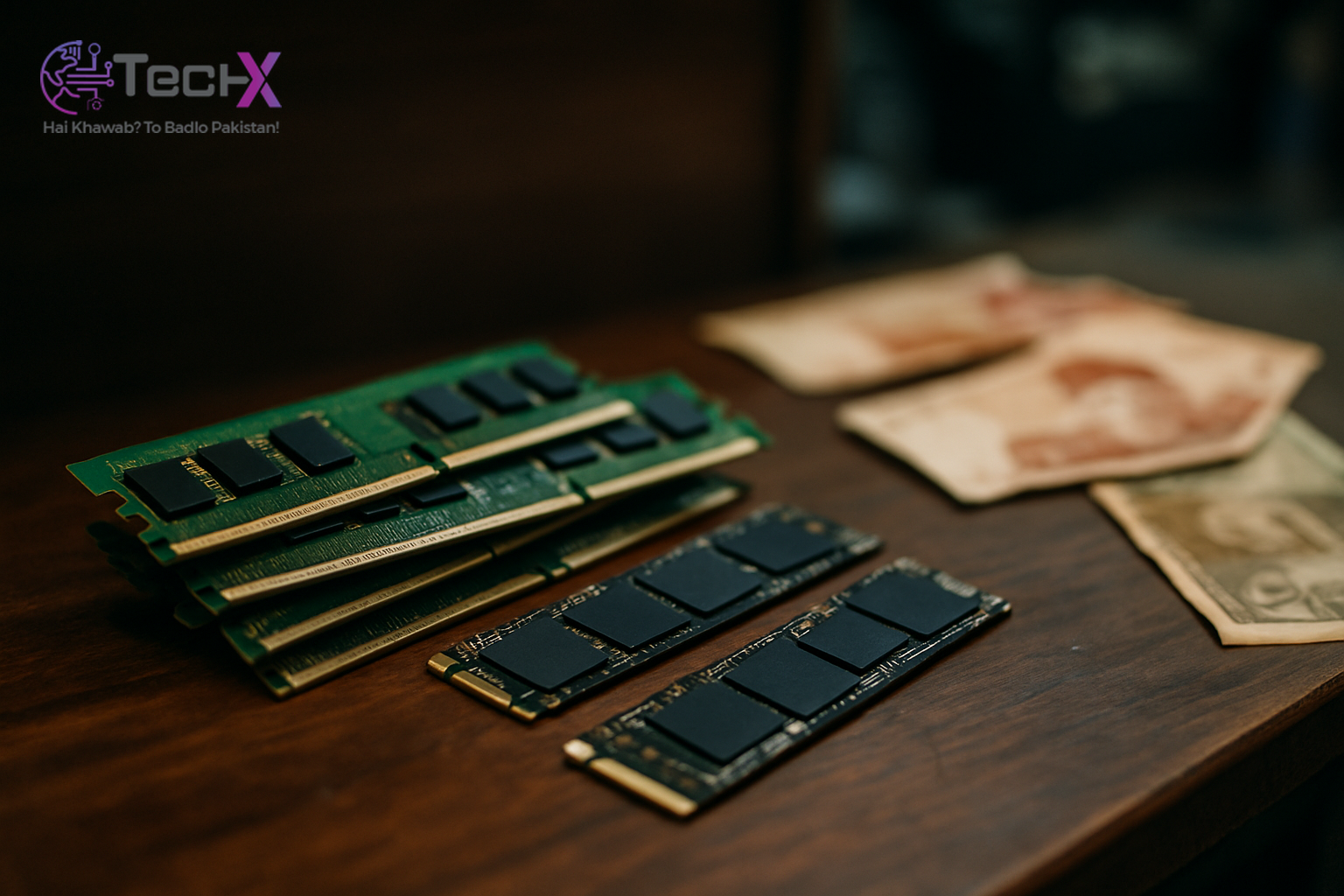
RAM and SSD prices surged by up to 107% in Q2 2026, driven by a global memory shortage caused by AI data centre demand. According to market research firm Sigmaintell, multiple DRAM and storage components have doubled or nearly doubled in price — directly raising the cost of laptops, smartphones, and other electronics in Pakistan.
If you’ve recently tried to buy a new laptop or smartphone in Pakistan and walked away shocked by the price tag, you’re not imagining things. A full-blown global memory crisis is quietly making your next tech upgrade significantly more expensive — and it’s only getting worse.
How Bad Are the RAM and SSD Price Increases in 2026?
According to Sigmaintell, the global memory market in Q2 2026 remained deeply entrenched in what analysts are calling a “super memory cycle,” characterised by persistent supply shortages and pronounced price divergence. The numbers paint a stark picture for everyday consumers.
On the DRAM side, a 16 Gb (2GB) DRAM module now costs an average of $28.50, up from $19.20 in the previous quarter — a 49% jump. Meanwhile, a 16GB DDR4 module that sold for $137 in Q1 has climbed to $207.10, marking a 51% increase.
Low-power memory used in smartphones took an even harder hit. In the LPDDR segment, prices for LPDDR4X 4GB products increased 75% from the previous quarter, while LPDDR5X 12GB products surged 89%. The component most used in everyday Android smartphones and budget PCs just nearly doubled in price in a single quarter.
Storage Costs More Than Double — uMCP Hits 107%
The situation is equally alarming on the storage front. A 512GB PCIe Gen 4 NVMe SSD increased by 54% to $126.30 during the second quarter, while the price of 256GB UFS 3.1 storage climbed by 103%, rising from $31 to $62.70.
16GB eMMC 5.1 flash is also up 69% — now at $22.60 versus $13.40 previously — while uMCP (Universal Multi-Chip Package), which combines memory and storage into one chip, is up 107%, jumping from $72.50 to $150.40. uMCP components are found in a wide range of affordable smartphones and mid-range tablets, meaning budget buyers are the hardest hit.
The NAND market also continued its upward trend, with Sigmaintell reporting that SSD prices rose approximately 50% quarter-over-quarter in the second quarter.
Why Is This Happening? The AI Boom Is Eating Your RAM
The root cause is a massive and unprecedented shift in how memory chips are being manufactured and allocated. The voracious demand for High Bandwidth Memory (HBM) by hyperscalers such as Microsoft, Google, Meta, and Amazon has forced the three biggest memory manufacturers — Samsung Electronics, SK Hynix, and Micron Technology — to pivot their limited cleanroom space and capital expenditure towards higher-margin enterprise-grade components.
This is essentially a zero-sum game: every wafer allocated to an HBM stack for an Nvidia GPU is a wafer denied to the LPDDR5X module of a mid-range smartphone or the SSD of a consumer laptop.
The increase in LPDDR prices was specifically driven by intensified competition for supply, as this memory type is increasingly being adopted in next-generation server GPUs, including those used in Nvidia’s Vera Rubin AI computing platform.
Micron disclosed it could fulfill only 55–60% of core customer demand, identifying three structural drivers: exponential acceleration of AI data centre buildouts, HBM’s 3-to-1 consumption ratio against DDR5 capacity, and cleanroom construction lead times now stretching years rather than months.
How RAM and SSD Prices Are Hitting Pakistani Consumers
For Pakistani buyers, the global memory crisis compounds an already tough local environment. The price surge reflects a combination of global supply pressure and local economic constraints, with consumers across Pakistan now facing record-high prices for basic and premium devices — entry-level laptops crossing PKR 99,000 and flagship smartphones exceeding PKR 400,000.
The manufacturing cost for entry-level smartphones has jumped by 25% as a direct result of rising memory costs, with companies passing these increased costs directly on to buyers. On top of that, the government continues to enforce an 18% standard sales tax on smartphones, which further suppresses local affordability.
The depreciation of the Pakistani Rupee against the US Dollar directly impacts import costs, meaning Pakistani consumers effectively absorb the global chip crisis twice — once at the manufacturing level and again at the currency exchange rate.
Local laptop retailers have already felt the squeeze. Entry-level laptops are being sold for around PKR 99,000–150,000, typically featuring Intel Core i3 or AMD Ryzen 3 processors with just 8GB RAM. Mid-range models with Core i5 and up to 16GB RAM now sit at PKR 150,000–250,000. Configurations that were once comfortably mid-tier now command premium pricing.
When Will Prices Come Down?
The outlook is not encouraging. Soaring memory costs are projected to drive worldwide PC shipments to decline 10.4% and smartphone shipments to drop 8.4% in 2026, with Gartner estimating a 130% surge in combined DRAM and SSD prices by year-end — enough to push PC prices up 17% and smartphone prices up 13% compared to 2025 levels.
Gartner warns that this sharp increase removes vendors’ ability to absorb costs, making low-margin entry-level laptops nonviable — and the firm expects the sub-$500 entry-level PC segment to disappear entirely by 2028.
Research director at Counterpoint states bluntly that the supply-demand balance will not normalize until 2028, and even then, suppliers will only cover 60% of global demand for DRAM.
A SigmaIntell official noted that “with the supply-demand imbalance for HBM and enterprise-grade NAND still persisting, the tight supply flow for consumer memory will continue for the time being,” though the pace of increases in the second half may gradually moderate depending on purchase resistance from device brands and order adjustments.
What Should Pakistani Buyers Do Right Now?
- Buy now if you need to upgrade: Given the current market trend, waiting is likely to cost you more. If you are building a new PC or planning an upgrade from 16GB to 32GB RAM, purchasing sooner rather than later is the smarter move.
- Hold on to existing hardware: Higher prices will narrow the range of devices available, prompting many buyers to hold on to devices for longer — fundamentally altering upgrade cycles. Gartner expects PC lifetimes to increase by 15% for business buyers and 20% for consumers by end of 2026.
- Target Gen 4 SSDs over Gen 5: High-end Gen 5 SSDs are the most affected by price hikes. Gen 4 remains more affordable and is more than sufficient for most workloads including gaming.
- Compare prices carefully: With memory costs varying significantly across vendors, comparing retailers before purchasing can still yield meaningful savings even in a seller’s market.
For Pakistani tech enthusiasts who are also watching how broader technology adoption is evolving locally, this memory crisis has implications beyond just device prices — it could slow the pace at which affordable tech reaches everyday Pakistanis at a time when digital adoption is accelerating. If you’re curious about how Pakistan’s own tech infrastructure is keeping pace, read about the expansion of AI-powered systems in Karachi as a sign of where local tech investment is heading.
Frequently Asked Questions
Why are RAM and SSD prices rising so sharply in 2026?
The core reason is that AI data centres are consuming enormous volumes of high-end memory like HBM and enterprise SSDs. The single biggest driver of the current price surge is the explosive growth in demand from AI, cloud computing, and hyperscale data centres, with large AI models and inference systems requiring astronomical amounts of high-performance memory and storage. This leaves far less production capacity available for the consumer memory used in everyday laptops and smartphones.
Which memory components saw the biggest price increases in Q2 2026?
The uMCP (Universal Multi-Chip Package) component recorded the largest single increase, up 107% to $150.40. 16GB eMMC 5.1 flash rose 69%, while the LPDDR5X 12GB mobile chip surged 89%. These are all components found in the mid-range and budget smartphones most Pakistanis use daily.
How do global RAM and SSD prices affect Pakistan specifically?
Freight costs have increased and insurance premiums for cargo have followed the same trend, directly raising import costs for electronics entering Pakistan. Combined with PKR depreciation against the USD and local sales taxes, Pakistani buyers end up paying a compounded premium on top of already elevated global component prices.
When will RAM and SSD prices return to normal?
Any production changes from manufacturers are unlikely to provide immediate relief, and the current shortage could continue until 2028 — meaning memory and storage prices may remain high or increase further before any meaningful normalization occurs. New factory capacity from Samsung and Micron is not expected to reach full output until around that timeframe.