

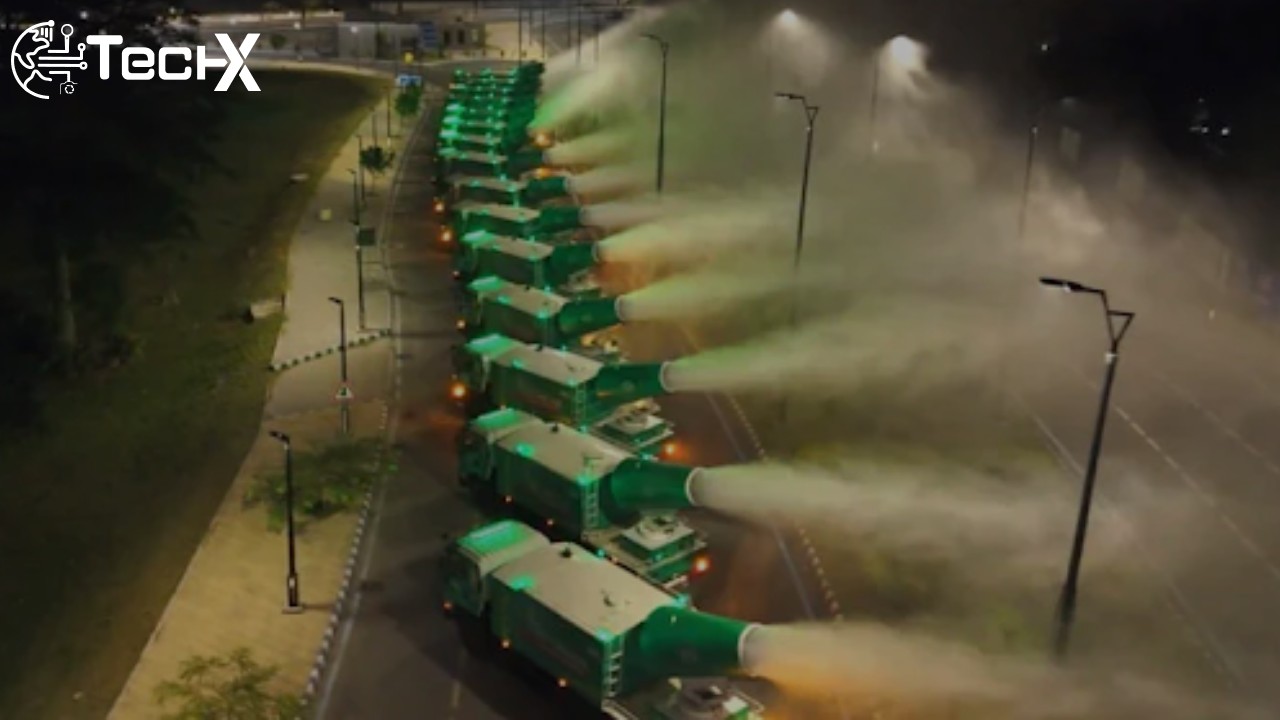
Lahore’s war against smog has taken a new turn with the launch of anti-smog guns. These water cannon vehicles spray a fine mist into the air to reduce dust and particulate matter. The Punjab government has started night operations in highly polluted areas, hoping to clean the city’s skies. Yet, environmental experts warn this fight against smog could worsen Lahore’s ongoing water crisis.
Trial Phase of Anti-Smog Guns in Lahore
In the first phase, the government has deployed 15 anti-smog vehicles on a trial basis. Each cannon can store 12,000 litres of water and completes a full spray cycle within an hour. Officials believe this technology will bring quick relief. However, the amount of water used for each operation has raised alarm among environmentalists who worry about its long-term effects on groundwater.
EPA Defends the Anti-Smog Initiative
According to Sajid Bashir, spokesperson for the Punjab Environmental Protection Agency (EPA), 16 air quality monitors are being used across Lahore to identify the most polluted zones. He said that after the fog cannons were used in the Kahna area, PM10 particle concentration dropped by almost 70 percent. He added that a technical committee will study data to measure how much the water cannons improve air quality.
Scientific Basis of the Project Questioned
Bashir dismissed claims that the project lacks scientific support. He said that while China once tested similar technology, its results cannot be directly compared because of different weather conditions. He assured that Lahore’s anti-smog guns are built according to the local climate and wind speeds. However, experts continue to question whether spraying millions of litres of water into the air is truly effective or simply symbolic.
Experts Call It a “Smog Theatre”
Environmental specialists have criticized the project as “smog theatre,” claiming it only gives the illusion of cleaner air. Maryam Shah from the Pakistan Air Quality Initiative said these water cannons may help briefly, but their scientific impact is very limited. She added that China also tested this approach but abandoned it after finding it did not significantly reduce smog or improve long-term air quality.
Water Experts Warn of Unsustainable Practice
Dr. Muhammad Yaseen, a water resources expert from the University of Punjab, called the anti-smog policy unsustainable. He warned that the cannons consume enormous amounts of water for minimal gain. Lahore already faces a severe groundwater shortage, with the water table dropping two to three feet every year. Using such massive water volumes could make the city’s water situation even more desperate.
Lahore’s Groundwater Crisis Deepens
Data from the Water and Sanitation Agency (WASA) reveals that Lahore’s groundwater has fallen over 18 meters since the 1960s. In the 1980s, water could be found at a depth of 15 meters, but now it lies below 70 meters in some areas. With rapid urbanization and over-extraction, every drop counts. Experts argue that diverting millions of liters for air cleaning is wasteful and short-sighted.
Environmental Lawyer Raises Alarming Figures
Environmental lawyer Altamash Saeed pointed out that if one cannon operates for 12 hours a day, it uses 144,000 liters of water. With 15 cannons in use, total daily consumption exceeds 2.2 million liters. He explained that the cannons only bring down larger dust particles. The smaller, deadlier PM2.5 particles remain in the air, continuing to pose serious health risks to Lahore’s population.
Long-Term Pollution Solutions Urged
Experts like Hammad Naqi Khan, Director General of WWF Pakistan, believe water scarcity poses a far greater threat than smog. He said that emissions from vehicles, low-quality fuel, and unfiltered industrial waste are the main culprits behind Lahore’s poor air quality. Unless these root causes are addressed, anti-smog campaigns will remain temporary fixes without bringing real change to the environment.
A Call for Sustainable Action
Environmentalists agree that the government’s intentions are good, but the method is flawed. Spraying water may clear the air for a moment, but it drains a precious resource already in danger. As Maryam Shah warned, Lahore may win its battle against smog for a day—but lose the war for water forever. The city needs sustainable solutions, not quick spectacles that cost it its future.