

This week, the USB Promoter Group released the final USB4 version 2.0 specifications.
The main enhancement of the specification is that it doubles bandwidth from 40Gbps to 80Gbps.
PAM3 signal encoding allows for 80Gbps connections over newly defined 80Gbps USB-C active cables or existing 40Gbps passive cables.
However, technically, 80Gbps is not the maximum bandwidth. Asymmetrical connections reaching up to 120Gbps in one direction and 40Gbps in the other may be possible with high-performance USB4-based displays and other specific situations.
Last month, the USB group announced the new standard, revealing upgraded data protocols, display protocols, and physical layers that allow for increased bandwidth as well as the technology to intelligently utilize it.
Because the specification is new, consumers should not expect to see USB4 2.0 products until 2023.
The ability to tunnel USB 3.2 connections beyond their original 20Gbps bandwidth is an intriguing new feature of USB4 2.0.
The standard is also backwards compatible with PCIe 4 and the recently introduced DisplayPort 2.1. Backward compatibility with USB4 1.0, USB 2.0, and Thunderbolt 3 is expected.
Because the specifications are similar, Thunderbolt 4’s 40Gbps bandwidth matched that of USB4 1.0.
Thunderbolt is also upgrading to a new 80Gbps-capable specification, which Intel demonstrated in Israel last month. Surprisingly, it is not referred to as Thunderbolt 5. (For now).
It has also not gone unnoticed that the name USB4 2.0 is not very straightforward.
Less-versed users may confuse it with the 20-year-old USB 2.0 specification, which tops out at 480Mbps.
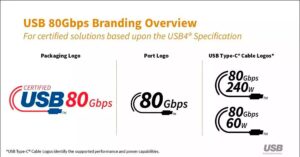
To address this issue, the USB4 2.0 logos, which were released alongside the final specification, emphasize bandwidth over specification number.
None of the logos mention USB4 2.0. The packaging logo reads “Certified USB 80Gbps,” while the others simply state “80Gbps,” sometimes with wattage indicators such as 240w or 60w
To read our blog on “With USB4 Version 2.0 interface, transmission rates can reach 80 Gbps,” click here