

You might try laying your phone or other portable devices on top of your laptop as a fresh way to charge it.
This approach has long been under consideration by Apple, and a recent patent reveals that Dell is also taking it into account.
However, as patents frequently don’t result in actual items, readers should just view this as an experimental idea at this moment.
A Dell patent for charging portable devices on laptop surfaces has been found by Patently Apple.
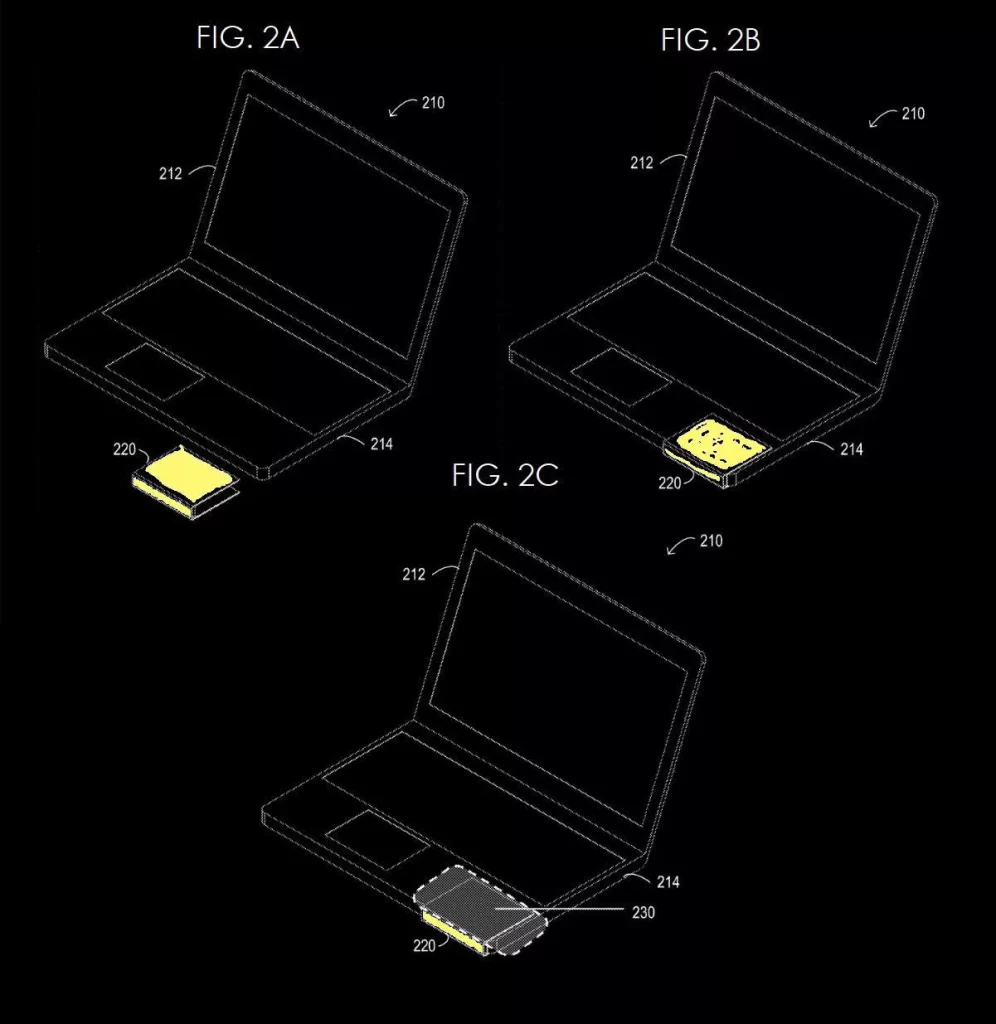
The system entails placing the gadgets on top of a laptop attachment that serves as a source of inductive power.
The images below are from Dell’s US patent application 20220239124, which was released last week.
Smartphones and other devices would be placed on top of the clip, which consists of a ferrite sheet and a charging coil.
Apple has filed patents for a somewhat distinct charging mechanism that utilizes the same fundamental idea.
Apple would incorporate the charging coils that could charge an iPhone, iPad, or Apple Watch positioned on top within upcoming MacBooks rather than using an accessory.
Apple’s idea would allow MacBooks to charge devices even when they are closed, providing a larger surface area for more gadgets than a clip could supposedly only provide.
However, since it could be attached to other laptops, Dell’s suggestion for a separate clip might end up being less expensive.
In the event that either approach is ever implemented, chargers might end up using fewer outlets than other options like charging pads.
The AirPower, Apple’s effort at a huge charging station, was scrapped in 2019.
The company currently provides the MagSafe Charger and MagSafe Battery Pack for individuals who require longer gadget longevity.
Other businesses are experimenting with various forms of wireless charging. The $40 Ikea charger mounts below a desk or table to charge items placed on top of it.
That system still needs connections even though it is less noticeable. An IR-based system is being developed by a company called Wi-Charge, in which a charger plugged into an outlet transmits electricity straight to gadgets.
Although this approach seems adaptable, it is unable to supply enough power to keep a phone completely charged.
To read our blog on “Dell is leaving the phone syncing industry called Mobile Connect,” click here.