
Part 10 of 14 in our Independence Day series.
Youm-e-Azadi: The Day a Nation Was Born
Every year on 14 August, the streets of Pakistan come alive in green and white. Flags flutter from rooftops, children paint their faces in national colours, and slogans of Pakistan Zindabad fill the air, just as they did on that extraordinary day in 1947. Pakistan’s Independence Day is more than a public holiday. It is a living reminder of one of history’s most remarkable stories: the birth of a nation carved out of sacrifice, conviction, and an unshakable dream.
The Road to 14 August 1947
For nearly two centuries, the Indian subcontinent had been under the control of the British, first through the East India Company and then directly under the British Crown. The struggle for freedom was long and hard-fought by many communities across the region. For the Muslims of the subcontinent, the movement for a separate homeland took a decisive turn with the Lahore Resolution of 1940, which formally called for an independent Muslim state.
Under the brilliant and tireless leadership of Quaid-e-Azam Muhammad Ali Jinnah and the All-India Muslim League, that demand grew louder and stronger with each passing year. The goal was clear: a place where the Muslims of the subcontinent could live freely, practice their faith, and shape their own future. On 14 August 1947, that dream became reality. Pakistan’s Constituent Assembly held its first session in Karachi, Quaid-e-Azam addressed the nation as its first Governor-General, and the green-and-white flag, bearing the crescent and star, was raised for the first time. Streets filled with celebrations, and cries of Pakistan Zindabad echoed from Karachi to Peshawar.
The vision behind this new nation was also shaped deeply by the poetry and philosophy of Allama Iqbal, the Poet of the East, whose words had long inspired the idea of a Muslim homeland in South Asia. And steadfast by Quaid-e-Azam’s side stood Madar-e-Millat Fatima Jinnah, whose own dedication to the Tehreek-e-Pakistan remains an enduring source of pride.
Independence Day is not just a celebration of what was achieved. It is also a respectful acknowledgement of the enormous sacrifices made by millions of people who gave up their homes, their loved ones, and in many cases their lives, so that Pakistan could exist. Their courage is the foundation on which every generation of Pakistanis stands.
What Independence Day Means Today
Across Pakistan, Independence Day is observed with flag-hoisting ceremonies, military parades, special prayers in mosques, and vibrant cultural events. The main national ceremony is held in Islamabad, the country’s capital, and is marked by great patriotism and pride. It is one of six official public holidays in the country and is felt deeply by every Pakistani, at home and abroad.
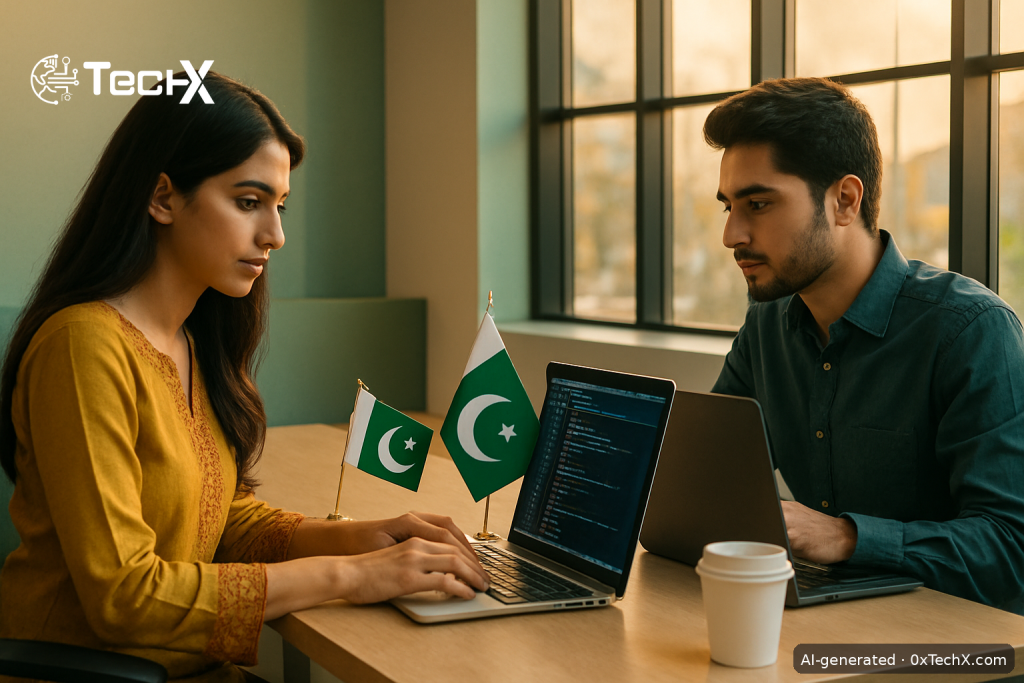
But beyond the flags and fireworks, Independence Day carries a deeper question for each new generation: How are we honouring this gift? For the young people of Pakistan today, the answer is increasingly being written in lines of code, startup pitch decks, and digital platforms that are reaching the world.
The New Frontier: Pakistan’s Young Tech Generation
Here is a fact worth celebrating on this Independence Day: Pakistan is one of the youngest nations on earth. Nearly two-thirds of the population is under the age of 30, and this youthful energy is fast becoming one of the country’s greatest assets in the digital age.
Pakistan’s IT and IT-enabled services sector has been growing at a remarkable pace. According to data from the State Bank of Pakistan, exports of IT and IT-enabled services exceeded $4.18 billion in the first eleven months of fiscal year 2025-26 alone, a record high and a major jump from $3.47 billion in the same period the year before. The Pakistan Freelancers Association (PAFLA) has noted that more than 99% of the skilled workforce driving these exports consists of young people, working from cities and small towns alike, earning valuable foreign exchange for their families and their country.
Pakistan’s startup world tells an equally inspiring story. Since 2012, the country’s startup ecosystem has grown from just two incubators and fewer than 100 startups to over 24 incubation centres supporting more than 500 active startups by 2025. Today, young entrepreneurs are building solutions in fintech, health-tech, agri-tech, edtech, and e-commerce, not just copying what works elsewhere, but solving real Pakistani problems with homegrown creativity.
Consider WonderTree, a Pakistani health-tech startup using AI and augmented reality to help children with special needs through gamified therapy. It was selected as one of just four global grantees of the GSMA Innovation Fund for Impactful AI, chosen from 625 applications across 40 countries. Or Farmdar, an agri-tech company using AI and satellite technology to help Pakistani farmers deal with climate challenges, which secured Silicon Valley funding in a first-of-its-kind deal for the sector. These are not small stories. These are Pakistani young people competing and winning on the world stage.
The government’s DigiSkills.pk platform has delivered over 4 million training completions since 2018, including more than 800,000 to women, offering free courses in everything from freelancing basics to AI, cloud computing, and full-stack development. And Pakistan consistently ranks among the top countries globally in freelance talent, young professionals from Multan, Quetta, Gilgit, and everywhere in between are finding international clients and building independent careers through sheer skill and determination.
The Dream Continues
Quaid-e-Azam Muhammad Ali Jinnah built a nation. Allama Iqbal dreamed of it in verse. The millions who made the journey of Partition made it possible through sacrifice. Today, a 22-year-old developer in Lahore writing code for a client in London, or a young woman in Rawalpindi running her own digital business, is part of that same, unbroken story.
Independence Day reminds us that freedom is not just something that was won, it is something that must be built upon, day after day, with hard work and honest ambition. The tools have changed. The challenges are different. But the spirit is the same: a people determined to make something great of this gift called Pakistan.
This 14 August, as you hoist the flag and feel that familiar pride in your chest, know that the best chapters of this story are still being written, by you.
Pakistan Zindabad.
Frequently Asked Questions About Pakistan’s Independence Day
When is Pakistan’s Independence Day celebrated?
Pakistan’s Independence Day, known as Youm-e-Azadi, is celebrated every year on 14 August. It marks the day in 1947 when Pakistan emerged as a sovereign nation, free from British colonial rule, under the leadership of Quaid-e-Azam Muhammad Ali Jinnah.
Why is Independence Day celebrated on 14 August and not 15 August?
The transfer of power to Pakistan took place during the day on 14 August 1947 in Karachi, ahead of the midnight independence ceremony in New Delhi. Pakistan chose to mark 14 August as its official Independence Day, and this date has been observed every year since. It is a distinct and proud date in Pakistan’s national calendar.
How is Independence Day celebrated in Pakistan?
Celebrations include flag-hoisting ceremonies at government buildings and homes, military and civilian parades, special prayers in mosques, cultural events, music, fireworks, and dressing in green and white. The main national ceremony is held in Islamabad. People across the country, and Pakistanis around the world, mark the day with great enthusiasm and patriotism.
What is the connection between Pakistan’s youth and Independence Day today?
Pakistan’s youth are honouring the spirit of Independence Day through innovation and enterprise. With nearly two-thirds of the population under 30, young Pakistanis are driving record IT exports, building startups that compete globally, and using digital skills to create a stronger, more self-reliant Pakistan, a living tribute to the vision of the founders of this nation.
- How the Demand for Pakistan Began, The Story Behind Independence Day
- How Pakistan Won Its Independence on 14 August 1947
- Part 3: Pakistan Independence Day Heroes of the Independence Movement
- Part 4: The Partition, the Migration, and the Birth of a Nation
- Part 5: The Green Flag and the Anthem That Gave Pakistan Its Voice
- Part 6: Quaid-e-Azam’s Dream for Pakistan and What It Means for Us Today
- Part 7: Pakistan Independence Day Stories of Sacrifice from the 1947 Migration
- Part 8: How Pakistan Went from Telegraphs to 5G and AI in 79 Years
- Part 9: Pakistan Independence Day and How Tech Startups Are Building the Nation’s Future
Disclaimer: This article has been compiled from information publicly available on the internet and from published sources. The featured image is AI generated and is for illustration only. If you notice anything that needs correction, please contact us.