
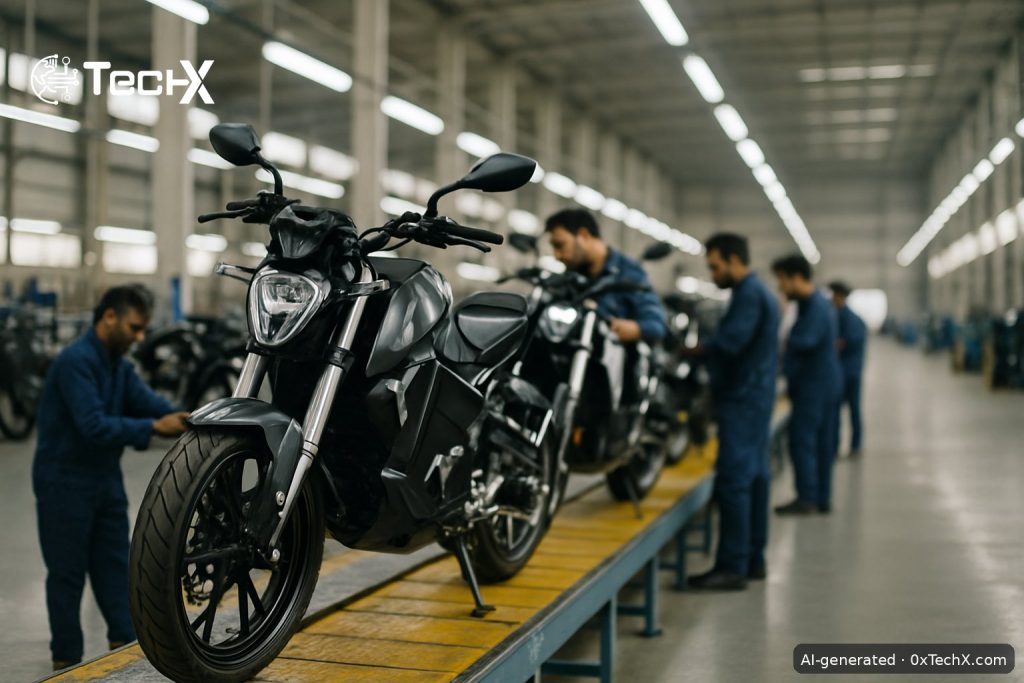
Electric bike manufacturing in Punjab is moving from plans to reality after China’s G-Force Group signed a formal joint venture agreement with a Pakistani electric vehicle company on 13 October 2026. The deal covers three product lines: electric bikes, EV batteries, and EV charging stations, making it one of the most complete EV supply chain investments Punjab has seen from a single Chinese partner.
What Was Signed and Where
China’s G-Force Group has signed a joint venture agreement with a local electric vehicle company to manufacture and trade EV products in Punjab. The signing took place at a formal ceremony in Lahore.
The agreement was signed at PISC House on Davis Road in Lahore, with Punjab Minister for Industries and Commerce Chaudhry Shafay Hussain attending as chief guest. G-Force Group China Director Zhang Rui and local company Chairman Dr Muhammad Amjad signed on behalf of their respective companies.
Two separate plants are planned under the agreement. Under the agreement, the local company will establish an electric bike manufacturing plant at Quaid-e-Azam Business Park in Sheikhupura, while G-Force Group will set up a plant to manufacture batteries and EV charging stations in the province.
One important detail that most early reports glossed over: the companies have not disclosed the project’s investment value, production capacity, or expected completion dates in the reported announcement. That means the real test of this deal is still ahead, in execution.
Electric Bike Manufacturing in Punjab, Why Sheikhupura?
Sheikhupura sits about 30 km from Lahore and already hosts a dense cluster of light engineering and auto-parts factories. Putting the electric bike plant inside Quaid-e-Azam Business Park gives the venture access to shared industrial utilities and a skilled local workforce without the high land costs of Lahore city.
Speaking at the ceremony, the minister said the Punjab government was focusing on expanding the EV sector under the chief minister’s leadership, and noted that several electric two-wheeler factories were already operating in the province while other local and foreign companies were establishing manufacturing facilities.
The minister said electric bikes could gradually replace petrol-powered motorcycles in the coming years, helping reduce noise and air pollution. Pakistan sells well over a million motorcycles every year, so even a small shift to electric two-wheelers would be a big market.
The Battery and Charging Station Plants
The more strategically important part of this deal may be the battery and charging station plants that G-Force itself will build. Pakistan currently imports almost all its EV batteries, which pushes up the final price of electric vehicles for local buyers.
Chinese investors have expressed keen interest in investing in Pakistan’s electric vehicle sector, including the assembly and eventual local manufacturing of EVs, EV batteries, and advanced energy storage batteries. The G-Force deal is a direct example of that interest turning into a signed agreement.
The timing fits a broader government push too. Pakistan has introduced a Battery Manufacturing Policy (2026-31) to encourage domestic manufacturing and spur further private-sector investment in the sector. If G-Force’s battery plant goes ahead, it will be one of the first Chinese-led facilities specifically targeting this new policy window.
Earlier in 2026, China’s Dongjin Group announced plans to invest $15 million in a dry battery manufacturing facility in Allama Iqbal Industrial City near Faisalabad. The G-Force deal adds another node to this growing Chinese battery manufacturing footprint in Punjab.
Punjab’s Growing Role in Pakistan’s EV Supply Chain
Punjab is fast becoming the hub of Pakistan’s EV supply chain ambitions. The Punjab government offers attractive facilities to investors, including a 10-year income tax holiday and duty-free import of machinery for plants being set up in Special Economic Zones. These incentives are clearly pulling Chinese manufacturers in.
At the four-wheeler end, BYD, the world’s top electric vehicle maker, was set to produce its first Pakistan-assembled car by mid-2026. The plant, under construction near Karachi, is a joint venture with Mega Motor Company, a subsidiary of Hub Power. Combined with the G-Force two-wheeler and battery push in Punjab, Pakistan is building an EV manufacturing base that covers both ends of the market.
The minister also highlighted investment opportunities in Punjab’s special economic zones and urged Chinese investors to establish EV charging station manufacturing plants in the province. The G-Force deal answers that call directly, since charging station production is one of its stated goals. For more on how foreign investment talks are opening doors for Pakistani industry, see Pakistan Netherlands investment talks and tech funding opportunities.
Pakistan’s government has set an ambitious target: 30% of all new vehicle sales must be electric by 2030. Deals like this one are the building blocks needed to reach that goal. To learn more about Pakistan’s electric vehicle landscape and how local assembly has grown, Wikipedia has a useful overview.
Frequently Asked Questions
Who signed the G-Force Group deal in Punjab?
G-Force Group China Director Zhang Rui and local company Chairman Dr Muhammad Amjad signed the agreement on behalf of their respective companies. Punjab’s Industries Minister Chaudhry Shafay Hussain attended as the chief guest.
Where will the electric bike plant be located?
The local company will establish an electric bike manufacturing plant at Quaid-e-Azam Business Park in Sheikhupura. Sheikhupura is an industrial city near Lahore with an existing base of auto-parts manufacturers.
What else will G-Force Group build in Punjab?
G-Force Group will separately set up a facility in Punjab to manufacture batteries and EV charging stations. This is significant because locally made batteries could lower the price of electric vehicles for Pakistani buyers.
How much is the investment and when will the plants open?
That information has not been made public yet. The companies have not disclosed the project’s investment value, production capacity, or expected completion dates in the reported announcement. More details are expected as the joint venture moves into its implementation phase.