
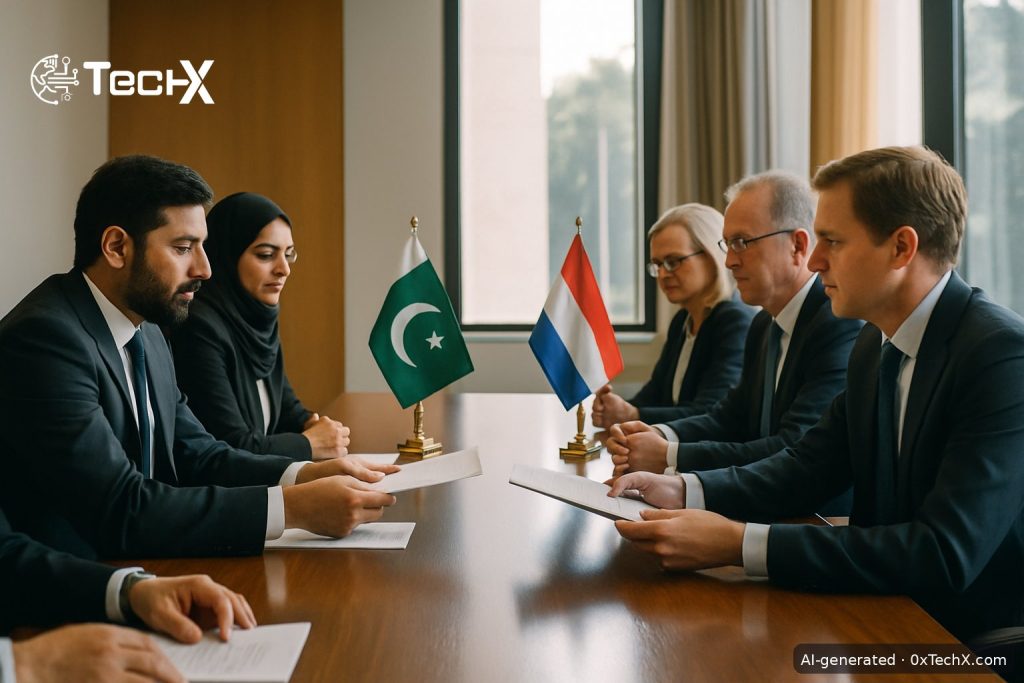
Pakistan Netherlands investment talks held in Islamabad on 9 October 2026 could mark a turning point for Pakistani tech founders looking for fresh European capital. Finance Minister Muhammad Aurangzeb hosted a Dutch business delegation led by the Founders Carbon Network (FCN), with Netherlands Ambassador Robert-Jan Siegert also present. The talks covered technology, public-private partnerships (PPPs), trade growth and Pakistan’s digital economy ambitions.
What Happened at the Pakistan Netherlands Investment Meeting
The discussions took place during a luncheon hosted by Finance Minister Aurangzeb in honour of a Dutch business delegation led by the Founders Carbon Network, accompanied by Netherlands Ambassador Robert-Jan Siegert.
Aurangzeb said Dutch expertise, technology and investment could complement Pakistan’s development priorities across various sectors, and identified public-private partnerships as an important mechanism for mobilising private investment and developing commercially viable projects.
The finance minister outlined several economic priorities, including a shift from aid dependence towards trade and investment, and a goal to position Pakistan to benefit from the “New Economy” through digitalisation and emerging technologies. That last point is directly relevant to tech entrepreneurs: it signals that the government wants digital-sector deals to be a core part of any future Netherlands partnership.
Why Pakistani Tech Founders Should Pay Attention
Pakistan’s startup ecosystem is growing but still struggles with early-stage capital. Pakistani startups raised $74.7 million across five deals in Q3 2026, nearly five times the amount raised in Q3 2025, bringing total 2026 funding to $133.7 million across ten deals. But most of that was concentrated in a few large rounds. Seed and pre-seed funding remains hard to find locally.
This is where a stronger Dutch connection could matter. The Netherlands is the ninth-largest startup hub globally, with over 81,000 startups and funded companies that have collectively raised $167 billion in venture capital and private equity. There is already at least one established link: Sarmayacar, widely regarded as Pakistan’s largest tech-focused venture capital fund, is itself headquartered in Amsterdam, showing that Dutch-Pakistan capital ties are not a new idea but are ready to grow.
Analysts note that while capital scarcity remains a major challenge, developments in Pakistan’s public markets and regulatory environment are creating new opportunities for startups and investors. A formal bilateral push from the government could accelerate that process by giving Dutch VCs and family offices a clearer signal that Pakistan is open for business.
The Trade Numbers Behind the Talks
The investment conversation sits on top of a growing trade relationship. Bilateral trade between Pakistan and the Netherlands reached approximately $1.9 billion in the 2025-26 fiscal year, and Pakistani business leaders believe this could grow to $5 billion through enhanced cooperation and stronger business linkages.
Areas flagged for cooperation include renewable energy, IT, maritime services, food processing and Dutch expertise in seed technology, greenhouse farming, dairy development and water management. For the tech community, the IT sector mention is key, as it sits alongside physical industries rather than leading the list. Founders can use this window to make the case for digital services as a priority vertical.
Aurangzeb said regular engagement between businesses could identify viable investment opportunities and build investor confidence, suggesting this meeting is meant to be the start of a sustained relationship, not a one-off visit.
How PPPs Could Work for Tech Companies
The public-private partnership model discussed at the meeting is commonly used for infrastructure projects like roads and power plants. But in the context of digitalisation, PPPs can also cover government technology platforms, broadband rollout, digital skills training and e-government services. Pakistani tech firms that build B2G (business-to-government) products or work in govtech could find Dutch partners willing to co-invest through this route.
The Adviser to the Prime Minister on Privatisation, who was present at the meeting, reaffirmed the government’s commitment to expanding private-sector participation through privatisation and public-private partnerships, noting that these initiatives aim to improve efficiency, attract investment and create greater opportunities for private enterprises.
Pakistan is also pursuing similar investment treaty talks with other European nations. The government recently revived discussions with Sweden on a bilateral investment treaty, showing a broader pattern of building formal legal protections for foreign investors. You can read more about that effort in our coverage of the Pakistan-Sweden investment treaty talks scheduled for November 2026.
What Comes Next
No signed agreement or specific deal was announced after the October 9 meeting. The talks were exploratory, which is typical for this stage. The next step the government has pointed to is sustained business-to-business engagement that moves from broad interest to specific projects. For Pakistani founders, the practical action is to monitor whether the Founders Carbon Network or the Dutch embassy’s commercial desk in Islamabad opens a formal programme for startups in the coming months.
The government is also working on a $10 million second phase of the Pakistan Startup Fund, planning to use the money to anchor a larger fund alongside local and international investors and appoint a professional fund manager, which could make $25 million to $50 million available to startups over the next few years. A Dutch co-investment arrangement could fit naturally alongside that structure.
Frequently Asked Questions
What is the Founders Carbon Network?
The Founders Carbon Network (FCN) is a Dutch organisation focused on connecting business founders and investors. It led the delegation that visited Islamabad for the Pakistan Netherlands investment discussions in October 2026. It was accompanied by the Netherlands Ambassador to Pakistan, Robert-Jan Siegert.
What sectors did Pakistan and the Netherlands discuss for investment?
The talks covered technology, digitalisation, renewable energy, IT, food processing, and public-private partnerships in infrastructure. Finance Minister Aurangzeb specifically mentioned positioning Pakistan for the “New Economy” through digital technologies, which is a direct signal to the tech sector.
How big is the current Pakistan-Netherlands trade relationship?
Bilateral trade between Pakistan and the Netherlands reached approximately $1.9 billion in the 2025-26 fiscal year, with Pakistani industry bodies expressing confidence it could reach $5 billion with deeper cooperation.
Does the Netherlands already invest in Pakistani startups?
Yes. Sarmayacar, Pakistan’s largest technology-focused venture capital fund, is headquartered in Amsterdam, the Netherlands. Pakistani startups have raised $133.7 million across 10 deals in 2026 so far, despite continued challenges in accessing early-stage capital. A formal bilateral investment framework could help bring more European capital into that pipeline.